Philosophy and political counsel
UtopiaPhilosophy and political counsel in Utopia is a sustained argument about whether a principled thinker should enter political service, and what honest advice can accomplish in a court shaped by ambition and self-interest. Thomas More’s case for adapting counsel to circumstances meets Raphael Hythloday’s fear that participation will either be useless or make a counsellor complicit. Their disagreement reaches beyond the court: Raphael identifies private property and money as foundations of social injustice, while the dialogue’s ending preserves a distinction between admiring Utopia and accepting every part of its constitution.
The question of public service
The argument begins when Peter Giles wonders why Raphael Hythloday does not enter a king’s service. Raphael answers that he has already shared his means with friends and relations, and refuses to exchange the freedom to live as he chooses for dependence on a ruler. Peter insists that service need not mean slavery, but Raphael replies that changing the word does not change the substance. He sees little attraction in courtly advancement and doubts that his presence would benefit either the public or himself. Thomas More presses the opposing case. A learned and experienced adviser, he argues, could do public good by persuading a prince toward worthy actions. The prince’s decisions flow outward through the nation, so counsel near the ruler could affect the condition of many people. More invokes the ideal associated with Plato: a happier political order would arise if philosophers became kings or kings became philosophers. Raphael accepts the force of the ideal but doubts its likelihood. Philosophers may offer sound advice in books, he says, yet rulers whose habits and assumptions were formed before they could judge such counsel are unlikely to follow it.
Courtly resistance to advice
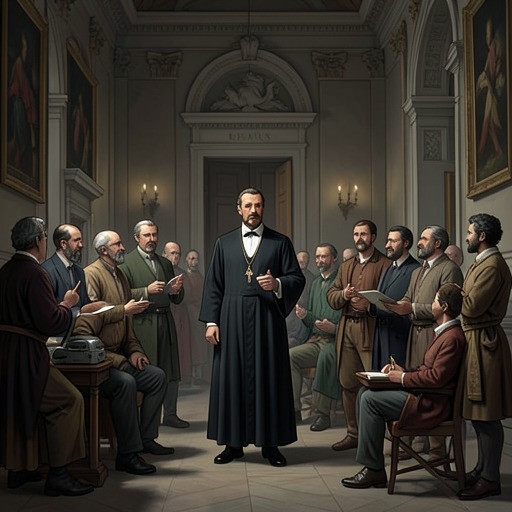
Raphael’s account of John Morton’s household gives the debate a concrete example. At a dinner, a lawyer praises severe punishment for theft. Raphael argues that public policy should address the conditions that produce theft and recounts an alternative he has encountered. The company initially dismisses his proposal. Later, when John Morton makes a related suggestion about dealing with vagabonds, the same listeners approve it, although they had rejected the idea when it came from Raphael. A jester’s remarks about beggars and religious orders sharpen the episode’s comedy; the Cardinal’s intervention eventually turns the conversation elsewhere. Raphael presents the dinner as evidence that courtiers respond less to the merit of counsel than to the standing of the person who offers it. That example supports Raphael’s broader portrait of princely councils. He imagines advisers debating how a king might acquire territory, secure temporary alliances, buy influence, and turn legal or diplomatic arrangements to his advantage. In such a setting, a proposal to govern for the people’s welfare would challenge both the ruler’s ambitions and the ministers’ interests. Raphael argues that those present would defend their own reputations, flatter the prince, or invoke ancestral practice rather than consider a better alternative. His point is not simply that a particular policy would be rejected: the court’s habits would make frank counsel appear threatening before its merits could be heard. Raphael contrasts acquisitive rule with a king’s public responsibility. A ruler, he argues, should protect the people’s welfare rather than impoverish them to secure obedience. Poverty does not make subjects reliably peaceful: people in distress may have little to lose and much reason to desire change. If a king can retain authority only through oppression, Raphael says, he would do better to relinquish the kingdom than preserve its name while destroying its dignity. He also proposes that rulers prevent crimes through good government instead of relying on severity after wrongdoing has become common. As a concrete example of restraint, he describes the Macarian rule limiting a new king’s gold reserve to a thousand pounds, with silver capped at an equal value. The limit is meant to preserve the country’s wealth, keep money circulating, and prevent a ruler from accumulating the means to violate his subjects’ rights or launch conquests.
Accommodation or complicity
More does not deny that Raphael’s proposals may be sound. He argues instead that counsel must be fitted to its political setting. When harmful opinions cannot be removed and a fault cannot be cured outright, an adviser should try to make affairs as little bad as possible rather than abandon the commonwealth. More compares this practical judgment to performing one’s part in a play already under way: importing a different kind of performance, however admirable in itself, may only disrupt the action. His position treats political engagement as a difficult practice of adjustment, not as an endorsement of everything a court does. Raphael sees a moral danger in that adjustment. In a court, he says, silence may not be permitted: a counsellor may be expected to approve even the worst proposals, and a cautious objection may be treated as disloyalty. If he joins the company and remains steady, he may still share the blame for its decisions; if he tries to adapt himself, he risks helping those decisions along. Raphael illustrates the problem with Plato’s image of a man who stays indoors rather than join a crowd that runs into the rain: if he cannot persuade them to return, he should at least avoid sharing their folly. The image makes withdrawal look less like indifference than a defence against futile intervention. The two positions therefore test different measures of responsibility. More emphasizes the possible public benefit of partial improvement; Raphael emphasizes the cost of lending one’s presence and reputation to a corrupt process. Raphael also refuses to treat familiar political life as the only available standard. He distinguishes his warnings about existing abuses from a wholesale proposal to impose an ideal constitution, arguing that even listeners resistant to radical change could heed warnings about the consequences of current practices. He further invokes the teachings of Christ: if those teachings are made to conform to prevailing conduct, he argues, people become more secure in wrongdoing rather than more virtuous. For Raphael, tactful adjustment can become a euphemism for surrender.
Utopia and the limits of agreement
Raphael’s critique ultimately moves from courtly conduct to the structure of society. So long as property exists and money measures value, he argues, a nation cannot be governed justly or happily: advantages collect among the worst people, wealth is divided among a few, and the rest are left in misery. He sets this against Utopia, where common provision and the absence of private ownership are presented as preventing want and reducing the need for laws. In Raphael’s account, the commonwealth’s arrangements show why political counsel cannot be confined to advising rulers how to manage an unjust system; the foundations of that system must also be questioned. The dialogue does not make More’s position identical with Raphael’s. After Raphael finishes, More recalls objections to Utopian practices, particularly common living without money, and does not raise them immediately because Raphael is tired and may not welcome contradiction. He commends the constitution in general but reserves the right to examine it further. The ending therefore holds admiration and hesitation together: More wishes that many Utopian practices could be adopted by existing governments, but says he cannot agree with everything Raphael has described. Counsel remains unresolved between the hope of working within imperfect institutions and the suspicion that their deepest arrangements make genuine reform impossible.