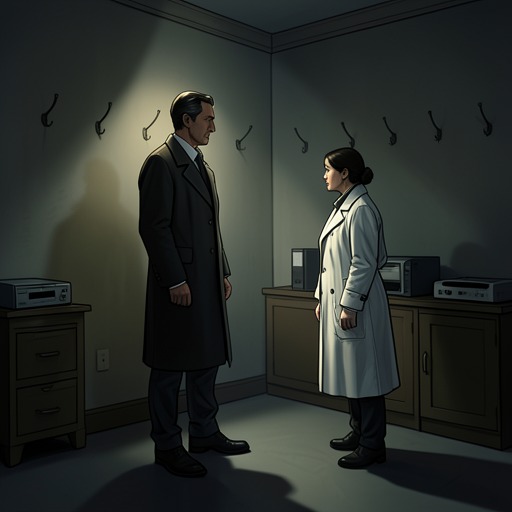
Frenesi and Rex accuse Weed Atman of being an FBI informant
VinelandFrenesi and Rex accuse Weed Atman of being an FBI informant during a tense encounter at Rex’s house, where Howie unexpectedly hears their account. The disclosure makes a private suspicion into a crisis for PR3: if Weed has betrayed the group, its commitment to sheltering outsiders may leave it vulnerable; if the accusation is wrong, acting on it could violate the solidarity the group claims to defend. The scene turns on that unresolved pressure and on a proposed response: to put Weed in front of a camera.
Background and surveillance
Frenesi had been spending increasingly more time at Rex’s house, both inside and out, while rarely seeing anyone from 24fps. After consultations within the collective, DL suggested that Howie keep an eye on her. Howie took up the task by using an old surfboard as a pretext and visiting Rex’s house at least once a day. The arrangement made him an observer before he understood what he might be observing: he could watch Frenesi’s movements, but he did not know what they meant.
One evening, Howie fell asleep in a bedroom during a rerun of The Invaders. An unusual vibration in the living room, and laughter that carried from there, woke him. He entered blinking and found Frenesi and Rex sitting together on the sofa, their faces warm and their dark eyes damp. They had been laughing shortly before. Howie’s arrival interrupted a moment of closeness; he asked whether they had heard about Weed, without yet knowing that the talk he had stumbled into concerned a plan and a betrayal.
The accusation
Frenesi and Rex exchanged a look before she asked whether they could tell Howie. Rex decided that they could. Frenesi then told him that Weed was an FBI mole, assigned to lead them onto the wrong path and into a trap. When Howie challenged the claim, asking who said so, Frenesi answered that Weed had said it himself. The disclosure therefore rests, as she presents it, on Weed’s own admission to her; the scene supplies her account rather than an independent confirmation of the claim.
Howie’s response registers the force of the news physically. He had been holding a chocolate-covered banana from the refrigerator; as the room’s atmosphere turned serious, his mouth went dry and the frozen fruit seemed to him like sawdust. He could no longer find humor in their manner. The sensory shift marks his dawning recognition that Frenesi and Rex are not teasing him and that the informant allegation, whether or not he can verify it, has already changed the terms of the encounter.
Solidarity under pressure
Howie proposed that they call a meeting and report Weed to the collective. Frenesi rejected the suggestion as though he had mistaken a matter of life and death for a children’s game. Rex described activists being arrested, confined in prisons and asylums, and dismantled as a movement; he said Weed had always worked for those targeting them and had played both sides. Howie tried to preserve doubt, reasoning that an agency capable of placing a mole could also lie about someone. Frenesi returned to the same point: Weed had told her directly.
The argument is not only about whether the accusation is true. It is also about what the collective can do with suspicion. Frenesi insisted that the group’s solidarity had to be absolute because it could not simply expel people without taking a path toward the authoritarianism it opposed. PR3 had been founded as an open refuge, she reminded Howie, taking his face in her hands with a gentleness edged by the threat of greater force. In her account, that openness is both the group’s purpose and a vulnerability that a double agent can exploit. A standard procedure for reporting an informant seems inadequate to her because she sees the crisis as evidence that the group’s survival is already at stake.
Howie’s argument faltered. He acknowledged the prospect that the situation was a game whose mask had now fallen, while Rex treated the next stage as a game with death. Howie then turned to the television and stood in front of it, feeding on the screen rather than continuing the exchange. Rex called this proof that Howie was clever. His retreat does not resolve the dispute; it shows how quickly the television can become a refuge from an immediate political demand.
The camera as a proposed response
Frenesi soon asked Howie whether they could turn on some lights. When he asked what she had in mind, she proposed confronting Weed with the Scoopic and a microphone, without mercy. The camera that had been used to document the group’s world would now be aimed at one of its suspected betrayers. Howie objected that doing so would take Weed’s soul. Rex answered that it had already been taken.
The plan remains a proposal in this encounter, not a completed filming. Its importance lies in the reversal it announces: rather than rely on the collective’s ordinary process, Frenesi and Rex would make Weed visible and record him. That reversal carries particular weight because Frenesi had also given Brock Vond copies of her footage, telling herself that films intended for everyone could be shared with him; over time, he began suggesting what she should film. The film camera therefore occupies no simple position as neutral witness or weapon. Here it is proposed as an instrument of exposure, while Frenesi’s earlier work shows how easily observation can enter other hands. The scene ends not with the accusation settled, but with the group’s refuge ideal, the danger of infiltration, and the power to record all pressing against one another.