The destruction of the Chipco laboratory
VinelandThe destruction of Chipco’s research laboratory is presented as both an industrial disaster and an investigative puzzle: the building has vanished, leaving a gigantic footprint-shaped crater, while the evidence invites competing explanations ranging from an animal attack to deliberate sabotage. Takeshi Fumimota examines the site amid an insurance inquiry, only to see its apparent monster return as a Chipco helicopter in disguise. That reveal punctures one spectacle without settling the central mystery of who or what destroyed the laboratory.
The destruction and its setting
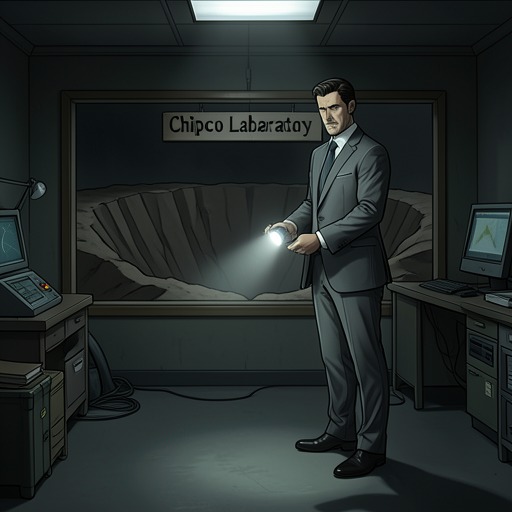
Takeshi arrives at the site about a week after Brock Vond reaches Tokyo, during work connected to the mysterious obliteration of a research facility belonging to Chipco, an international conglomerate described as dubious. The building, on a little-frequented stretch of coast, has been reduced to what looks like an enormous animal footprint. From the insurance perspective, the loss is total: the laboratory has been demolished so completely that the episode describes it through the verb associated with total destruction.
The apparent scale is difficult to take in. In the dark morning drizzle, Takeshi cannot see across the crater. Yellow lights on technicians’ helmets move far below as they collect and analyze fragments; at places around the rim, the edge has begun to cave in. Temporary traffic lights and a network of plastic walkways have been set up across the muddy floor, where activity is already busy. The improvised order of the investigation—marked routes and sample-taking inside a vast, unstable cavity—makes the absence of the building more conspicuous than any surviving structure could have been.
Insurance, evacuation, and competing explanations
The disaster has produced no casualties because it occurred during an evacuation drill. That coincidence is immediately treated as strange, rather than as a reassuring resolution. Professor Wawazume, Takeshi’s former mentor and an executive at Wawazume Vita & Non-Vita, has also alerted him that Chipco recently sought an addition to its insurance policy covering damage caused by animals of any species. The timing makes an animal explanation look potentially useful to the company: a creature could have emerged from the sea, planted one foot on the sand for leverage, and crushed the building with the other. Since the destruction occurred at low tide, the returning water could have erased other tracks on the beach.
Wawazume’s conjectures range from a reptilian creature to a deranged environmentalist. Takeshi does not accept that these possibilities exhaust the field. He considers professional work: special-effects makers, imaginative demolition specialists, Vietnam veterans, or an unpredictable faction of the Japanese organized crime (Yakuza). He knows many members of the underworld, men and women, but cannot always keep them all under control. The crater’s animal shape therefore functions as both physical evidence and a possible cover story; its appearance narrows no explanation securely.
The suspected mechanism would itself require extraordinary construction. Takeshi considers the possibility of an artificial paw measuring 20,000 centimeters from heel to claw tip. This estimate turns the footprint into a technical problem as well as an image: the investigators are not simply deciding whether a beast exists, but what kind of machinery, staging, or force could have made a mark of that scale. The site’s fragments and samples promise material evidence, yet the scene offers no conclusive answer before the investigation is interrupted.
The apparent creature returns
As Takeshi and Minoru prepare to leave the crater, a tremendous rumble comes from the clouded sky. The people Takeshi can see look upward, trapped in the mud and with nowhere obvious to flee. A dark, scaly surface wet with seawater and algae appears through the clouds, followed by enormous curved claws. The people cry out that it has returned. Some run; others raise cameras, a radiation meter, or a microphone toward the approaching object. Their instruments register different habits of response—documentation, measurement, and attempted recording—but none prevents the initial collective misrecognition.
The supposed visitor is smaller than it first appears and turns toward a makeshift landing ramp. It is a Chipco helicopter whose crew, described as notorious practical jokers, has covered the underside with suitable plastic material so that it resembles a monster’s footprint. The observers have been fooled: the monstrous surface is an aircraft disguise, not proof that a giant animal has returned. The reveal converts the scene’s terror into an elaborate prank, but it does not explain how the laboratory was destroyed or establish that the crater itself was manufactured by the helicopter.
The aircraft has come to evacuate everyone at the bottom of the crater under an order received by radio. Takeshi wonders aloud whether this, too, is a joke, then decides he has worked enough for the day and is ready to leave. Minoru boards with him and asks whether the promised drink is serious; Takeshi agrees, while the narration leaves him with something in mind without specifying what it is. Their departure closes the immediate investigation scene, not the case: the helicopter’s disguise is exposed, while the cause of the laboratory’s destruction remains open.
The footprint as spectacle and evidence
The event’s tension rests on the gap between a legible image and an unknown cause. A footprint suggests an animal, and Chipco’s recently requested animal-damage coverage gives that suggestion a financial context; the low tide offers a plausible reason that further tracks cannot be found. Yet the same image can be read as a technical fabrication, a criminal operation, or a story useful to an insurer. The later helicopter disguise makes the danger of treating a spectacular appearance as proof explicit, even as it leaves the original devastation unexplained.
The investigation is repeatedly redirected by things that seem to clarify the scene: the crater’s outline, the collected fragments, the insurance clause, and finally the glistening aircraft underside. Each can be interpreted, but none supplies a settled account of the laboratory’s destruction. The false monster is therefore more than comic relief. Its convincing appearance demonstrates how quickly observers can mistake a constructed image for an event’s cause, while the evacuation order and the unresolved crater preserve the material consequences beneath the performance.