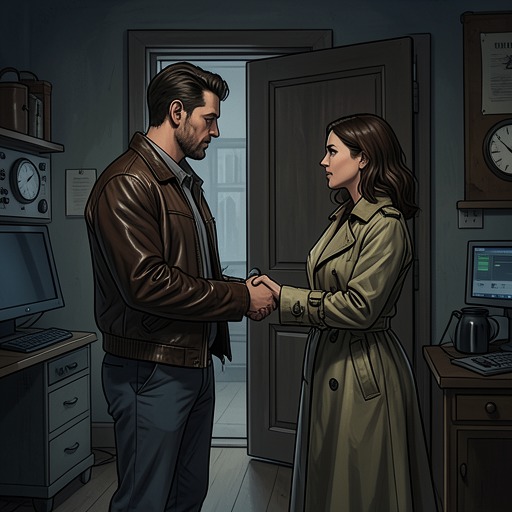
Takeshi and DL found a karmic repair practice in Shade Creek
VinelandTakeshi and DL found a karmic repair practice in Shade Creek after an unplanned stop at a Thanatoid settlement became the beginning of a new line of work. What first looked like a place to find shelter instead revealed a community with a continuing need to reckon with old injuries. Their practice took shape as a public listening service: part investigation, part record of grievances, and part attempt to address wrongs that conventional institutions had left alive.
The Detour to the Thanatoid Village
Takeshi and DL were traveling under pressure. The Chipco laboratory case remained open, and Professor Wawazume’s strategy had helped set a formidable pursuit in motion. During a conversation about their latest difficulties, DL recognized that they would need some kind of cover. Their unexpected companion, Ortho Bob Dulang, was heading to a Thanatoid village at the confluence of Shade Creek and Seventh River in Vineland County. He offered to arrange accommodation if they drove him there.
The village changed the direction of their journey. Its residents lived in Thanatoid apartment blocks or small houses, often in sparsely furnished prefabricated dwellings. The settlement’s way of life reflected a condition between ordinary life and death: possessions and appetite held little priority, while television occupied much of the residents’ waking time. Their emotional lives were also narrowed by the history and rules that bound them. Resentment, and especially the desire for vengeance, could remain among the few feelings capable of keeping a Thanatoid from moving further toward death.
That circumstance gave Takeshi and DL a community whose needs differed from those of their previous clients and contacts. The local grievances were not merely private disputes detached from history. They were entangled with property, inheritance, and the lingering effects of betrayal, all matters in which the Thanatoids had reason to seek redress but limited means to pursue it.
From an Idea to a Practice
The Shade Creek stop, as Takeshi and DL later told Prairie, initiated their work in karmic repair. At first, DL resisted the idea of making it a profession. She doubted that people in this setting would pay for a service whose name and purpose were difficult to define. Takeshi answered by comparing it to unpleasant work people hired others to do for them: like sweeping or pest control, the task was to enter accumulated filth that clients preferred not to handle. He argued that the past could not be recovered, even when people remained unable to stop living inside its consequences. His proposed qualification was not only experience but a claimed immunity to the dangers of the work.
The disagreement establishes the practice’s founding tension. DL understood the obstacles of operating locally; Takeshi saw a market in unresolved grievance and believed his specialized experience could make the work possible. The clinic would not erase the past or make every claimant prosperous. It would enter disputes that remained active because those affected still wanted recognition, correction, or some account of what had been taken from them.
The need was substantial. The Thanatoids brought accounts involving land and water rights, gangs and extortionists, vigilantes, landlords, lawyers, and property speculators. The injustices reached back into the past but remained virulent in the present. Even the promise of future protection from CAMP appeared as another part of the landscape of unresolved pressure. The practice therefore emerged not as a simple cure for private regret, but as a response to injuries that continued to circulate through ownership, local power, and institutional promises.
The Clinic and Its Work
Takeshi and DL established a recurring place for this work rather than relying on private encounters alone. They rented a meeting room at the Woodbine Motel, across the creek from town, for Saturdays and Sundays. On weekdays, they held meetings in a back room at the Zero Inn, where anyone could enter and contribute to the day’s testimonies. The arrangement made the practice accessible and collective: its working material came from people’s accounts, gathered in a room open to further witnesses.
At one meeting, a portable sign announced an open karmology clinic, free entry, and no appointment necessary. Takeshi, dressed in a suit and tie, sat beside DL, who wore a custom silk gi. They worked behind a long banquet table on a low platform, facing an oversized map of Vineland County flanked by the American and Californian flags. A portable blackboard, coffee pot, microphone, and amplifier completed the setup. The furnishings gave the improvised practice the visible shape of a public office, while the map placed individual testimony within a larger geography of disputed claims.
Their method was attentive rather than spectacular. They listened, recorded, asked questions, and took notes, making a point of appearing professionally serious. The combination of an open door and a formal arrangement mattered: claimants could arrive without appointments, but their accounts were treated as material to be heard and documented. The practice’s authority rested on the promise that someone would receive the testimony and follow its consequences into the tangled past.
The Practice in a Larger Community
The founders’ work became part of a broader Shade Creek world rather than a short-lived stopover. Later, when the Thanatoids were awakened by the synchronized playing of Bach’s Wachet Auf from watches, clocks, and personal computers, the sound carried the memory of something the troubled residents could recognize. Takeshi had helped bring about the commercial circumstances behind the sound chips, and he and DL heard the long, repeated broadcast that followed the awakening. DL chose to answer the call and asked Prairie whether she would come with them. The scene places the pair once more in the role of people who respond to a community’s distress, though the awakening itself is not presented as a result of their clinic.
The Thanatoid community’s later gathering also shows how much more than individual cases was at stake in the Shade Creek setting. Radio Thanatoide sent a team to record a night of arrivals and activity, broadcasting it to other Thanatoid enclaves among the living. The occasion drew people who discovered that they were Thanatoids without having known it, and some chose to remain. This communal movement does not mean that karmic repair has settled every grievance. Rather, it enlarges the social world in which Takeshi and DL’s work began: a world where unfinished wrongs can hold people in suspension, where testimony makes those wrongs visible, and where answering a call becomes one possible response to a history that has not stopped acting in the present.