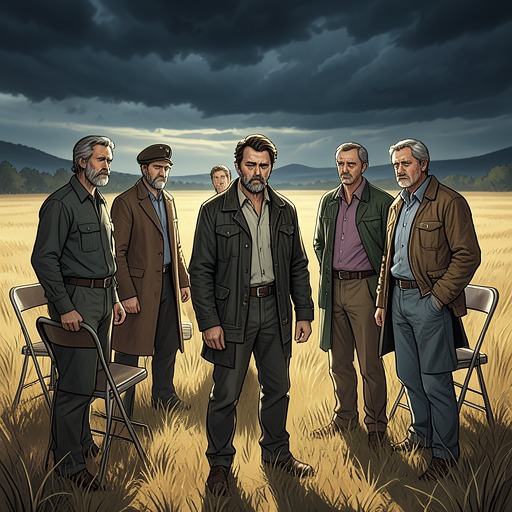
Zoyd and Frenesi’s wedding
VinelandZoyd and Frenesi’s wedding is remembered as a rare stretch of uncomplicated happiness: a hillside ceremony and an extended celebration in which music, family, and unlikely guests share the day without a fight. Seen through Zoyd’s later recollection, the wedding matters not only as the beginning of their marriage but as an image of love and peace that he continues to measure against the years that came after.
Setting and ceremony
Zoyd returns in memory to the San Joaquin Valley of his youth, a place he had known through risky rides and reckless expeditions with the Bud Warriors and the Ambassadors. He had lost many schoolmates to drunk driving and mechanical failures. Years later, he came back to that often-haunted landscape to marry Frenesi on a gentle California hill. The scene gathers small signs of ordinary life—darker green oak trees, a distant highway, children and dogs running, and a sky marked with colors some guests could not describe. The landscape seems briefly removed from the violent history beyond it: the Vietnam War, political violence, and burning Black neighborhoods feel far away, as though they belonged to another planet.
The ceremony’s vows imagine marriage as a commitment through good fortune and hardship, and ask whether the couple can remain lifted by love. The narration leaves the duration of the vows uncertain: the ceremony may have taken hours, or it may have passed in half a minute. There were few clocks among the guests, and no one seemed impatient. In this pre-digital gathering, time is not yet divided into the small units that television would later impose. The ceremony therefore survives in Zoyd’s mind less as a precise sequence than as a soft-edged, almost timeless image.
The celebration
The Corvairs supplied the music. They called themselves surfadelic, although the nearest shoreline was forty miles away at Santa Cruz, beyond difficult mountain passes; locally, they had to contend with the customary pride of the beer riders. The party drew an eclectic crowd. Centaurs and their elaborately dressed girlfriends arrived in stages, playing at being villains, followed at some point by a hay wagon carrying back-to-nature LSD enthusiasts on an old-fashioned outing in the upper valley.
The sheriff arrived too, but the evening did not turn into a confrontation. He danced the stroll, an old dance from his own youth, with three young women in miniskirts to an electric arrangement of Pipeline. He politely stayed away from the punch and did not investigate what it contained, accepting a can of beer instead on the hot day. These details make the celebration’s ease tangible: even the arrival of a law officer becomes part of the party rather than a threat to it.
The event lasted through the night, the following day, and another night. Zoyd would later try to revise the memory in a darker direction, but the party had brought no fights, vomiting, or collisions between cars. Everyone got along and loved the music; in his account, it was one of the best parties of his life. Its unruly mixture of guests and its sheer duration do not undo the prevailing calm. They make the absence of disaster feel like a genuine, if temporary, gift.
Frenesi and Zoyd in the memory
Throughout the celebration, Frenesi appears composed and smiling. Zoyd remembers her famous blue eyes shining beneath the brim of a large, light straw hat, and children running up to call her by name. During a break in the music, the newly married couple sit together on a bench beneath a fig tree. Frenesi eats a multicolored fruit ice cream cone, leaning forward to protect her wedding dress, which had belonged to her mother and grandmother. A tabby cat repeatedly darts beneath the dripping cone, recoils when drops of citrus ice cream strike it, and then returns to repeat its comic performance.
Beside this vivid recollection, Zoyd remembers asking Frenesi whether she believed love could save anyone. He later recognizes how foolish the question was, but the memory preserves his younger self’s hope: he smiles as someone unable to believe his happiness, while a breeze stirs the fig leaves. He silently wants to hold on to Frenesi’s face in that light, especially her calm eyes and slightly parted mouth. The wedding is thus recalled not only as a public celebration but through the precise image of a shared pause, when the noise recedes and Zoyd tries to make the moment last.
Memory and significance
The wedding’s ideal quality is inseparable from the fact that Zoyd remembers it later, after years have passed. His account admits that he might recast the day negatively, yet insists that the party really did proceed without the quarrels and mishaps one might expect from such a long, crowded gathering. Its atmosphere of harmony is not proof that the marriage will remain happy; it is the contrast that makes the memory consequential. The wedding holds an image of Frenesi and Zoyd together before the daily demands of life claimed more of their time and before the remembered question about love acquired its later irony.
For Zoyd, recollection becomes a way to revisit the day when time seemed slow and the visible world peaceful. The ceremony’s uncertain length, the band playing across two nights, and the small scene under the fig tree all resist reduction to a simple date or milestone. Together they form an intimate record of what he once believed could be preserved: Frenesi’s serene expression, a successful party, and the possibility that love might be enough. The wedding’s decisive significance lies in that double vision—it is both the joyful beginning of a marriage and a cherished image whose innocence becomes more fragile in retrospect.