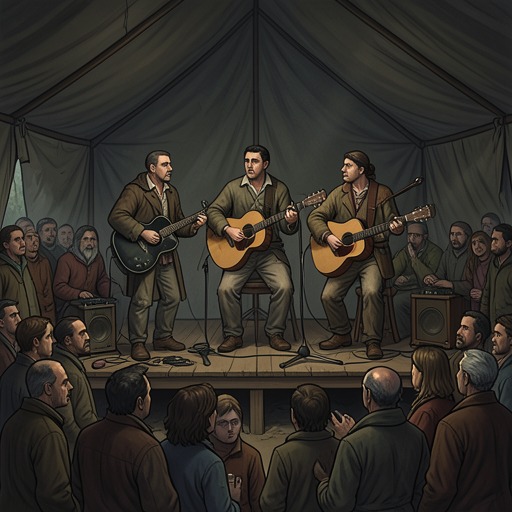
Prairie Leaves with Billy Barf and the Vomitones
VinelandPrairie Leaves with Billy Barf and the Vomitones marks Prairie’s first departure from Zoyd Wheeler’s care in pursuit of a life beyond their unsettled home. After Isaiah Due Quattro proposes that she travel with his band, Prairie accepts the possibility not as a simple escape but as a step toward Frenesi Gates: she loves her father, yet insists that something is missing. The next morning, a gaudy bus carries her away while Zoyd watches, unsure what lies ahead and fearful that she may be gone for good.
Background and the Offer
The departure takes shape amid two disruptions. Hector Zuñiga, who has been speaking with Prairie and Zoyd, is taken away in a padded vehicle operated by the television-treatment squad, protesting that he has a contract. Isaiah and his companions arrive as Hector is being driven off. With Billy Barf and the Vomitones engaged to play at a wedding, Isaiah suggests that Prairie go with them for a while, presenting travel as a change of air. The offer comes at once as a practical opening and as a proposal whose consequences Zoyd cannot confidently judge.
Zoyd compares the group to the armed forces and asks Isaiah whether he is prepared to take responsibility for her. Isaiah quietly promises to protect her, looking around to see who might overhear. His promise gives Zoyd some reassurance, but it does not make him certain that Prairie will be safe. He reminds her that life on the road means constant movement and asks whether that would really make her safer. The question exposes the gap between Isaiah’s assurance and Zoyd’s inability to control what happens once she leaves.
Prairie resists being treated as a decision passed between men. Irritated, she objects to their talking about her as though they could hand her back and forth like a piece of meat. Isaiah tries to turn the exchange into a joke, but she brushes his hand away. Her refusal makes clear that going with the band must be her choice, not a transfer of responsibility from father to prospective protector.
The Conversation with Zoyd
Before leaving, Prairie throws herself into Zoyd’s arms and begins to say that their home is part of what she cannot leave behind. She is not crying, but the interrupted thought gives the farewell its emotional force: departure does not mean that she feels nothing for the life she has shared with him. Zoyd asks her to stay the night, with Isaiah to collect her the following morning. They spend that night on bunks in Trent’s eccentric camper, listening to sirens on the river.
Later, Prairie acknowledges that Hector had understood her correctly: she really was willing to go with him to look for Frenesi. She tells Zoyd that she loves him but that their situation is incomplete. The search for her mother and the bond with her father thus coexist; leaving is neither a rejection of Zoyd nor evidence that she has stopped wanting a family. When Zoyd says he cannot imagine himself and Frenesi getting back together, Prairie answers that he always says this and asks whether he would not feel as she does in her place. Her insistence exposes the difference between his resignation and her continuing hope.
Zoyd is unsettled by her clarity. He feels fraudulent and lost, and wants to comfort her, but remembers that she has accused him of making himself an emotional decoy for incarceration. He restrains the embrace he wants to give her, settles for a nod and an attempt at reassurance, and lies down while she falls asleep on her own. The scene leaves his affection unmistakable while showing how little confidence he has in the role she needs him to play.
The Morning Departure
The next morning, the bus descends the two sandy tracks of the access lane. Its painted imagery evokes a nuclear, cybernetic death fantasy; miniature iron skulls are welded into a ring that serves as its steering wheel. Isaiah sits at the wheel, with indistinct faces behind tinted windows. The sight gives the vehicle a vivid identity before Prairie boards it, while Zoyd remains unable to picture clearly what she may encounter on the road. He worries that something may have escaped his notice the previous night and that she may be leaving forever.
A cassette by Fascist Toejam blasts through the bus’s stereo at a volume described as 300 watts of apocalypse. Isaiah gallantly helps Prairie aboard the fuchsia-upholstered vehicle, which the narration likens to a moving orgy room. There she becomes indistinct among the band members and their companions, a figure disappearing into the bus’s dense, unreadable mosaic. The public spectacle of the vehicle contrasts with the private uncertainty of the farewell: the band’s loud arrival offers no assurance about Prairie’s future.
Zoyd and Prairie agree to keep in touch through Sasha Gates, Zoyd’s former mother-in-law, who lives in Los Angeles. This arrangement is a modest connection across the distance about to open between them. It does not resolve his fear, but it gives their separation a practical thread of continuity.
Consequences and Significance
As the bus turns gracefully and climbs the narrow lane beneath a ceiling of clouds, those aboard turn toward the outside. Zoyd watches it go and experiences the vehicle as a time machine departing for the future—too soon, in his view. That image gathers the scene’s central imbalance: for Prairie, leaving makes a search possible; for Zoyd, the same movement is a loss whose destination he cannot see.
The event joins a daughter’s assertion of independence to her unresolved attachment to both parents. Prairie does not claim that the road will make her safe, nor does she present the trip as proof that home no longer matters. She leaves because the incompleteness she names cannot be answered by remaining beside Zoyd, and because finding Frenesi remains a live possibility. The bus carries her toward that uncertain future while the agreed contact through Sasha preserves, however tenuously, a route back to her father.