Vineland family reunion
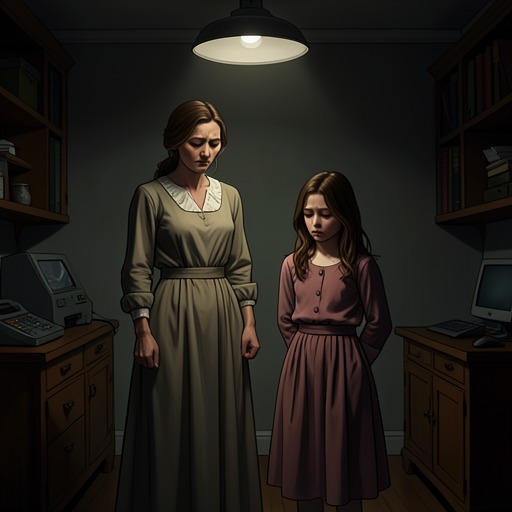
VinelandThe Vineland family reunion brings Frenesi back into the presence of her mother, Sasha, and daughter, Prairie, after years of separation. Its decisive moments are intimate rather than political: Sasha and Frenesi meet unexpectedly at the Vineland Palace and dance instead of explaining themselves, while the larger Becker–Traverse gathering gives Prairie, her mother, and her grandmother hours together to begin reconnecting. The reunion offers contact, not a return to the lives they once knew.
Return to Vineland
Frenesi arrives with Flash at Vineland Airport, where her return coincides with an atmosphere of military control. The airport lies south of town near the mouth of the Seventh River. On the descent, their plane passes over U.S. Route 101; the landing feels altered by military frequencies, unfamiliar procedures in the control tower, and the absence of the usual civilian controllers. Below, vehicles have turned the airport into a military staging ground. Incoming passengers are stopped and questioned individually while their names and numbers are entered into a system; some are allowed onward, others held inside an enclosure.
The scene makes homecoming inseparable from surveillance. Flash wonders whether Hector has set them up, and the arrivals face an official apparatus before they can reach the town. For Flash, the journey also carries personal stakes. He had once admired Frenesi from afar while she was associated with Brock Vond, and had imagined that rescuing her would bring a reckoning with Vond. Yet the years of marriage and shared life had not, by themselves, made Frenesi feel closer to him. Her arrival is therefore not a simple resolution of Flash’s hope: it places their complicated history inside a return already shaped by government power and uncertainty.
The encounter at the Vineland Palace
Sasha and Frenesi meet by chance in the Bigfoot Room at the Vineland Palace. Sasha has arrived with Derek, whose appearance and manner have occupied her thoughts, but the sight of her daughter displaces that preoccupation. The encounter overwhelms both women. Sasha seems younger than Frenesi remembers; Frenesi flushes, and neither can easily look away. They sit opposite one another in a booth beside red-and-gold wallpaper, as if sustained attention might keep the other from disappearing again. Their shock is so absorbing that Derek withdraws to the restrooms and remains away for some time.
The reunion does not follow the expected scene of tears, embraces, or shouted declarations. Asked afterward what happened, Sid reports that the women danced; Ernie specifies that it was the jitterbug. The pianist plays old swing standards, including “In the Mood,” “Polka Dots and Moonbeams,” and “Moonlight Serenade.” Their dance supplies a shared action where explanation might fail. It does not undo the separation or settle its causes, but it makes a brief, mutual presence possible. The gap between the gravity of the reunion and its form—two women dancing to familiar music—gives the meeting its particular emotional force.
The family gathering
The reunion extends beyond the hotel into the Becker–Traverse family gathering, where Prairie sees Frenesi beside Sasha. Frenesi is a woman in her forties, changed in appearance from the mother Prairie had imagined: heavier than Prairie expected, sun-weathered, with short hair in need of a visit to a hairdresser. That discrepancy makes the meeting concrete. Prairie is not encountering a remembered image but a living relative whose years apart have left visible marks.
Sasha responds to the return by joking and fussing over Prairie, treating her like a small child and pinching her cheeks to check her dimples. Prairie asks her to stop, then apologizes. Frenesi steps in by trying to steady Sasha, interpreting the performance as her mother’s awkward attempt to help. The exchange shows affection arriving through imperfect gestures: Sasha’s comic overfamiliarity presses against Prairie’s adulthood, while Frenesi’s intervention gives the three women a way to remain together without pretending that reunion has made them instantly at ease.
Prairie follows her mother and grandmother beneath an oak tree near a drinks cooler. They stay there for hours, talking about the past and gathering fragments of memory, which they begin to connect. Around them, a shifting crowd of aunts, uncles, cousins, and younger relatives trade stories—each retold and creatively revised over the years. The family’s history is not presented as a settled account. It circulates through recollection, embellishment, and repeated telling, and the three women’s conversation joins that larger, ongoing work of making a shared past.
Ritual, memory, and what reunion can restore
The gathering honors the bond between Eula Becker and Jess Traverse, the family tie that explains why the scattered relatives have assembled. Their kin have come from places ranging from Marin to Seattle, Coos Bay, and Butte. Lumber workers, fishermen, street preachers, basket weavers, old relatives, and young family members fill the gathering; year after year, attention turns to Jess and Eula seated together at the head of the table. The reunion of Frenesi’s immediate family thus takes place within a wider kinship ritual that has its own durable center.
Food is central to that ritual. The meal includes beef prepared over large grills, potatoes, beans, fried chicken, pasta, and Japanese-style tofu contributed by younger members of the family. The feast continues late into the night, binding a varied and far-flung group through the work of preparing, serving, and sharing food. Jess recites a passage from Emerson that he has memorized, about hidden punishments restoring balance. He connects its idea of consequence to Crocker Scantling, the lumber-industry leader who had gone unpunished for years after arranging the tree that injured Jess, and who later died in a high-speed crash on U.S. Route 101. Jess still finds the irony amusing; Eula keeps her eyes on him as he speaks.
The gathering’s repeated customs—shared food, familiar music, family stories, and Jess’s annual recitation—offer continuity without promising that the past can be repaired or that those who return can recover their former lives. The reunion is meaningful precisely because it does not erase the years of absence. Frenesi and Sasha have to meet as changed people; Prairie has to encounter her mother in the present; and their hours under the oak tree begin a conversation rather than complete one. In a novel attentive to records, memory, and the possibility of being lost to one another, the gathering makes kinship something renewed through presence and repeated acts, not something separation left untouched.