Olympic Auditorium
WomenOlympic Auditorium is the old Los Angeles arena where Henry Chinaski takes Katherine to watch boxing, and its significance lies in how an ordinary date gathers the book’s central contrasts: spectacle and observation, violence and artistic attention, companionship and loss. The visit moves from the crowd and the fights to the missing car outside, making the arena a setting for both a lesson Chinaski cannot quite put into words and the beginning of the end of his relationship with Katherine.
Setting and Audience
Chinaski says that he regularly takes women either to boxing matches or to the racetrack; on this Thursday night he brings Katherine to Olympic Auditorium, where she has never attended a live fight. They arrive before the first bout and sit at ringside. The arena is old, and Chinaski points out its two small restrooms, one for men and one for women, advising her to go before or after intermission. His practical directions establish their date through the building’s physical arrangements as much as through conversation.
The audience is made up mostly of Latinos and working-class white people, with a few movie stars and celebrities. Chinaski distinguishes the Mexican fighters, who fight with heart, from what he regards as the poor bouts when white or Black fighters compete, especially in the heavyweight division. His account makes the venue more than a generic boxing hall: it is a public gathering place whose crowd and contests he reads through class and race, while his own position remains that of a ringside observer who drinks beer and smokes as he waits.
The Fights and the Writer’s Eye
Chinaski tells Katherine that it is strange for people to sit and wait for two men to enter the ring and try to punch each other out. She agrees that it seems awful. The first fight, however, is good, marked by blood and courage, and the event unsettles any simple distance between his comment and his attention: he questions the spectacle, yet watches it closely enough to find material in it.
For Chinaski, boxing and the racetrack offer something useful to a writer, though the lesson does not arrive as a clear statement. He describes it as wordless, comparable to a house burning, an earthquake, or a flood. The value is precisely that its message is not explicit. He distrusts the authority of other writers and remains attached to his own habits and prejudices; the arena’s action gives him an experience he can absorb without reducing it to a rule. He also recognizes that writing about Katherine, whom he regards as a good woman, will be harder than writing about women he dismisses as whores. The night therefore joins his literary self-understanding to the difficulty of representing intimacy.
A Date Interrupted
Before the final bout, Chinaski suggests that they leave; Katherine agrees. They walk up the narrow aisle through air described as blue with smoke. Chinaski notes the absence of whistling and obscene gestures, then remarks that his scarred, battered face can sometimes be an asset. The passage shifts from the arena’s collective spectacle to his awareness of how his own appearance registers in public.
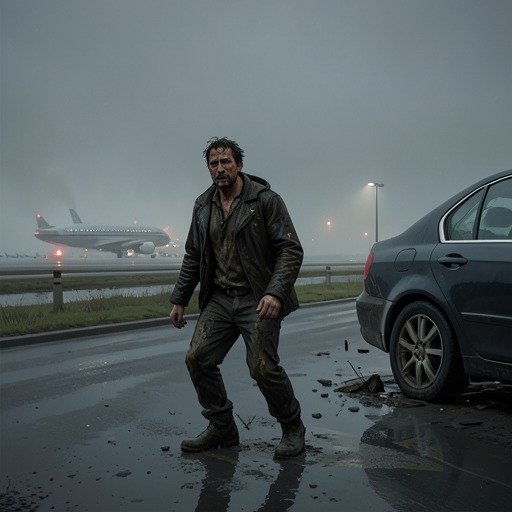
In the small parking lot beneath the freeway, they discover that Chinaski’s 1967 Volkswagen is gone. He reacts with anger and disbelief, while Katherine answers with concern. The stolen car abruptly replaces the boxing match as the immediate problem and brings their shared outing to a halt. The car’s disappearance is a concrete reversal: after an evening built around watching other people’s violence, the couple must confront the loss of their own transportation.
Relationship and Aftermath
The arena visit also gives Chinaski occasion to describe a pattern he sees in his relationships. People live together, share meals, sleep together, talk, and go places; then the relationship stops, a brief interval of being alone follows, and another woman arrives. He finds the transitions oddly normal, but admits that solitude never feels entirely right to him. The reflection turns the date into one instance of a larger cycle of attachment and separation rather than an isolated romantic outing.
Later that night, Katherine drinks half a bottle of red wine and becomes sad and quiet. Chinaski understands that she connects him with the racetrack crowd and the boxing world, and he accepts that he belongs to that world. He describes himself as drawn to drinking, idleness, and a condition of settled nothingness, while wanting a hazy, quiet life and the freedom to be left alone. He also acknowledges that drunkenness can make him loud and uncontrolled, a contradiction he does not try to resolve. Although the couple have sex that night, Chinaski identifies it as the night he lost Katherine; as she goes into the bathroom, a police helicopter circles above Hollywood. The relationship’s end is not presented as a consequence of the stolen car alone. Rather, the outing exposes the distance between Katherine and the life Chinaski accepts as his own, and the arena remains attached to that recognition.