Los Angeles
WomenLos Angeles is the principal setting for a life divided between solitary writing and uneasy involvement with other people. In the city, Henry Chinaski builds a writing routine, seeks escape from crowds at the racetrack, and repeatedly enters relationships that complicate his preference for isolation. The place also serves as a point of departure and return: even when he leaves for readings or other excursions, his apartment, car, and unfinished domestic life remain waiting in Los Angeles.
Setting and the Writer’s Routine
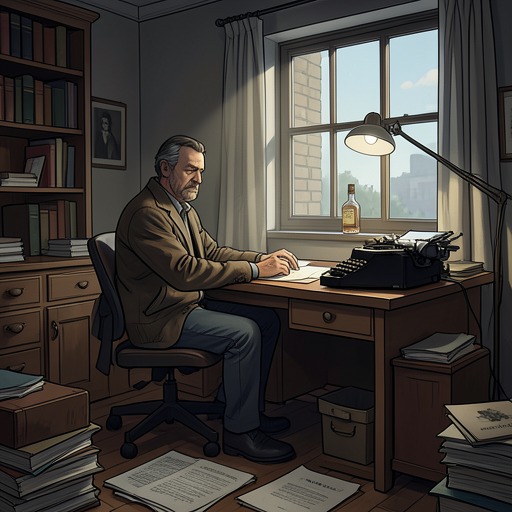
Chinaski’s account reaches back to a period when he had recently left a twelve-year postal job and was trying to establish himself as a writer in Los Angeles. Terrified by the change, he drank heavily while attempting his first novel, typing through the night to the accompaniment of classical music on the radio. He set himself a ten-page nightly goal, but only discovered the amount he had produced after waking and looking at the pages on the couch. The total sometimes reached seventeen, eighteen, or more than twenty pages; he later had to revise or discard that night’s work. The novel took twenty-one nights to write. This routine makes the city the setting not simply for literary ambition but for a demanding, alcohol-fueled practice in which the work’s value is uncertain until morning.
His modest domestic circumstances contrast with the intensity of that work. The owners of the court where he lived left groceries on his porch, including vegetables, oranges, and cans of soup. He drank with them late into the night, and his account presents the court as a small, informal household around the edges of his otherwise solitary life. The detail of the brown paper bags and recurring visits gives Los Angeles a local scale: alongside the public life of a writer, there is a precarious routine sustained by neighbors and ordinary provisions.
Several years later, the city is also where Chinaski’s writing acquires a more public and professional form. He drives with Lydia Vance along Hollywood Boulevard to submit an article on the life of a writer in Los Angeles to a California entertainment weekly. The destination is an office in Mosley Square, a district of expensive bungalows occupied by music publishers, agents, and promoters. The errand places his written work within a commercial landscape, while the contrast between the costly offices and his modest living arrangements underscores the distance between the literary career he is pursuing and the life he actually leads.
Solitude, Crowds, and the Racetrack
Chinaski’s sense of Los Angeles is shaped by his aversion to its public rhythms. Weekends distress him because people are out in the streets, playing Ping-Pong, mowing lawns, polishing cars, shopping, or heading to the beach and parks. Monday is his preferred day, when people return to work and disappear from view. He nevertheless goes to the racetrack on a Saturday, partly to get through the day despite the crowds. Before leaving, he eats a hard-boiled egg, drinks beer, and steps outside to find Lydia playing with the dog Bugbutt. The scene ties his dislike of the city’s social bustle to a habitual search for a separate world in racing.
The racetrack also offers a sharp contrast between Chinaski’s guarded view of gambling and the performances of other men. When a man repeatedly tells Katherine that he had picked the winning horses, Chinaski observes that successful bettors do not boast and suggests that the man’s claims are meant to impress her. Katherine does not respond to his boasts and begins to read him instead as unwell. In this setting, Los Angeles’s everyday social theatre appears in miniature: the track is not only a place to wager but a place where men display status and attempt to attract women. Chinaski’s attention to the difference between actual betting and self-advertisement gives the scene its critical edge.
His preference for withdrawal is not merely a matter of avoiding crowds. He describes himself as a loner and recluse who needs solitude to write, while Lydia argues that meeting people is necessary to learn about them. Their disagreement exposes an enduring conflict in how each wants to inhabit Los Angeles. Chinaski prefers living with a woman, eating and sleeping alongside her, and walking together, but he has little appetite for conversation or social outings beyond the track and boxing matches. Parties and small talk repel him; Lydia enjoys parties, dancing, and social attention. The city becomes the practical ground on which their opposed desires for privacy and company repeatedly collide.
Relationships and Domestic Conflict
Los Angeles is where Chinaski’s relationships are lived as interruptions to, and extensions of, his solitary routine. In one return from travel, he says that he has made love to Lydia several times, fought with her, and then left from the Los Angeles airport to give a reading in Arkansas. The quick succession of intimacy, conflict, and departure captures the unstable pattern of their relationship without resolving it. The city remains the base from which he leaves, while the relationship continues to shape the terms of his return.
Another evening at home brings an unexpected overlap between relationships. Chinaski and Dee Dee are lying naked on his bed when the telephone rings in the next room; the caller is Lydia. The brief interruption places the competing attachments inside the same Los Angeles domestic space. Rather than presenting the city as a refuge from romantic disorder, the episode makes the apartment a point at which separate relationships intrude upon one another.
His self-description as a loner exists alongside a repeated pursuit of new relationships. While waiting at an airport for Mindy, he reflects on the work and diminishing novelty of new affairs: people are compelling at first, then their flaws become apparent, and their importance to one another fades. He also connects his pursuit of younger women to anxiety about aging and death, wondering whether sexual experience might let him resist feeling old. These reflections place Los Angeles’s recurring pattern of meetings and departures within a broader personal crisis, although the account offers no lasting solution to it.
Departures, Returns, and the City’s Narrative Role
The airport gives Los Angeles a recurring threshold between improvised travel and the unsettled life Chinaski leaves behind. Before a departure, he has been drinking through the night and walking around his home. He sets out at 11:15 in the morning with no luggage, wearing shoes but no stockings and carrying only reading glasses in his shirt pocket. As he drives toward the airport, he struggles to keep the car from crossing the double yellow line into oncoming traffic. The journey begins in disarray, making departure less a clean break than an extension of his precarious routines.
A later return makes the city’s continuity almost comic. After spending five days and nights away with Joanna, Chinaski is driven to the airport and flies back to Los Angeles. He wonders what happened to his Volkswagen, then finds it on the other side of the airport parking area; all that has happened to it is that it has received a parking ticket. His apartment is unchanged as well, still cluttered with bottles and trash. The car and the apartment are concrete anchors in a life that keeps moving without producing much domestic change.
That return immediately leads into another departure. Tammie appears at his apartment, and Chinaski tells her he has to leave again on Saturday; when she asks what day it is, he answers Thursday. Los Angeles thus holds together an episodic pattern of arrival, temporary company, and imminent travel. Its significance is not that it settles Chinaski’s conflicts, but that it repeatedly receives him back into the same rooms and habits, ready for the next interruption.