Utah
WomenUtah becomes a setting where Henry Chinaski’s attempt to accommodate Lydia Vance takes him away from the familiar order of Los Angeles and into a landscape he cannot readily navigate. His trip to Muleshead and the sisters’ inherited mountain land begins as a concession to Lydia, but the isolation and his decision to explore alone turn the visit into a test of orientation and self-reliance. The episode’s decisive reversal comes when Henry takes a shortcut back to camp and realizes that he is lost in Vance Pastures.
Utah as a Place of Return and Retreat
Before Henry travels there, Utah is already part of Lydia’s life beyond their relationship. When Henry tells Dee Dee Bronson that Lydia has gone, he thinks she may have gone to Utah for the Fourth of July dance in Muleshead, which she never misses. The expectation connects the state to Lydia’s established habits and to a recurring destination, rather than presenting it as an unknown place that Henry has chosen for himself.
A few days later, while Henry and Dee Dee are at his place collecting mail, Lydia calls and says that she is in Utah. Her brief announcement confirms the destination Henry had suspected and places the state between them during their separation. Utah is therefore first encountered as a place Lydia has gone without Henry; later, Henry’s own journey there becomes an effort to restore or steady the relationship.
The Journey to Muleshead
Henry agrees to go to Muleshead, Utah, to pacify Lydia. The sisters’ camping place is in the mountains, on land they own in large part through an inheritance from their father. Glendoline, one of the sisters, has already pitched a tent in the woods and is writing a novel, while the other sisters are expected to arrive. Henry and Lydia reach the camp first and spend their first night together in a small tent, with mosquitoes making the stay uncomfortable.
The following morning, the camp’s routines make the contrast with urban life concrete. Lydia and Glendoline prepare breakfast around a campfire; Henry has brought forty dollars’ worth of groceries, including several six-packs of beer, which he keeps cooling in a mountain spring. After breakfast, he helps with the dishes while Glendoline reads aloud from her novel, The Wild Woman of the Mountains. Henry judges the manuscript harshly, viewing its assumptions about a reader’s interest in the writer’s life as a central weakness. His skeptical response places him apart from the sisters’ literary and social activity, even while he is physically sharing their camp.
The sisters’ attitude toward beer reinforces that distance. Henry returns from the spring with three bottles, but the women say they do not want any and are strongly opposed to beer. The disagreement leaves him with a solitary routine within the group: he drinks, while the sisters discuss Glendoline’s novel and its merits. The mountain setting does not create companionship; instead, the camp makes their differing habits and expectations harder to avoid.
Vance Pastures and the Walk Away from Camp
Henry eventually leaves the conversation and walks toward a lake, carrying a red notebook and pen. He writes a meditative poem, then continues through the landscape to the water. His route includes ordinary physical inconveniences that sharpen the difference between the mountains and his city life. After finding a place to relieve himself in the brush, he has to use leaves, and he reflects that he would prefer the conveniences of the city. At the lake, he tests himself by entering the cold water until he is immersed, then waits for the muddy water to settle before getting dressed again.
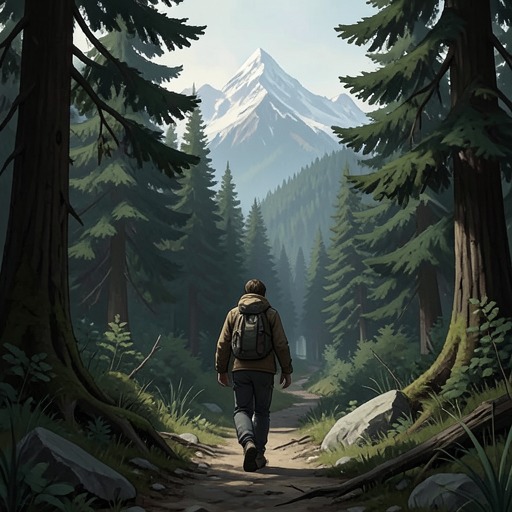
From the far end of the lake, Henry hears what sounds like a waterfall and follows it through forest and brush, crossing around rocks beside a gully. He finds a waterfall pouring over a rocky ledge and watches the water continue down the mountain toward streams that appear to lead back to the lake. This discovery briefly gives the walk a destination and a sense of wonder. Yet it does not help him establish a reliable route back to camp.
When he is ready to return, Henry chooses a different route, intending to take a shortcut from the opposite side of the lake. He still has his red notebook and stops to write another poem, this one less meditative. He keeps walking, but the camp does not appear; then he can no longer locate the lake. The landscape that had offered a waterfall as a clear point of discovery now provides no center or dependable connection between landmarks. Henry recognizes that he is lost in Vance Pastures, which stretches for miles around him.
Isolation and Narrative Significance
The loss of direction reverses the purpose of the visit. Henry had agreed to travel to Utah to pacify Lydia, but once away from camp he is alone, unable to find the lake or the route he expected to follow. He contrasts the uncertainty of the mountains with Los Angeles, where he believes a person could call a cab or use a telephone to address a problem. In the wilderness, those practical solutions are unavailable to him, and the scale of the property makes his sense of isolation immediate.
The red notebook links the episode’s writing motif to its physical danger. Henry carries it as he writes two poems during the walk, but when he understands how far he may be from camp, he throws it away and frames his predicament as a possible death for a writer. That gesture makes the notebook more than a tool for composition: in a moment of fear, it becomes something he is willing to abandon. Utah’s role in the episode rests on this change of scale—from Lydia’s familiar destination, to a shared camping trip, to a landscape in which Henry cannot orient himself. The retreat offers neither the comfort of the city nor a reliable route back to the people he came with.