Taking Refuge in the Teachings
Taking Refuge in the Teachings is the formal act of pledging oneself to the Buddha's doctrine and community, a ritual that marks a decisive turning point in the narrative by separating those who follow Gotama's path from those who, like Siddhartha, continue their own search. It is the moment when Govinda, Siddhartha's lifelong friend, chooses institutional faith over personal quest, and it becomes a recurring touchstone for the novel's central tension between received wisdom and direct experience.
The Ritual and Its Immediate Context
The act of taking refuge occurs in the grove of Jetavana, after Gotama has delivered his sermon on suffering, its origin, and the way to its cessation. The Buddha concludes his teaching by inviting those who have understood to join his community: "You have heard the teachings well, it has come to you well. Thus join us and walk in holiness, to put an end to all suffering." At this invitation, many pilgrims step forward. Govinda, described as "the shy one," also comes forward and declares, "I also take my refuge in the exalted one and his teachings," and is accepted into the community of disciples. The next morning, a senior monk dresses the new novices in the yellow robe and instructs them in their first duties. Govinda embraces Siddhartha one last time and leaves with the novices, his path now formally separated from his friend's.
Govinda's Choice and Siddhartha's Response
Govinda's decision to take refuge is the culmination of his long devotion to Siddhartha and his own spiritual yearning. When he urges Siddhartha to join him, Siddhartha refuses, saying he has not found any fault in the teachings but that he must seek his own goal. Siddhartha tells Govinda, "Always, oh Govinda, you've been my friend, you've always walked one step behind me. Often I have thought: Won't Govinda for once also take a step by himself, without me, out of his own soul? Behold, now you've turned into a man and are choosing your path for yourself." Govinda weeps, realizing his friend has left him. Siddhartha then reminds him that he has renounced home, parents, possessions, free will, and all friendship—this is what the teachings require. The parting is final: Govinda becomes a monk, while Siddhartha walks away from all teachings and teachers.
The Teachings as a Shelter for the Many
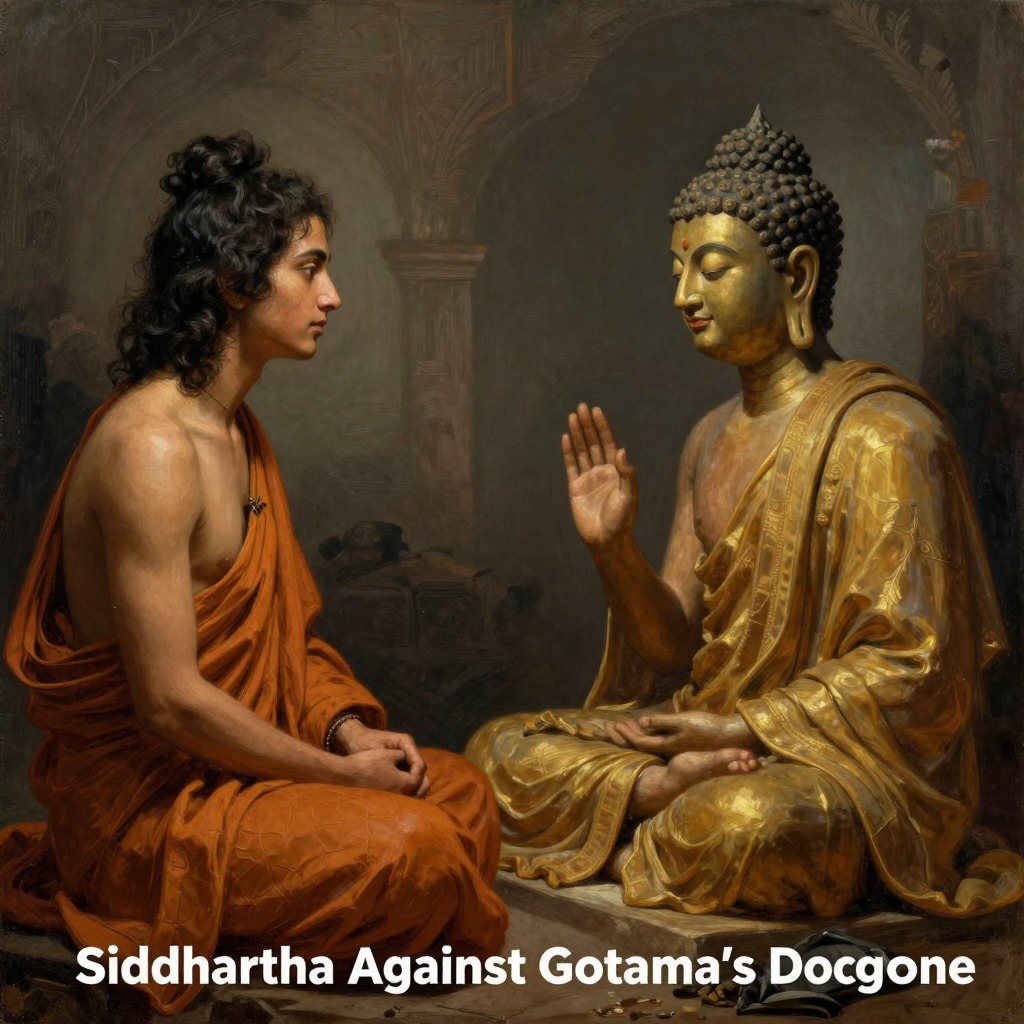
Gotama himself later points to the multitude of his followers who have taken refuge as evidence of the teachings' value. When Siddhartha argues that salvation cannot be conveyed through words, the Buddha asks whether it would be better for all those Samanas to abandon the teachings and return to worldly desires. Siddhartha immediately disavows any such thought, saying he wishes them all to stay and reach their goal. This exchange underscores that taking refuge is not a lesser path but a valid one for those who can find their fulfillment within it. The community of monks becomes a vast shelter, and Govinda, even in old age, remains within it, still searching but never leaving the refuge he chose as a young man.
The Limits of Refuge: Siddhartha's Rejection
Siddhartha's refusal to take refuge is the novel's pivotal act of independence. He explains to Gotama that if he became a disciple, he would merely replace his self with the teachings, his duty to follow the Buddha, his love for the master, and the community of monks—a deceptive calm that would not truly redeem him. This rejection is not a dismissal of Gotama's holiness; Siddhartha venerates the Buddha as a perfected being. But he insists that what Gotama experienced in his hour of enlightenment cannot be taught. "Nobody will obtain salvation by means of teachings!" Siddhartha declares. The act of taking refuge, for him, would be a substitution of one authority for another, not the direct discovery of the self.
The Persistence of the Pattern: Govinda's Final Visit
Decades later, Govinda, still a monk, hears of an old ferryman who is regarded as a wise man. He seeks him out and finds Siddhartha. In their final conversation, Govinda asks if Siddhartha has a teaching or a faith he follows. Siddhartha replies that he has learned from many teachers—a courtesan, a merchant, gamblers, the river, and the ferryman Vasudeva—but that wisdom cannot be passed on. He tells Govinda that knowledge can be conveyed but not wisdom, and that the opposite of every truth is just as true. Govinda, still bound by his refuge, struggles to understand. Yet when Siddhartha asks him to kiss his forehead, Govinda experiences a vision: he sees the face of his friend transform into a river of countless faces—fish, children, murderers, gods—all flowing together, and above them all, the same quiet, benevolent smile he had seen on Gotama's face. In that moment, Govinda knows that Siddhartha has become a perfected one. The vision is not a teaching but a direct experience, the very thing Siddhartha had always insisted could not be given through words. Govinda bows, tears running down his old face, feeling the most intimate love and humblest veneration. The act of taking refuge, which once separated the two friends, is finally transcended by a recognition that transcends all doctrines.
The Significance of Taking Refuge in the Novel
Taking Refuge in the Teachings functions as a structural and thematic counterpoint throughout Siddhartha. It represents the institutional, communal, and doctrinal path to salvation—a path that Govinda follows faithfully for his entire life. Siddhartha's refusal to take this refuge is the engine of his individual journey, driving him through asceticism, sensuality, despair, and finally to the river. The novel does not condemn the act of taking refuge; Govinda is portrayed with deep sympathy, and his final vision grants him a peace he had sought for decades. But the narrative ultimately affirms that the deepest truth cannot be contained in any formula or community. It must be lived, suffered, and finally recognized in a moment that lies beyond words. The act of taking refuge, for all its sincerity, remains a step short of that final, silent understanding.