The Four Noble Truths
The Four Noble Truths are the core of Gotama the Buddha's public teaching, the doctrine that draws thousands of seekers to the grove of Jetavana and that Siddhartha hears directly from the perfected one's own mouth. In the novel, they represent the most systematic, irrefutable expression of spiritual knowledge that words can achieve—and precisely because of that perfection, they become the boundary that Siddhartha must cross to reach his own awakening.
The Teaching in Jetavana
In the evening, after the heat of the day had cooled, Gotama taught the assembled pilgrims and monks in the garden of Jetavana. His quiet speech flowed calmly and clearly, presenting the world as full of suffering, identifying the origin of that suffering, and laying out the way to its relief. He taught the four main doctrines and the eightfold path, patiently repeating his examples, his voice hovering over the listeners like a light or a starry sky. The teaching was perfectly clear, a chain of causes and effects with no gap, no dependence on chance or on gods. Govinda, hearing it, immediately stepped forward to take refuge in the teachings and was accepted into the community of monks. Siddhartha, though he listened attentively, felt little curiosity for the content itself—he had heard it many times before through second- and third-hand reports—but he was struck by something beyond words: the Buddha's face, his walk, his quietly dangling hand, every joint of every finger seemed to breathe truth. The man himself was holy in a way that no teaching could capture.
Siddhartha's Critique: The Gap in the Chain
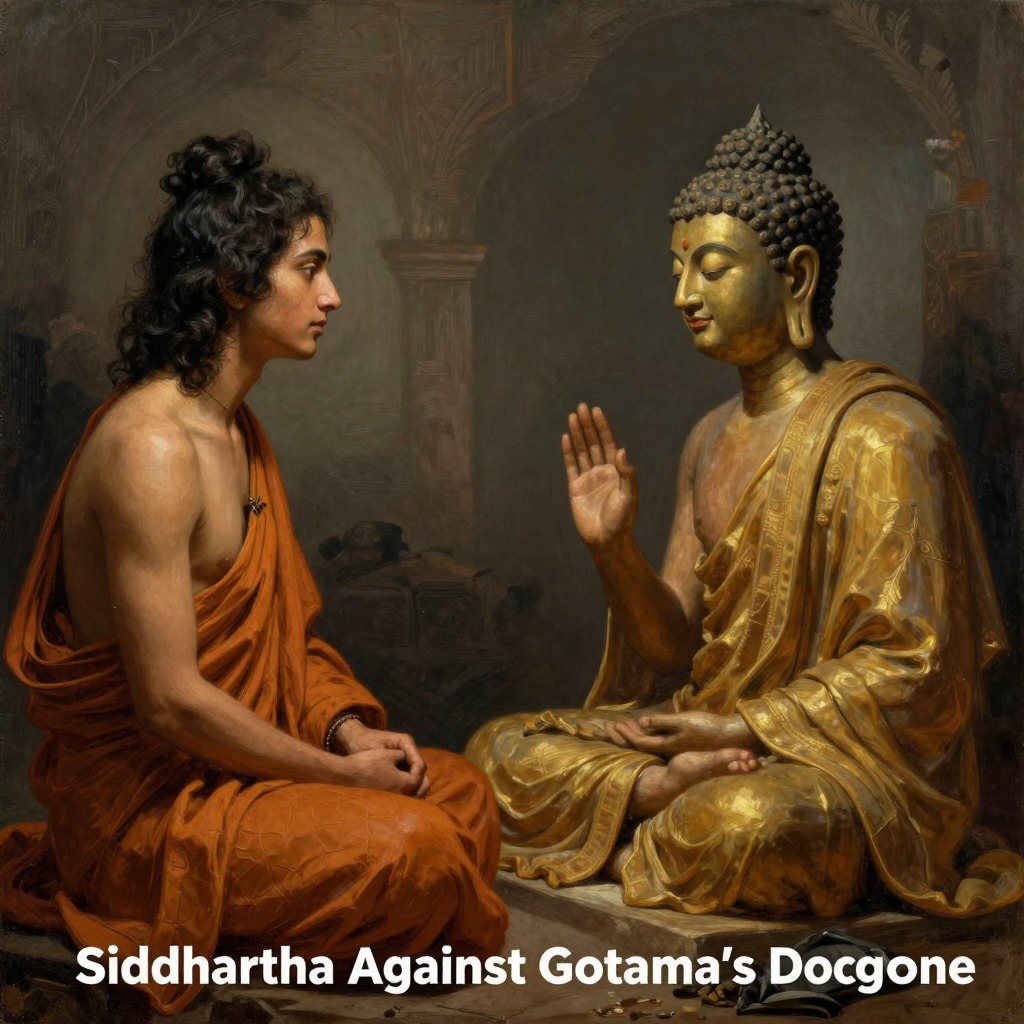
After the sermon, Siddhartha sought a private conversation with Gotama and voiced a precise objection. He admired the teachings for presenting the world as a perfect, unbroken chain of causes and effects—never before had this been seen so clearly. But, he argued, this unity is broken in one place: the teaching of salvation, of overcoming the world, introduces a small gap through which something alien and unprovable enters. With that breach, the entire eternal law of cause and effect becomes void. Gotama listened unmoved and replied that the teachings are not an opinion to be debated; their goal is not to explain the world but to bring salvation from suffering. Siddhartha then revealed the deeper insight that would shape his entire subsequent path: he had never doubted that Gotama himself was the Buddha, that he had reached the highest goal—but that goal had come through his own search, through thoughts, meditation, and enlightenment, not through teachings. No one, Siddhartha declared, will obtain salvation by means of teachings. The mystery of what the exalted one experienced in the hour of enlightenment cannot be conveyed in words.
The Limits of Doctrinal Knowledge
After leaving Gotama and Govinda behind, Siddhartha realized that the wish to have teachers and to listen to teachings had left him like a snake sheds its old skin. He had parted even from the highest and wisest teacher. The Four Noble Truths, for all their clarity, belonged to the realm of knowledge that can be conveyed—but wisdom, he would later tell Govinda, cannot be passed on. Knowledge can be taught; wisdom must be found, lived, carried, but never expressed in words. This was what he had suspected even as a young man and what had driven him away from teachers. The truths, like all teachings, are one-sided: they divide the world into Sansara and Nirvana, deception and truth, suffering and salvation. But the world itself is never one-sided. Time is not real, Siddhartha came to see, and if time is not real, then the gap between suffering and blissfulness, between evil and good, is also a deception. The sinner is not on a slow path toward becoming a Buddha; within the sinner, now and today, the future Buddha is already present.
The River's Deeper Lesson
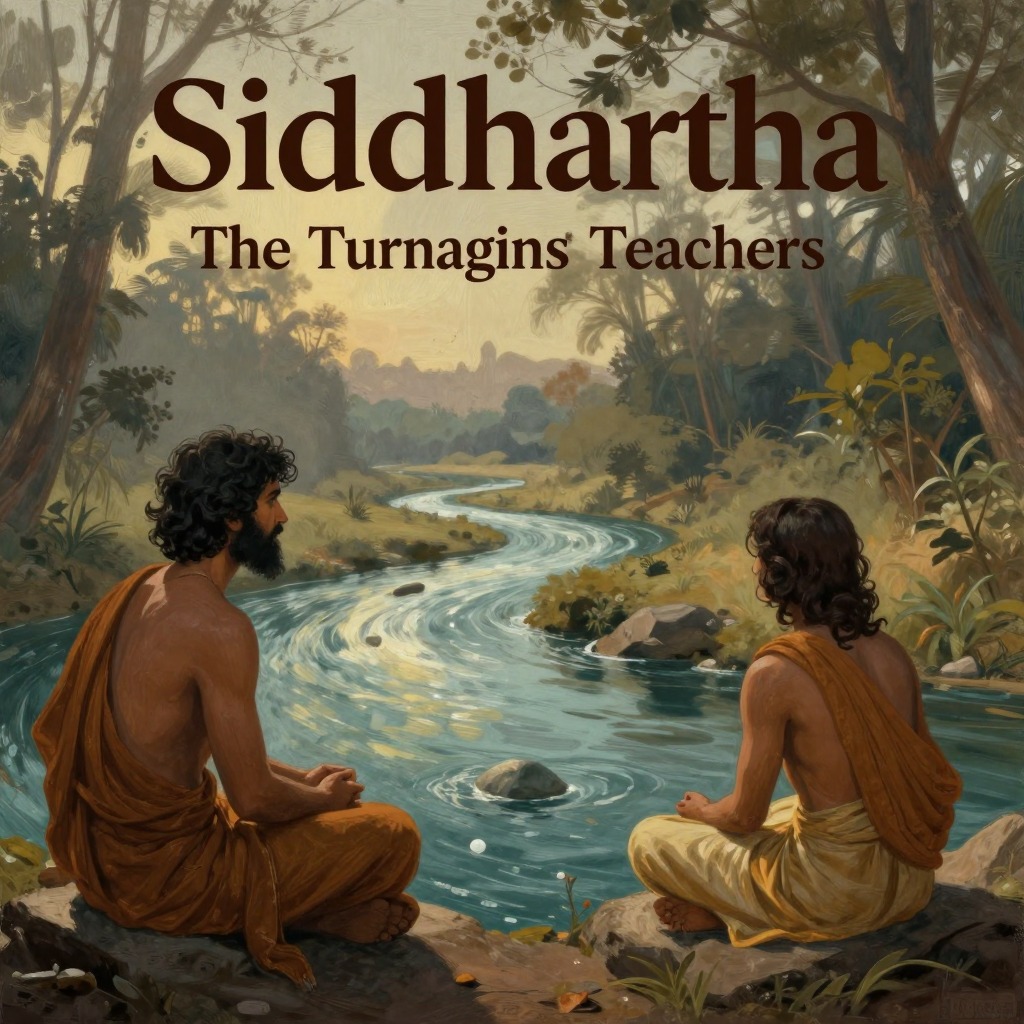
By the river, Siddhartha learned what no doctrine could teach. Vasudeva the ferryman had learned to listen to the river, and from the river he had learned that everything comes back, that the river is everywhere at once—at the source and at the mouth, at the waterfall and at the sea—and that there is only the present time, no shadow of the past or future. Siddhartha came to see his own life as a river, with the boy Siddhartha separated from the man and the old man only by a shadow, not by something real. The Four Noble Truths, with their clear chain of cause and effect, had seemed to offer a path out of suffering, but the river taught a more radical truth: all voices—of joy and suffering, of children and of men, of the dying and the newborn—belong together, are intertwined and connected, and when one hears them all without tying the soul to any particular voice, the great song of a thousand voices consists of a single word: Om, the perfection. The wound of love for his son, the suffering of separation, the envy of happy fathers—all of this, Siddhartha finally understood, was not something to be escaped through a doctrine but something to be lived through, consented to, loved. The Four Noble Truths had pointed toward salvation from suffering, but Siddhartha's final realization was that suffering itself, when fully accepted and loved, becomes part of the perfect oneness of the world.
The Smile Beyond Words
In his final meeting with Govinda, Siddhartha articulated the limit of all teachings, including the Four Noble Truths. Wisdom cannot be passed on; the opposite of every truth is just as true; words are not good for the secret meaning—everything becomes a bit different, a bit silly, as soon as it is put into words. He preferred things to words: a stone, a tree, a piece of bark could be loved, but teachings had no hardness, no softness, no colors, no smell, no taste. Nirvana itself, he said, is just a word. What mattered was not the doctrine but the life, the actions, the gestures—the smile of the perfected one, which Govinda saw at last on Siddhartha's face, the same quiet, delicate, thousand-fold smile that Gotama himself had worn. The Four Noble Truths had been the most perfect expression of the path, but the path itself, Siddhartha had discovered, could only be walked, not taught.