The Oneness of All Life
The Oneness of All Life is the culminating realization of Siddhartha's lifelong quest, the insight that resolves the novel's central tension between the spiritual and the worldly, the self and the world. It is not a doctrine he learns from a teacher but a state of being he arrives at after decades of experience, suffering, and love, finally grasped through the voice of the river and the silent teaching of the ferryman Vasudeva. This understanding transforms Siddhartha from a seeker who scorned the world into a man who loves it unconditionally, seeing the divine in every stone, every face, and every moment.
The Failure of Asceticism and the Search for Unity
Siddhartha's early life as a Brahman and a Samana was driven by a desire to overcome the self and reach the Atman, the ultimate unity behind all appearances. He practiced self-denial, meditation, and fasting, seeking to become "empty, empty of thirst, empty of wishing, empty of dreams, empty of joy and sorrow" . Yet he found that these techniques were merely a "short escape of the agony of being a self," no different in essence from the numbing effect of a drunkard's rice-wine . The world of diversity—the blue sky, the yellow sand, the river and the forest—had seemed to him a "veil of Maya," a deception to be penetrated and destroyed by thought . His goal was to find the essence "somewhere behind the things," not in them.
The Descent into Worldliness and the Death of the Self
After leaving Gotama, Siddhartha entered the world of the "childlike people," becoming a merchant, a lover, and a gambler. He learned to trade, to enjoy power, to wear fine clothes, and to drink wine. But this life, too, became a trap. He was "captured by the world, by lust, covetousness, sloth, and finally also by that vice which he had used to despise and mock the most: greed" . He played dice with increasing rage, losing and winning fortunes, hating himself all the while. The bright voice of his inner self grew silent. He had to "pass through so much stupidity, through so much vices, through so many errors, through so much disgust and disappointments and woe, just to become a child again and to be able to start over" . This descent was necessary: the priest and Samana in him had to die so that a new Siddhartha could be born.
Learning from the River: The Revelation of Timeless Unity
At the river, Siddhartha found his true teacher. He told the ferryman Vasudeva the entire story of his life, and Vasudeva listened with a rare, complete attention . Through this confession and his daily life by the water, Siddhartha began to learn the river's secret: "that there is no time" . The river is "everywhere at once, at the source and at the mouth, at the waterfall, at the ferry, at the rapids, in the sea, in the mountains, everywhere at once, and that there is only the present time for it" . This insight transformed his understanding of his own life: "the boy Siddhartha was only separated from the man Siddhartha and from the old man Siddhartha by a shadow, not by something real" . All suffering, he realized, was time, and to overcome time was to overcome the world's hostility.
The Wound of Love and the Final Blossoming
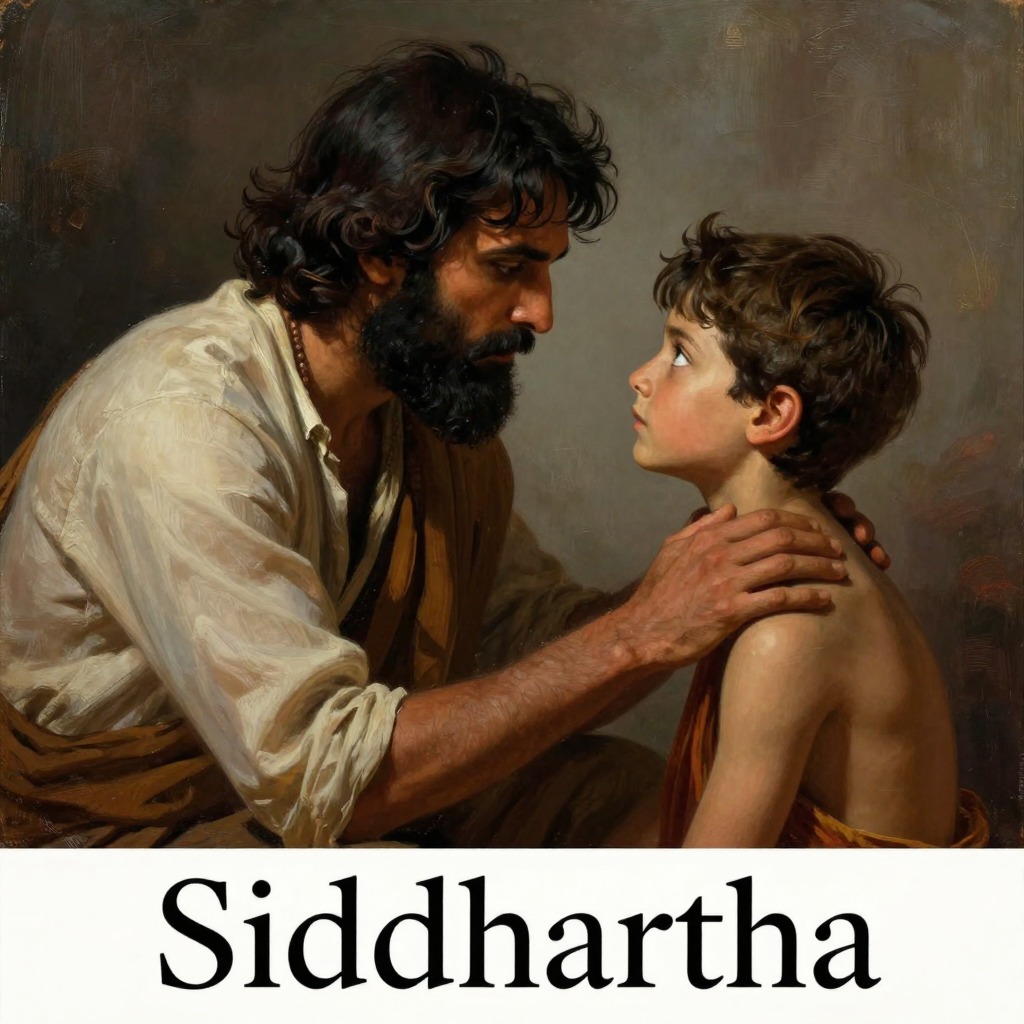
Yet the deepest lesson came through pain. When his son arrived and then ran away, Siddhartha suffered a wound of love that burned for a long time. He envied every father he ferried across the river, and he confessed his anguish to Vasudeva, who listened as the river itself . In this confession, Siddhartha felt his pain flow into the listener and become one with the river. Later, when he asked Govinda for a final teaching, he articulated the core of his realization: "The world, my friend Govinda, is not imperfect, or on a slow path towards perfection: no, it is perfect in every moment, all sin already carries the divine forgiveness in itself, all small children already have the old person in themselves, all infants already have death, all dying people the eternal life" . The sinner is not on his way to becoming a Buddha; the Buddha is already present within the sinner, now and today .
The Thousand Voices and the Single Word
The ultimate expression of the Oneness comes when Siddhartha listens to the river's thousand voices—the lamentation of yearning, the laughter of the knowledgeable, the scream of rage, the moaning of the dying—and hears them all as a single word: Om, the perfection . He no longer distinguishes between happy and weeping voices, between those of children and men; "everything was one, everything was intertwined and connected, entangled a thousand times" . This is the knowledge that wisdom cannot be passed on in words, but can only be found and lived. It is the readiness of the soul to think the thought of oneness in every moment, to feel and inhale it . Siddhartha's final smile, which Govinda sees as identical to the smile of Gotama the Buddha, is the smile of this oneness—a smile that encompasses all manifestations, all transformations, all existence .