Atman
Atman is the central spiritual concept in Hermann Hesse's Siddhartha, the innermost, indestructible self that is one with the universe and the ultimate object of the protagonist's lifelong quest. It is the singular, eternal reality behind all phenomena, the divine core that Siddhartha seeks to know, possess, and finally realize not through teachings but through direct experience of life itself.
Definition and Early Understanding
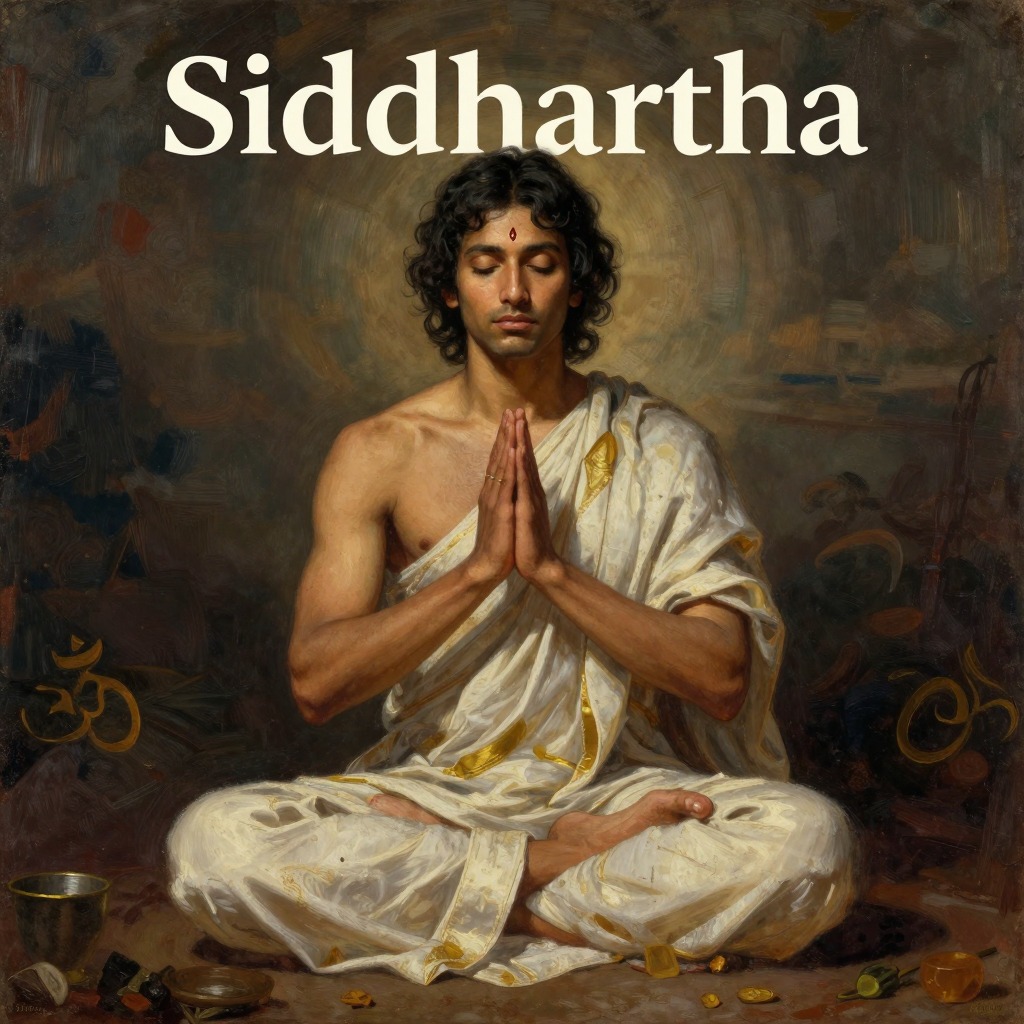
From his earliest years, Siddhartha, the handsome son of a Brahman, already knew how to feel Atman in the depths of his being, indestructible and one with the universe, and could speak the sacred syllable Om silently while breathing in and out with full concentration of his soul. The holy books, particularly the Upanishads of the Samaveda, contained wonderful verses declaring that the soul is the whole world and that in deep sleep a man meets his innermost part and resides in the Atman. Yet Siddhartha came to suspect that his venerable father and the other wise Brahmans, for all their knowledge, had not truly reached this innermost place. He questioned whether the gods themselves were not merely creations like himself, subject to time and mortality, and whether the only being truly worthy of worship was the Atman. The crucial question became: where was Atman to be found? It was not flesh and bone, neither thought nor consciousness, as the wisest ones taught, but resided in one's own self, in its innermost, indestructible part. Siddhartha realized that the Brahmans knew infinitely much about the creation of the world, the origin of speech, the arrangement of the senses, and the acts of the gods, but they did not know that one and only thing, the most important thing, the solely important thing: how to live the knowledge of Atman, not merely to know it.
The Failure of Asceticism and Teachings
As a Samana, Siddhartha set himself a single goal: to become empty of thirst, wishing, dreams, joy, and sorrow, dead to himself, so that once the self was overcome and every desire silenced, the ultimate part of his being—the innermost self that is no longer his self—would awake. He learned many ways of leaving the self through pain, meditation, and imagining the mind void of all conceptions, but though he fled from himself a thousand times into nothingness, into animals, into stone, the return was always inevitable. He always found himself back in the sunshine or moonlight, once again his self and Siddhartha, again feeling the agony of the cycle. He came to believe that there is just one knowledge, which is everywhere, which is Atman, within him and within every creature, and that this knowledge has no worse enemy than the desire to know it, than learning itself. After hearing Gotama the Buddha's teachings, Siddhartha realized that what he had long known—that his self was Atman, in its essence bearing the same eternal characteristics as Brahman—was true, but he had never really found this self because he had wanted to capture it in the net of thought. The body was not the self, nor the spectacle of the senses, nor thought, nor the rational mind, nor learned wisdom; both the thoughts and the senses were pretty things, but the ultimate meaning was hidden behind both of them, and both had to be listened to without being scorned or overestimated.
The Awakening to the Self
After leaving Gotama, Siddhartha experienced a profound awakening. He realized that he had been afraid of himself, fleeing from himself, searching for Atman and Brahman by trying to dissect his self and peel off all its layers to find the core, only to lose himself in the process. He declared that he would no longer begin his thoughts and his life with Atman and the suffering of the world, nor kill and dissect himself to find a secret behind the ruins. Instead, he wanted to learn from himself, to be his own student, to get to know the secret of Siddhartha. He saw the world as if for the first time—blue, yellow, green, the sky and the river, the forest and the mountains—and understood that the purpose and essential properties were not somewhere behind the things but in them, in everything. The singular and divine lived hidden in the blue and the river and in Siddhartha himself, and it was that very divinity's way and purpose to be here yellow, there blue, there sky, there forest, and here Siddhartha.
The River and the Realization of Oneness
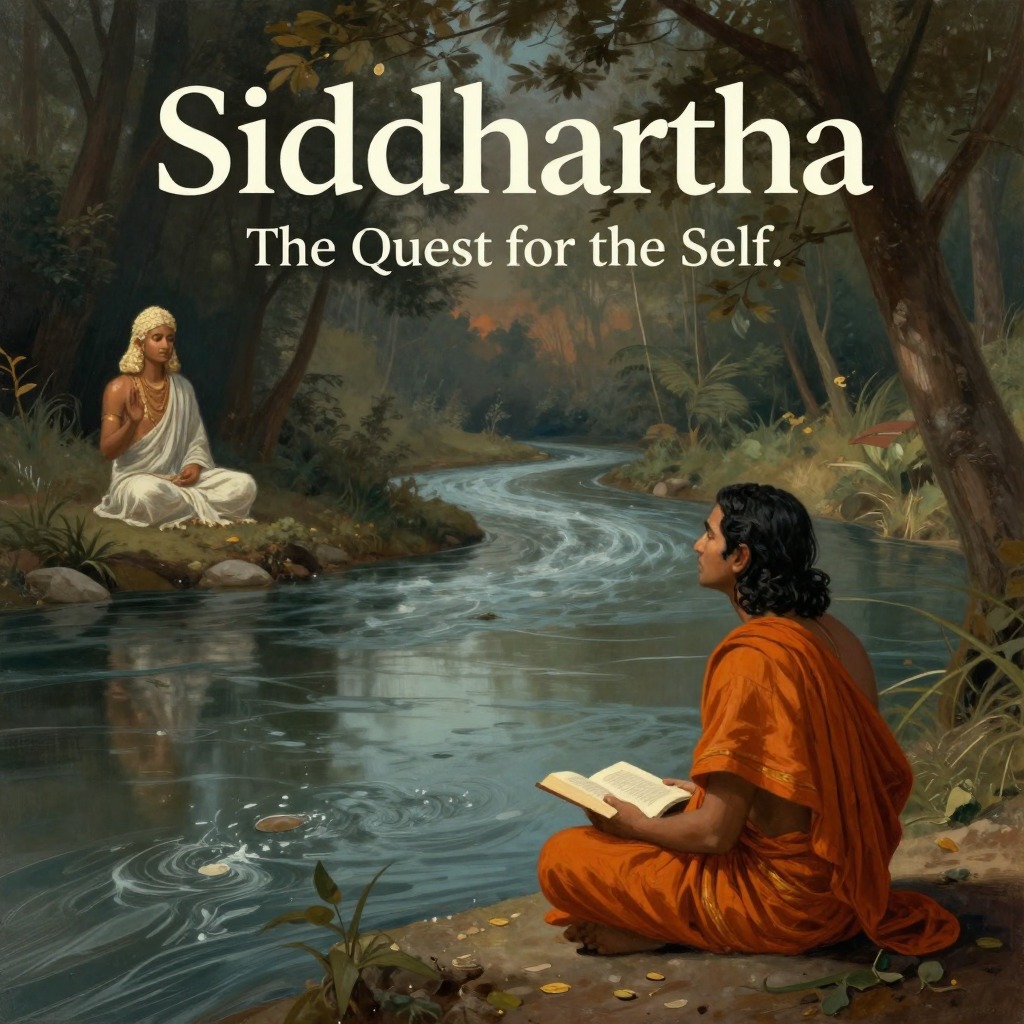
By the river, Siddhartha learned from the ferryman Vasudeva, who had been taught by the river itself. Vasudeva told him that the river knows everything and that everything can be learned from it, including that it is good to strive downwards, to sink, to seek depth. Siddhartha learned from the river the secret that there is no time: the river is everywhere at once, at the source and at the mouth, at the waterfall and at the ferry, and there is only the present time for it, not the shadow of the past nor the shadow of the future. When Siddhartha understood this, he looked at his own life and saw that it too was a river, and the boy Siddhartha was separated from the man Siddhartha and the old man Siddhartha only by a shadow, not by something real. His previous births were no past, and his death and return to Brahma were no future; nothing was, nothing will be, everything is, everything has existence and is present. He realized that all suffering is time, and that everything hostile in the world is overcome as soon as one has overcome time. In his final realization, Siddhartha listened to the river's thousand voices—the lamentation of yearning, the laughter of the knowledgeable one, the scream of rage, the moaning of the dying—and heard them all together as a single word: Om, the perfection. His self had flown into the oneness, and he understood that the sinner is not on his way to become a Buddha but that within the sinner, now and today, the future Buddha is already all there. The world is perfect in every moment; all sin already carries divine forgiveness in itself, all small children already have the old person in themselves, all infants already have death, all dying people the eternal life. In deep meditation, it is possible to put time out of existence and to see all life that was, is, and will be as simultaneous, and there everything is good, everything is perfect, everything is Brahman.
The Stone and the Love of Things
In his final teaching to Govinda, Siddhartha picked up a stone from the ground and explained that he no longer loved it because it might one day become a human being or a spirit in the cycle of transformations, but because it is already and always everything—a stone, animal, god, Buddha. He loved it for its very stoneness, for its veins and cavities, its yellow and gray, its hardness, the sound it makes when knocked, the dryness or wetness of its surface. Every stone prays the Om in its own way; each one is Brahman, but simultaneously and just as much it is a stone. He concluded that he can love a stone, a tree, a piece of bark—things—but cannot love words, and that teachings are no good for him because they have no hardness, no softness, no colors, no edges, no smell, no taste. The most important thing, he told Govinda, is to be able to love the world, not to despise it, not to hate it and oneself, but to look upon it and oneself and all beings with love and admiration and great respect.