The Eightfold Path
The Eightfold Path is the central practical teaching of Gotama the Buddha, the set of eight right practices that, according to his doctrine, lead to the cessation of suffering and the attainment of Nirvana. In Hermann Hesse's novel, it is presented as the culmination of the Buddha's sermon in the grove of Jetavana, where Gotama "taught the four main doctrines, taught the eightfold path, patiently he went the usual path of the teachings, of the examples, of the repetitions." For the community of monks who take refuge in the teachings, the Eightfold Path provides a clear, systematic framework for righteous living and mental cultivation. Yet for Siddhartha, the path represents precisely the kind of codified knowledge he has come to distrust—a set of instructions that, however noble, cannot transmit the singular, ineffable experience of enlightenment that Gotama himself underwent under the Bo-tree.
The Path as Doctrine and Its Presentation
Gotama's teaching of the Eightfold Path occurs during the evening sermon in Jetavana, where the Buddha's voice is described as "perfected, was of perfect calmness, was full of peace." He teaches "the teachings of suffering, of the origin of suffering, of the way to relieve suffering," and within this framework the Eightfold Path is the practical method—the way to walk out of suffering. The narrative emphasizes the clarity and completeness of this teaching: "Calmly and clearly his quiet speech flowed on. Suffering was life, full of suffering was the world, but salvation from suffering had been found: salvation was obtained by him who would walk the path of the Buddha." The Eightfold Path is thus presented as a complete and irrefutable system, a chain of causes and effects that explains the world and offers a way beyond it. Many pilgrims, including Govinda, immediately step forward to take refuge in these teachings, accepting the path as their guide.
Siddhartha's Critique: The Limits of Teachable Knowledge
Siddhartha, however, does not join them. In his private conversation with Gotama the following morning, he articulates a fundamental objection that applies directly to the Eightfold Path as a teachable system. He acknowledges that Gotama's teachings present "the world as a perfect chain, a chain which is never and nowhere broken, an eternal chain the links of which are causes and effects," but he identifies a "small gap" in this unity: the teaching of salvation itself. Siddhartha argues that the Eightfold Path, like all teachings, is a one-sided formulation that divides the world into Sansara and Nirvana, suffering and salvation, but that the reality of enlightenment—what Gotama experienced in the hour of his awakening—cannot be conveyed through any set of instructions. "You will not be able to convey and say to anybody," Siddhartha tells Gotama, "in words and through teachings what has happened to you in the hour of enlightenment!" The Eightfold Path, for all its clarity, remains a verbal formula, and Siddhartha's quest has taught him that "there is nothing to be learned" from teachings alone; the knowledge that matters is the unteachable, self-discovered realization of the Atman within.
The Path as a Stage in Siddhartha's Journey
Although Siddhartha rejects the Eightfold Path as a final answer, the discipline it represents—the structured effort to overcome the self through right thought, right action, and right meditation—is a stage he has already passed through and will later transcend. As a Samana, he practiced a similar regimen of self-denial: he learned "to breathe sparingly, learned to get along with only few breathes, learned to stop breathing," and he "killed his senses, he killed his memory, he slipped out of his self into thousands of other forms." This ascetic discipline, like the Eightfold Path, aims at escaping the cycle of suffering, but Siddhartha comes to see it as a temporary numbing of the self rather than true liberation. He tells Govinda that the Samana's exercises are no different from a drunkard's escape: "It is fleeing from the self, it is a short escape of the agony of being a self, it is a short numbing of the senses against the pain and the pointlessness of life." The Eightfold Path, in this light, is a more refined version of the same strategy—a noble but ultimately insufficient attempt to overcome the self through methodical effort.
The Path and the River: From Doctrine to Direct Experience
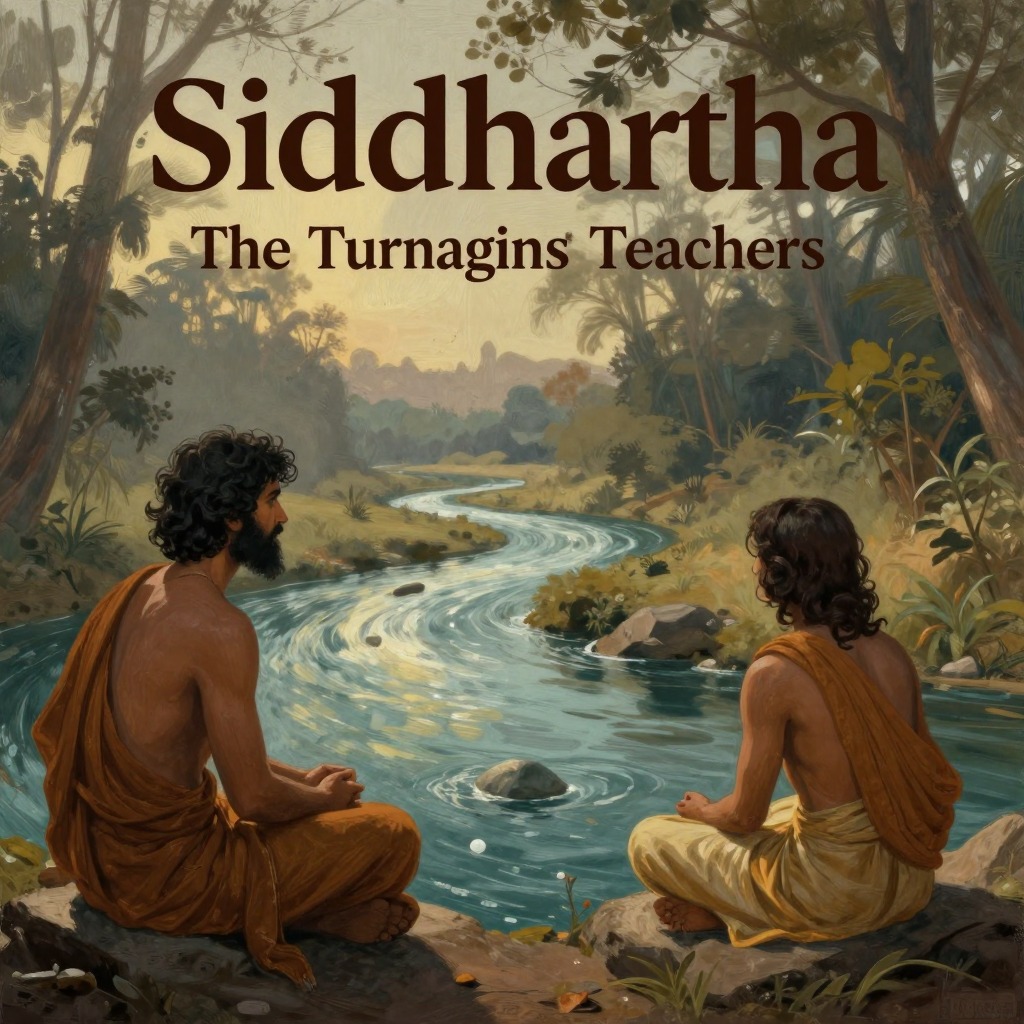
Siddhartha's final wisdom, achieved by the river, stands in direct contrast to the Eightfold Path as a teachable system. Where the path offers a sequence of right practices to be followed, Siddhartha learns to listen to the river, which speaks in "a thousand voices" and teaches him that "time is not real" and that "the opposite of every truth is just as true." The river's teaching is not a path to be walked but a reality to be experienced: "When he heard them all, perceived the whole, the oneness, then the great song of the thousand voices consisted of a single word, which was Om: the perfection." This is the knowledge that cannot be passed on—the wisdom that Siddhartha tells Govinda "cannot be expressed in words and taught." The Eightfold Path, as a verbal teaching, belongs to the realm of words and opinions, which Siddhartha has learned to distrust. In his final conversation with Govinda, he explains that "the words are not good for the secret meaning, everything always becomes a bit different, as soon as it is put into words, gets distorted a bit, a bit silly." The path of the Buddha is thus not wrong, but it is incomplete: it points toward the goal but cannot deliver the seeker there. Siddhartha's own journey—through asceticism, sensuality, despair, and finally to the river—has taught him that the only true path is the one each person must discover alone, through living fully and listening to the voice within.
The Eightfold Path as a Symbol of the Limits of Doctrine
In the novel's structure, the Eightfold Path functions as a symbol of all formal religious and philosophical systems that promise salvation through adherence to rules and teachings. Siddhartha's rejection of it is not a rejection of Gotama himself—whom he venerates as a holy man—but a rejection of the idea that enlightenment can be transmitted through words. The path is perfect in its logic, but logic cannot capture the paradoxical, timeless nature of reality. Siddhartha's final insight, that "the sinner is not on his way to become a Buddha, he is not in the process of developing," but that "within the sinner is now and today already the future Buddha," undermines the very notion of a path that leads from one state to another. The Eightfold Path implies a journey from suffering to salvation, but Siddhartha comes to see that all states coexist in the eternal present. The path, like all teachings, is a useful illusion—a raft to be abandoned once the far shore is reached. Siddhartha's story suggests that the true journey is not along the Eightfold Path but through the full experience of life itself, including its sins and sufferings, until one awakens to the oneness that was always already there.