The Great Vomiting
The Great Vomiting is the most violent and decisive metaphor in Siddhartha's journey, a figure for the total, bodily rejection of a life that has become unbearable. It does not describe a physical act but a spiritual convulsion so intense that it is experienced as a physical purging. The metaphor crystallizes at the moment of Siddhartha's deepest despair, when he stands by the river, having lost everything—his wealth, his position, his son, his will to live—and feels an overwhelming need to expel the accumulated poison of his years in the world. This is not a gentle renunciation but a desperate, almost biological necessity: the soul, having eaten and drunk far too much of the world's pleasures, must vomit them back up to survive.
Origins in Disgust and the Collapse of the Worldly Self
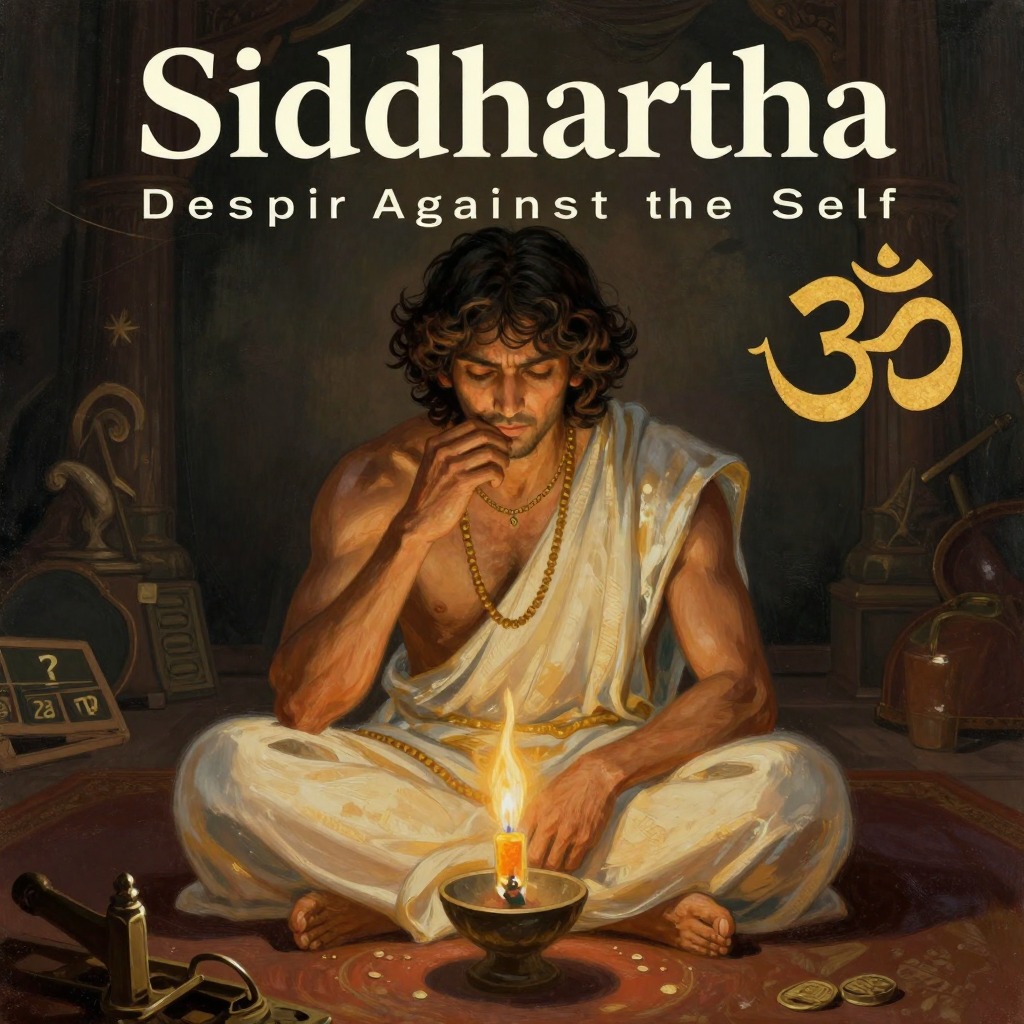
The metaphor is prepared by a long, slow accumulation of disgust. Siddhartha's life as a merchant, lover, and gambler had become a "saturated, lukewarm, dull life" , and the voice of his innermost self had fallen silent. The final trigger is a dream of a dead singing bird in a golden cage, which he throws away, feeling as if he had thrown away all value and everything good . This dream precipitates a crisis: he sees his life as worthless and pointless, and he is filled with a disgust that penetrates his entire body like the "lukewarm, repulsive taste of the wine, the just too sweet, dull music, the just too soft smile of the dancing girls" . The disgust is not merely intellectual; it is a physical revulsion against the very texture of his existence. It is from this state that the thought of the Great Vomiting emerges as a longed-for relief.
The Act of Vomiting: Annihilation as Liberation
The metaphor is explicitly invoked at the riverbank, where Siddhartha contemplates suicide. He looks into the water and sees only a "frightening emptiness" reflected back, answering the "terrible emptiness in his soul" . In this moment, the desire to annihilate himself is framed as a "great vomiting"—a desperate wish to "smash the failure into which he had shaped his life, to throw it away, before the feet of mockingly laughing gods" . He imagines his body as food for fishes and crocodiles, a "dog Siddhartha, this lunatic, this depraved and rotten body" . The Great Vomiting is thus synonymous with death, the ultimate purging of a self he has come to hate. Yet, at the very instant he prepares to let himself fall, the sound of "Om" rises from the depths of his soul, and he realizes the foolishness of his actions . The vomiting is not completed as suicide; instead, it is transformed into a spiritual act.
The Aftermath: Purification and the New Self
After the crisis, Siddhartha understands that the Great Vomiting has already happened, but in a different sense. He reflects that he has "completely tasted and spit out, devoured up to the point of desperation and death, a piece of suffering, a piece of misery" . The metaphor shifts from a future act to a past accomplishment: he has vomited out the world. This purging is what allows him to feel joy again, to hear the bird in his chest singing, and to laugh at himself. The old self—the proud Brahman, the ascetic Samana, the greedy merchant—has been expelled. He now sees that he had to "sin, to be able to live again" , and that the path of disgust and despair was necessary to empty him for a new beginning. The Great Vomiting is thus not an end but a threshold: it clears the way for his life as a ferryman, his learning from the river, and his final, loving acceptance of the world as it is.
Thematic Significance: The Necessity of Descent
The Great Vomiting is the novel's most powerful expression of the necessity of experiencing the lowest depths in order to reach the highest wisdom. It is the antithesis of the ascetic's controlled self-denial; it is an uncontrolled, overwhelming expulsion that comes only after the self has been fully immersed in the world. Siddhartha's earlier attempts to kill the self through fasting and meditation had failed because they were acts of will, still rooted in pride. The Great Vomiting, by contrast, is a surrender to the body's own revulsion, a letting-go that cannot be commanded. It is the moment when the "priest and Samana in him was dead" , and the new Siddhartha could be born. The metaphor thus encapsulates the novel's central paradox: that the path to holiness leads through the most profound defilement, and that the only way to be cleansed is to first be utterly sickened.