Om
Om is the sacred syllable and the central spiritual symbol in Hermann Hesse's Siddhartha, representing the perfection, unity, and indestructibility of all existence. It serves as the word of words, the beginning and end of all Brahmanic prayers, and functions as the key that repeatedly awakens Siddhartha from spiritual crisis, guiding him toward his final realization of the oneness of life.
The Word of Words and Early Training
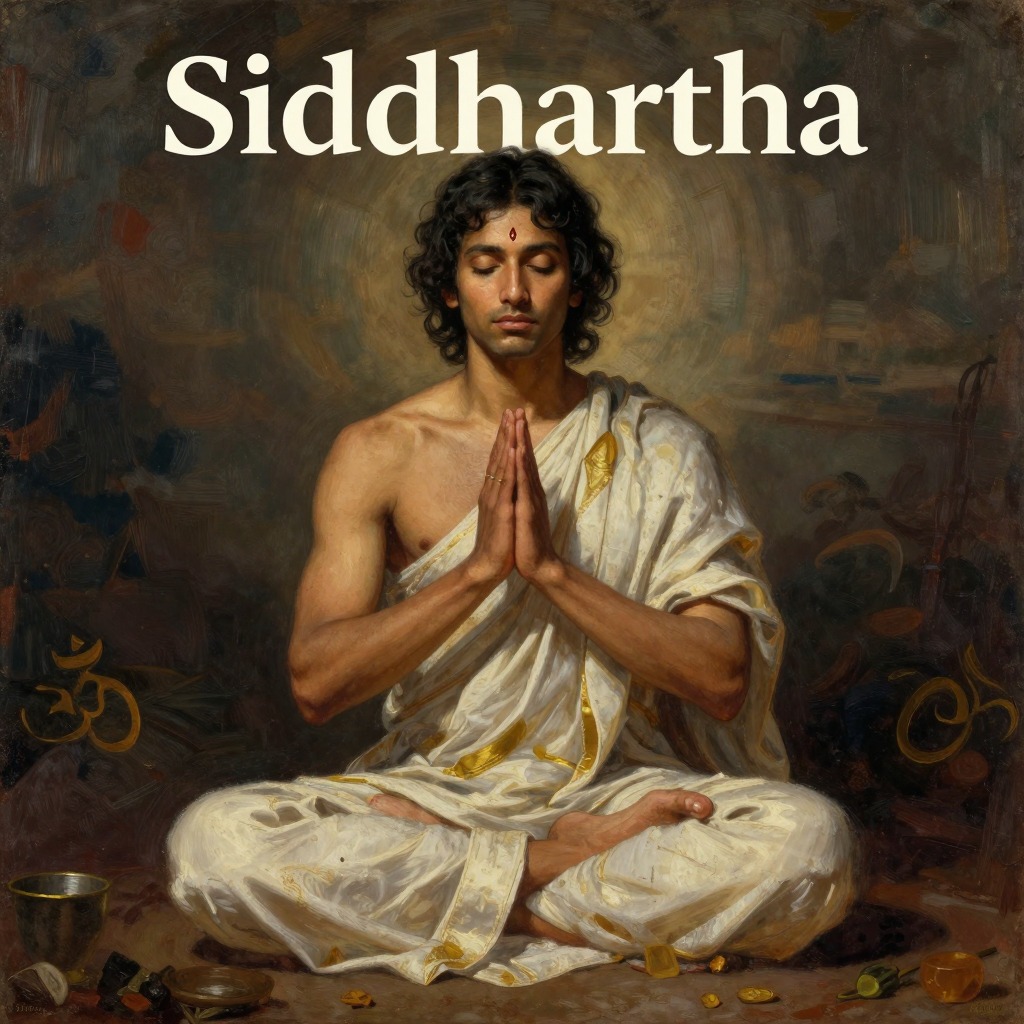
From his earliest youth, Siddhartha learned to speak the Om silently, the word of words, to speak it silently into himself while inhaling and to speak it silently out of himself while exhaling, with all the concentration of his soul, the forehead surrounded by the glow of the clear-thinking spirit. He already knew to feel Atman in the depths of his being, indestructible, one with the universe. This early mastery of Om was part of his Brahmanic education, a practice that connected him to the ultimate reality even before he understood its full meaning. The verse he murmured while meditating under the Banyan tree with Govinda made the syllable's power explicit: "Om is the bow, the arrow is soul, The Brahman is the arrow's target, That one should incessantly hit." In this formulation, Om is not merely a sound but the instrument of spiritual aim, the bow from which the soul-arrow is launched toward the divine.
The Sound That Saves from Suicide
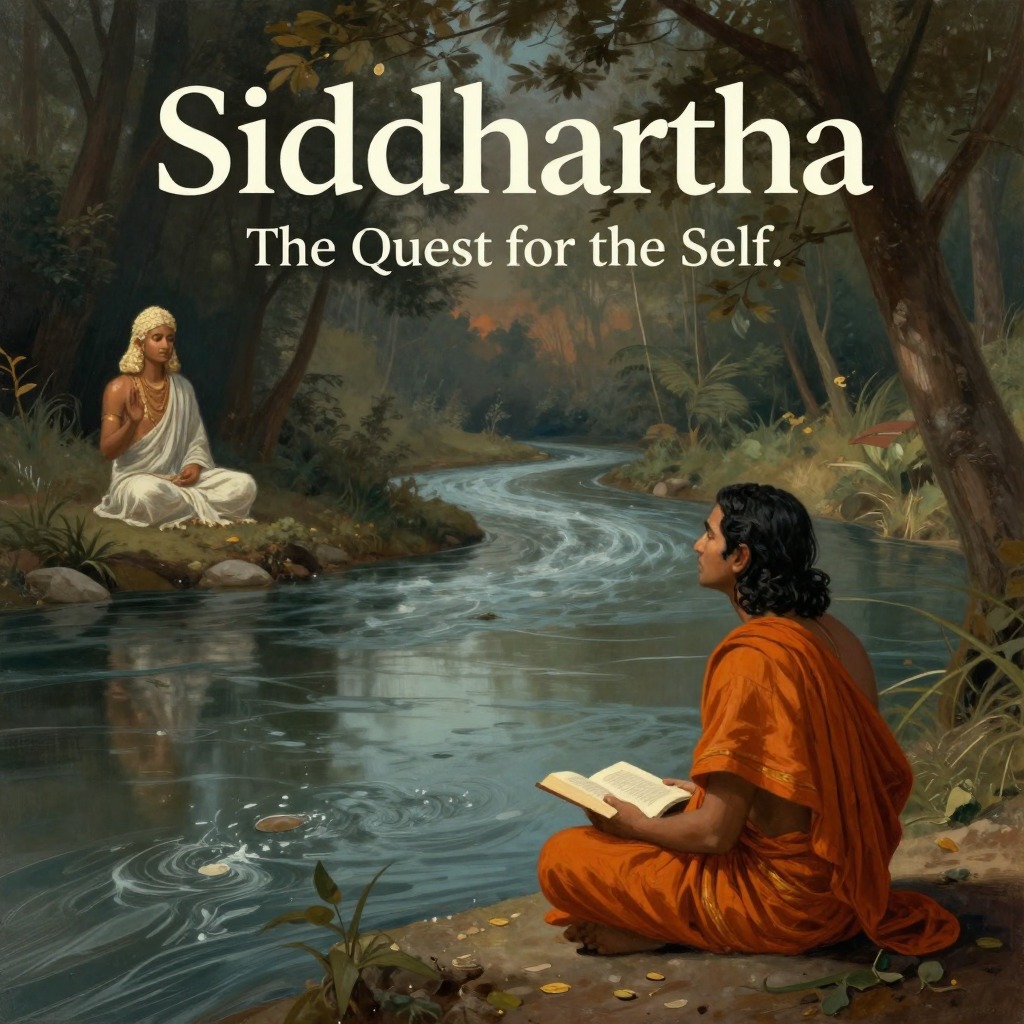
After years of worldly indulgence, gambling, and disgust, Siddhartha reached the river intending to drown himself. With a distorted face, he stared into the water, saw the reflection of his face and spit at it, and slipped toward death. Then, out of remote areas of his soul, out of past times of his now weary life, a sound stirred up. It was a word, a syllable, which he, without thinking, with a slurred voice, spoke to himself: the holy Om. In the moment when the sound of Om touched Siddhartha's ear, his dormant spirit suddenly woke up and realized the foolishness of his actions. He was deeply shocked, became aware of himself in his misery and in his error, and again knew about Brahman, knew about the indestructibility of life, knew about all that is divine, which he had forgotten. He collapsed by the foot of the coconut-tree, mumbling Om, and fell into a deep, dreamless sleep. When he woke up, it seemed to him as if his entire long sleep had been nothing but a long meditative recitation of Om, a thinking of Om, a submergence and complete entering into Om, into the nameless, the perfected.
The River's Thousand Voices and the Single Word
Living as a ferryman with Vasudeva, Siddhartha learned to listen to the river. Vasudeva taught him that the river has many voices—the voice of a king, of a warrior, of a bull, of a bird of the night, of a woman giving birth, of a sighing man, and a thousand other voices. When Siddhartha asked what word the river speaks when one succeeds in hearing all of its ten thousand voices at once, Vasudeva's face smiled happily, and he bent over to Siddhartha and spoke the holy Om into his ear. This was the very thing which Siddhartha had also been hearing. Later, in the climactic moment of his final realization, Siddhartha listened to the river with complete concentration. He heard the lamentation of yearning and the laughter of the knowledgeable one, the scream of rage and the moaning of the dying ones, everything together, all voices, all goals, all yearning, all suffering, all pleasure, all that was good and evil. When he did not tie his soul to any particular voice but heard them all, perceived the whole, the oneness, then the great song of the thousand voices consisted of a single word, which was Om: the perfection.
The Stone That Prays Om
In his final teaching to Govinda, Siddhartha picked up a stone from the ground and weighed it in his hand. He explained that there are stones which feel like oil or soap, and others like leaves, others like sand, and every one is special and prays the Om in its own way, each one is Brahman, but simultaneously and just as much it is a stone. This understanding represents the culmination of Siddhartha's wisdom: the sacred syllable is not a transcendent abstraction but immanent in all material things, each of which, in its own particularity, utters the same word of perfection. The stone, like the river, like the ferryman, like Siddhartha himself, participates in the oneness that Om names and embodies.
The Smile of the Perfected Ones
The ultimate expression of Om in the novel is not a sound but a visible presence. When Govinda kissed Siddhartha's forehead, he saw a vision of all forms flowing and merging, and above them all was a mask smiling—the smile of oneness above the flowing forms, the smile of simultaneousness above the thousand births and deaths. This smile of Siddhartha was precisely the same, of the same kind as the quiet, delicate, impenetrable, thousand-fold smile of Gotama, the Buddha. Like this, Govinda knew, the perfected ones are smiling. The smile is the silent, visible Om, the perfection made flesh, the word that has become gesture and light, the final proof that wisdom cannot be passed on in teachings but can be lived and radiated.