The Word of Words
The Word of Words is the sacred syllable Om, the foundational mantra of Hindu and Buddhist tradition, which in Hermann Hesse's Siddhartha becomes the central symbol of spiritual perfection, the unity of all existence, and the indestructible core of life. From Siddhartha's earliest training as a Brahman's son to his final enlightenment by the river, Om marks every major turning point in his quest, evolving from a ritual formula into a lived experience of oneness that transcends all teachings and words.
Definition and Early Practice
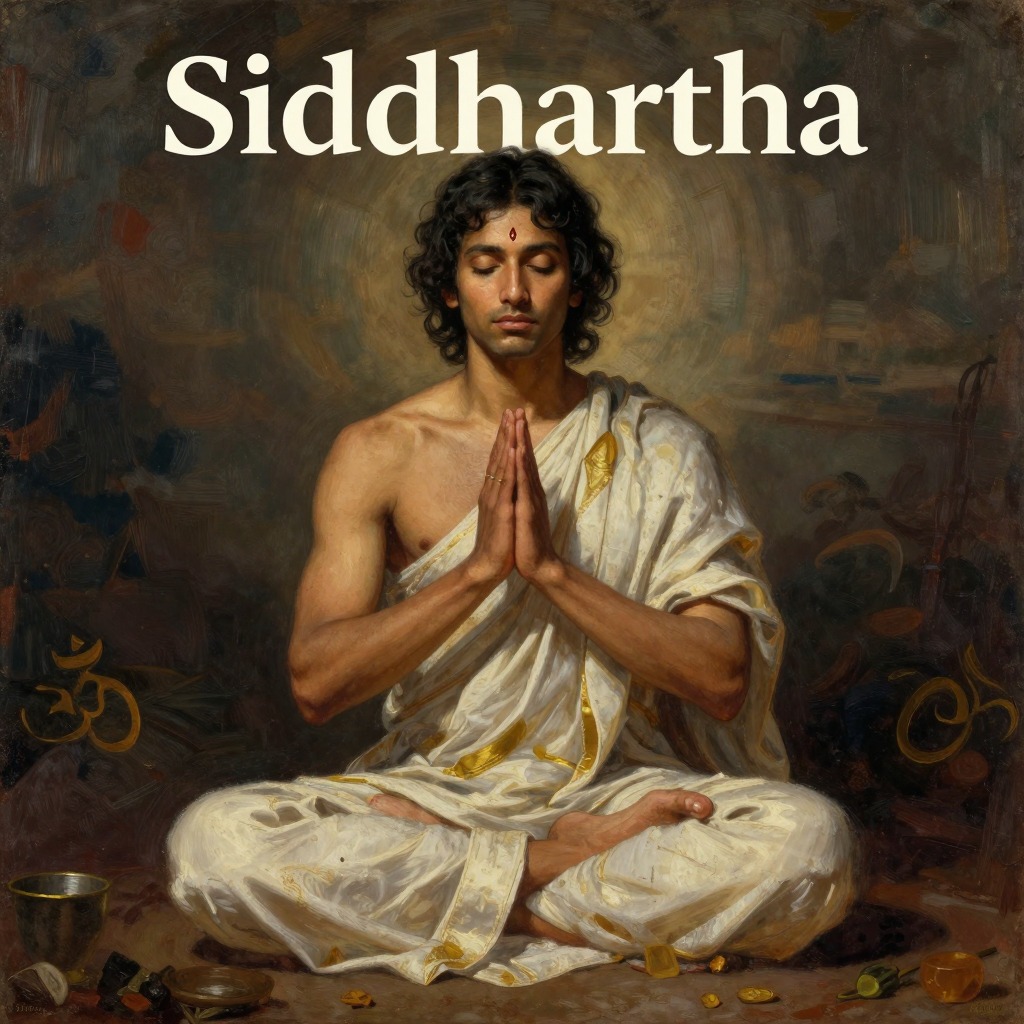
From his boyhood, Siddhartha learned to speak the Om silently, "the word of words," mastering its recitation with complete concentration of his soul. He would speak it silently into himself while inhaling and silently out of himself while exhaling, his forehead surrounded by the glow of clear-thinking spirit. Through this practice, he already knew how to feel Atman in the depths of his being, indestructible and one with the universe. The Om was the bow, the arrow was the soul, and the Brahman was the arrow's target—a formulation Siddhartha murmured while preparing for meditation under the Banyan tree with his friend Govinda. In these early years, the syllable was a technique, a precise instrument for focusing the mind and aiming the self toward the divine.
The Sound of Perfection in the Buddha
When Siddhartha first beheld Gotama the Buddha walking through the grove of Jetavana, he recognized the perfected one not by any outward distinction but by the perfection of his calm, the quietness of his appearance in which there was no searching, no desire, no imitation, no effort—only light and peace. The Buddha's face seemed to smile quietly and inwardly, and his walk, his quietly lowered glance, his quietly dangling hand, and even every finger of that hand expressed peace, perfection, and an untouchable calm. This visible embodiment of the Om—the state of completion and unity—struck Siddhartha more powerfully than any teaching. He realized that the Buddha's treasure and secret were not the doctrines he preached but the unexpressable and not teachable experience of enlightenment, the very thing that Om names.
The Turning Point of Despair and Rebirth
Years later, after Siddhartha had sunk into the depths of worldly life—gambling, lust, greed, and disgust—he stood by the river, ready to drown himself. In that moment of utter despair, a sound stirred from the remote areas of his soul: the word Om, which he spoke to himself with a slurred voice. The moment the sound touched his ear, his dormant spirit suddenly woke up and realized the foolishness of his actions. He became aware of himself in his misery and error, and again knew about Brahman, about the indestructibility of life, about all that is divine which he had forgotten. He collapsed by the foot of a coconut-tree, mumbling Om, and fell into a deep, dreamless sleep. When he woke, he felt as if ten years had passed, and his entire long sleep seemed to have been nothing but a long meditative recitation of Om, a submergence and complete entering into the nameless, the perfected. This sleep refreshed, renewed, and rejuvenated him like a new birth.
Learning from the River
Living with the ferryman Vasudeva, Siddhartha learned to listen to the river, which had many voices—the voice of a king, a warrior, a bull, a bird of the night, a woman giving birth, a sighing man, and a thousand others. Vasudeva taught him that when one succeeds in hearing all of these ten thousand voices at once, the river speaks a single word: Om. The river itself, which Siddhartha had intended to drown himself in, became his greatest teacher. He learned from it to listen with a quiet heart, a waiting and opened soul, without passion, without a wish, without judgment. The river taught him that there is no time, that everything is everywhere at once, and that the boy Siddhartha is separated from the man and the old man only by a shadow, not by anything real. This realization that everything has existence and is present—that nothing was and nothing will be, but everything is—was the wisdom of Om made manifest.
The Final Realization and the Smile of Oneness
In his final hours by the river, Siddhartha listened to the thousand voices of the water—the lamentation of yearning, the laughter of the knowledgeable one, the scream of rage, the moaning of the dying—and heard them all together as one. When he did not tie his soul to any particular voice but submerged his self into the whole, the great song of the thousand voices consisted of a single word: Om, the perfection. His wound blossomed, his suffering shone, his self flowed into the oneness. In this hour, he stopped fighting his fate and stopped suffering; on his face flourished the cheerfulness of a knowledge no longer opposed by any will, full of sympathy for the pain and pleasure of others, devoted to the flow, belonging to the oneness. When Govinda, his childhood friend, later kissed his forehead, he saw not Siddhartha's face but a flowing river of faces—fish, newborn children, murderers, gods, all transforming into one another, all covered by a thin, transparent mask that was smiling. That smile was precisely the same as the quiet, delicate, thousand-fold smile of Gotama the Buddha: the smile of the perfected ones, the smile of oneness above the flowing forms, the smile of simultaneousness above the thousand births and deaths. Even the stone Siddhartha picked up, he said, prays the Om in its own way, each thing being Brahman while simultaneously being just what it is. The Word of Words thus becomes not a sound to be uttered but the very structure of reality, the unity that underlies all diversity, the perfection that is already present in every moment.