Edwin Johns
2666Edwin Johns is a painter whose career is defined by a collision between artistic representation and bodily fact: he cuts off the right hand with which he paints, has it embalmed, and makes it the physical center of a celebrated self-portrait. His work emerges from a neglected London neighborhood and helps give it a new artistic reputation, but the success of the exhibition does not restore the painter himself. Johns later lives in a Swiss convalescent home, where his guarded encounter with Piero Morini becomes an elusive episode in the critics’ search for Benno von Archimboldi; years afterward, Johns dies in an accident while sketching a waterfall.
Identity and Background
Johns is introduced through a story Liz Norton tells Piero Morini over dessert. About thirty-three and known in the art scene without being famous, he moved into a poor London neighborhood because a studio there cost less than elsewhere. Its former factories and dry docks had not yet given way to boutiques and fashionable restaurants. The people who remained were mostly retired workmen; women were conspicuously absent, either dead or confined indoors, and the one pub was as dilapidated as the surrounding streets. Johns’s decision to live there begins as a practical calculation, but the landscape becomes central to how he sees and paints.
The neighborhood does not frighten him. He likes walking at night through streets where he sees no one, noticing the streetlamps, the light across house fronts, and the shadows that shift with his movement. He is drawn to the sooty dawns and to the taciturn men in the pub where he becomes a regular. In Norton’s account, the place’s history of pain seems to drain away into an unnamed void. Johns’s art develops from that unsettling movement: suffering does not resolve into consolation but appears to empty itself, an equation that seems to apply to everything around him.
The Neighborhood and the Exhibition
Johns works more eagerly after settling there. A year later, he exhibits at the Emma Waterson gallery, an alternative space in Wapping, and the show is an enormous success. His large canvases, each ten feet by seven, depict the remains of the neighborhood’s shipwreck in mingled grays. The paintings and their setting seem to enter into a reciprocal relation: the neighborhood appears to paint Johns as much as Johns paints it, both rendered in savage, gloomy strokes. The show becomes a founding gesture for what would later be called the new decadence or English animalism.
The central work is smaller than the monumental canvases around it, but it is the one that secures the show’s lasting impact. Seven feet by three and a half feet, it can be seen as an ellipsis of self-portraits or, from another angle, a spiral. Its center is not another painted likeness but Johns’s mummified right hand, suspended within the work. The viewing angle never settles into a single, certain interpretation. That instability makes the work’s central image more than a shocking exhibit: the missing hand, its preserved material remnant, and the repeated self-portraits keep representation circling the body that made it.
The hand entered the artwork through a deliberate act concealed as an accident. After two days of feverish work on the self-portraits, Johns cut off his painting hand. He immediately applied a tourniquet and took the hand to a taxidermist he knew, who had already been told what the assignment involved. Johns then went to hospital to have the bleeding stopped and his arm sutured. When doctors asked what had happened, he said he had accidentally struck his hand off with a machete while working. Asked where the hand was, he claimed to have thrown it in the river on the way to the hospital, out of rage and pain; the account hid the fact that the hand had already been prepared for preservation.
The exhibition sells out despite astronomical prices. An Arab working in the City is said to have bought the central masterpiece as well as four of the large paintings. Its reception gives Johns influence beyond the immediate success of the show: years later, it is remembered as the work that led many British artists toward new decadence. The bodily relic that makes the painting singular also turns it into a legend, circulating as both an artwork and a story about what its maker did to himself.
Breakdown and Life in Switzerland
Not long after the exhibition, Johns goes mad. By then he is married, and his wife has no choice but to send him to a convalescent home outside Lausanne or Montreux. Norton says that he still lives there when she tells Morini his story. The narrative offers no diagnosis or fuller account of his condition; instead, his withdrawal from public life stands in stark contrast to the exhibition’s celebrated influence. The artist whose work helped animate a changing neighborhood remains in an institution, while the neighborhood itself continues to change around his absence.
Other painters move into the area, at first because rents are low and also because they are drawn by the legend of the man who made the most radical self-portrait of his time. Architects follow, then families buying renovated houses, and finally boutiques, black-box theaters, and fashionable restaurants. The district becomes one of London’s trendiest neighborhoods, no longer as cheap as its reputation suggests. The transformation is not presented as Johns’s conscious aim, but his work and legend become part of the chain by which the place is remade. The old industrial neighborhood is first his subject and then the setting for an artistic and commercial revival that overtakes the conditions that brought him there.
Morini learns Johns’s name and asks Norton whether there was a catalog of the notorious exhibition. She finds a large volume that is more an art book than a catalog, attempting to cover the course of his career. Its first page shows Johns before the self-mutilation: about twenty-five, dark-haired and straight-haired, looking directly at the camera with a half-smile that could be shy or mocking. Norton gives the book to Morini as a gift. The photograph offers a brief counter-image to the hand at the center of the later work: a young artist before the act that will define his public identity, preserved now in a book that Morini chooses to open even while relaxed in Norton’s apartment.
The Visit and Morini’s Encounter
Years after hearing the story, Morini persuades Jean-Claude Pelletier and Manuel Espinoza to visit Johns at the Auguste Demarre Clinic, a discreet psychiatric asylum in Switzerland. The initiative is Morini’s: he has somehow learned that a painter he considers one of the most disturbing of the twentieth century lives there. In recounting the visit later, Espinoza first describes the trip by train toward a town between Montreux and the foothills of the Bernese Alps, then the hired car’s drive along a winding but carefully paved road. The three visitors encounter the clinic through its iron gate and railings, which seem at once to welcome them and block passage, and through the distant building’s fortress-like inertness. The approach makes the interview feel less like an ordinary visit than an entry into a secluded and difficult-to-cross world.
When Johns raises his right hand, he holds it only an inch or so from Morini’s expectant face. The gesture gives the hand a presence independent of the famous painting: it is a surviving part of Johns’s body, now placed between him and a visitor whose disability has become a focus of the encounter. Johns asks Morini whether he thinks he is like him. Morini answers that he is not an artist. The comparison remains unsettled; Johns’s question draws the two men together without making their circumstances equivalent, and Morini does not accept the identity Johns proposes.
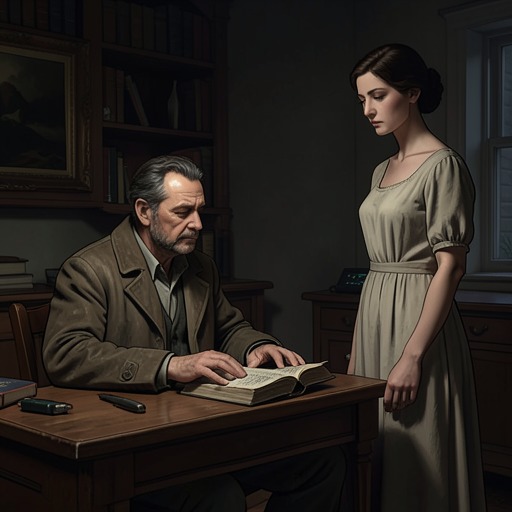
At dusk, the nurse begins to move as if to turn on the light, but Pelletier stops her with a finger to his lips. Johns’s body, previously stiff and martial, finally relaxes. He leans toward Morini and says something into his ear, promising to tell him why he cut off his hand. The content is not disclosed to the others or to the reader. Johns then shakes hands politely with Espinoza and Pelletier, but not with Morini, either at the beginning or at the end of the interview. Pelletier notices the omission; Morini says nothing. The scene closes not with an explanation but with this asymmetry: Johns has privately confided something to Morini while withholding the ordinary handshake that marks the other two visitors’ farewells.
Death and Narrative Significance
Johns’s eventual death is reported to Norton by Morini. It was an accident: Johns went for a walk because he wanted to sketch a small waterfall near the sanatorium. He climbed onto a rock, slipped, and was found at the bottom of a ravine 150 feet below. Norton initially cannot believe the news, but Morini confirms it. The account supplies no suggestion of suicide or deliberate return to the circumstances of his earlier self-mutilation. Rather, Johns dies during an ordinary act of drawing, the landscape that had long fed his art again the setting of a bodily fall.
Morini gives a further detail about the outing. Johns had a nurse and an orderly with him. He asked the nurse to sit on a stump and pretend to read a book while he drew with his left hand, which he had become quite proficient at using. His sketch included the waterfall, mountains, rock outcroppings, forest, and the nurse reading at a distance. Then Johns stood on the rock and slipped; the orderly tried to catch him but could not. The scene places deliberate composition beside sudden accident: Johns arranges the nurse in the landscape as a figure in his drawing, yet the fall interrupts the act of making an image and cannot be controlled or incorporated as a completed work.
Johns’s story repeatedly shifts attention between a representation and the material thing it cannot contain. A hand becomes both the instrument of painting and the preserved object at the center of a self-portrait; an alleged accident conceals a planned act; an unstable arrangement of painted selves is anchored by a bodily remnant. The later visit brings that remnant into proximity with Morini, but the promised explanation remains private and unrevealed. Even Johns’s final sketch is known through Morini’s report rather than through a surviving image. The narrative therefore makes Johns’s artistic legend vivid while keeping its crucial interior motive out of reach: the work and the gestures remain visible, but the reason he finally whispers to Morini does not.