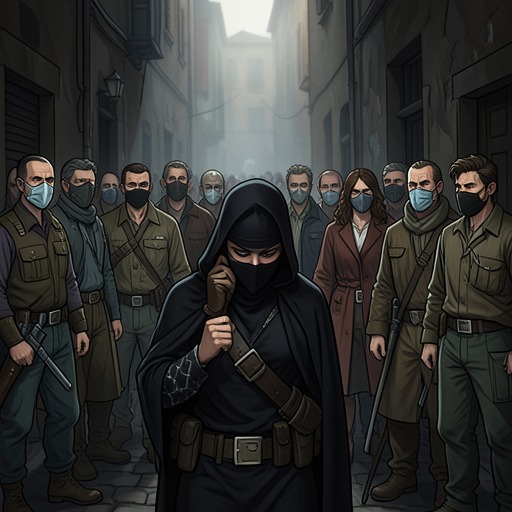
La Lo Kura
2666Lalo Cura, born Olegario Cura Exposito, is a young man whose passage from a small town into Santa Teresa’s private security and police worlds brings the novel’s violence into the routines of work, travel, and protection. His decisive test comes when armed men target Pedro Rengifo’s wife: Lalo intervenes while his fellow bodyguards run, is wounded, and is taken into police custody instead of directly to medical care. Reclaimed by Pedro Negrete, he chooses to become a policeman, entering an institution already marked by stalled investigations and the recurring discovery of murdered women.
Identity and Entry into Santa Teresa
Lalo comes from Villaviciosa, a town of low adobe houses, two bars, and a grocery store, where Pedro Negrete seeks a trustworthy young man for his old friend Pedro Rengifo. Negrete asks prospective recruits whether they can shoot, whether they can be relied upon, and whether they want to earn money. He selects the youngest boy. Lalo’s full name, Olegario Cura Exposito, strikes Negrete as unusual; on the journey through the desert, the boy sits in the back of the car while Negrete and Epifanio travel in front.
The journey gives Lalo little explanation of the world he is entering. When Epifanio stops after hitting an animal, the adults inspect it by flashlight and argue over whether it is a wolf or a coyote. The exchange is a small episode of classification and authority: Epifanio has killed the animal, while the police chief corrects him and supplies measurements. Lalo, still a passenger, watches from the car. His new position will soon demand that he act rather than observe.
He has been to Santa Teresa only once before, as a small child accompanying women who sold herbs at the market, and remembers little of that visit. On arriving this time, he sees highway ramps, dark streets, large houses behind high walls, and then the countryside. He sleeps in a bungalow beside the gardener’s house, on a cot without a pillow, with a rancid-smelling blanket; he moves a stack of newspapers and magazines from the cot to the floor. The two men who will work beside him arrive late, in suits and cowboy boots. Lalo privately judges them cowards rather than gunmen, an early sign that he is not simply accepting the hierarchy into which he has been placed.
Work as a Bodyguard
Rengifo’s security chief, Pat O’Bannion, formally introduces Lalo to the two other bodyguards and gives him a Desert Eagle .50 Magnum. Lalo says he does not know how to use it. O’Bannion loads a seven-round magazine, sets cans on the roof of a car, and has him practice shooting before explaining how to load the weapon, operate its safety, and carry it. Lalo’s assignment is to protect Mrs. Rengifo; his pay is issued every fifteen days by O’Bannion, who says no one has complained about being paid.
The security arrangement is explicitly ranked. Rengifo’s wife has three bodyguards, while the children have two others; both groups rank below the boss’s own men in pay, duties, and the expected willingness to risk their lives. Lalo therefore begins near the bottom of a structure that measures protection by status as well as responsibility. His judgment of his partners will soon be tested against their conduct in an actual attack.
One morning, after accompanying Mrs. Rengifo to appointments and errands, Lalo waits with the other guards outside a friend’s house on Calle Astronomos in Colonia Madero. When she comes out, one guard notices two men approaching behind a pair of maids. Lalo recognizes them as gunmen and understands that they intend to kill her. His two partners run. Lalo releases the safety on his pistol and stays beside the woman he is assigned to protect.
As the gunmen push the maids aside to clear their line of fire, Lalo pulls Mrs. Rengifo down and fires. He hits the gunman carrying an Uzi; when the second attacker shoots him in the shoulder, Lalo fires again and brings that man down as well. Wounded, he sees his former partners at a distance and shoots toward them, but they escape around a corner. His intervention saves Mrs. Rengifo from the immediate attack, while leaving him injured and exposed to the authorities’ response.
From Private Guard to Police Recruit
A patrol car arrives about twenty minutes later. Mrs. Rengifo has a cut on her forehead and directs the officers, first concerned for her friend and then insisting that Lalo also be taken to a clinic. But Lalo never reaches the clinic: officers seize him and drive him to Precinct #1. The dead attacker is recognized as a state judicial police inspector. In the basement, officers question Lalo about why he killed the two gunmen. The detail reveals how his successful defense has placed him in conflict with a police force whose personnel and interests cannot be treated as separate from the violence around them.
Pedro Negrete and Epifanio arrive at the precinct. Negrete’s appearance changes the room’s balance: the officers stand, and Epifanio attacks one of those questioning Lalo. The episode does not simply end with Lalo’s rescue; it shows that his fate is being handled through personal power and intimidation as much as official procedure. His employment under Rengifo has brought him into a crisis in which the distinction between protecting someone, using force, and answering to the police is unstable.
A month later, Negrete visits Rengifo’s ranch and demands that Lalo be returned. He objects that the boy was not placed with an experienced guard such as O’Bannion and instead was assigned to men he considers unfit. Rengifo concedes the point and releases Lalo. He says the boy’s shoulder has recovered and describes his ranch work as easy: Lalo sleeps and reads magazines. Negrete, however, warns that Lalo may be killed if matters continue as they are. The concern turns his return into more than a change of employer; Negrete is taking him out of a position he considers dangerous.
On the drive back toward Santa Teresa, Negrete asks whether Lalo would like to join the police. Lalo nods. As they pass a huge black stone, Negrete says it may be a meteorite, then questions the possibility because no crater is visible. Lalo looks back and thinks he sees a Gila monster on the stone, but when he looks again it has vanished. The scene ends his transition from Rengifo’s security detail with an image that remains uncertain, while his decision to enter police work is clear.
The City’s Violence and Its Ordinary Routes
Lalo’s story sits within a wider account of women killed in and around Santa Teresa. At the outset of the critics’ visit, a boy tells Jean-Claude Pelletier and Manuel Espinoza that more than two hundred women have died, perhaps as many as 250 or 300, since 1993 or 1994; he says that no one will ever know the total. Chucho Flores later describes the public cycle around the killings: whenever the numbers rise, the story returns to the news, grows in public conversation, and then fades as people go back to work. He compares the killings to a brutal strike, a metaphor that links violence to the labor that continues around it.
The individual cases make that relation concrete without producing an answer about who is responsible. Margarita Lopez Santos, a dependable sixteen-year-old worker at K&T, disappears after finishing the third shift at five in the morning. Her route home runs from the maquiladora in El Progreso industrial park across the Nogales highway and through Colonia Guadalupe Victoria toward Colonia San Bartolome. Much of the area has inadequate street lighting; many northern homes lack electricity, and roads near the industrial park lack paving and drainage. More than forty days after her mother reports her missing, children find Margarita’s body near a shack in Colonia Maytorena. The circumstances of her commute and the failing infrastructure are recorded, but they do not establish what happened along the way.
Other accounts show the same gap between a person’s ordinary plans and the disappearance that follows. Lucy Anne Sander crosses into Santa Teresa with her friend Erica Delmore for a night out. After leaving a club, they drive around the historic center; Lucy Anne gets out near the plaza and runs across grass that has just been watered. Erica searches the plaza, calls out with young men who help her, waits in the locked car, and reports Lucy Anne missing at dawn. Rosario Marquina, a nineteen-year-old who works at the same maquiladora as her parents, disappears after going dancing and is found days later in the factory’s back lot. These women’s separate routes and circumstances resist any easy account that would make disappearance a single kind of event.
In January 1996, Klaus Haas calls attention to a more direct challenge to the claim that the killings have been solved: murders continue even though he is imprisoned as the killer. He points to identical knots in the ropes used on Michelle Requejo and Estrella Ruiz Sandoval, and says that Estrella was the only victim with direct contact with him. At the same time, women activists in Santa Teresa publicly criticize the treatment of victims’ families and send letters to state and federal officials that receive no reply. These developments sharpen the institutional background against which Lalo enters police work: the city’s violence persists, its public attention fluctuates, and the institutions charged with addressing it do not provide a settled explanation.
Narrative Role
Lalo’s movement from recruit to would-be policeman is a compact passage through the competing systems of authority in Santa Teresa. Negrete selects him in Villaviciosa; Rengifo’s household trains and deploys him; a police precinct briefly treats him as a suspect after he has defended his employer’s wife; and Negrete eventually brings him back and asks him to join the force. His decisions are visible in gestures rather than speeches: he judges his fellow guards, stays when they flee, and nods when offered police work.
The surrounding cases complicate the apparent clarity of that progression. Lalo can recognize an immediate threat and act, but the novel places that personal decisiveness beside a much larger crisis that cannot be resolved by one act of courage. Women disappear on the way home from night shifts, while going out, or after ordinary work and recreation; reports, investigations, and public attention recur without yielding comprehensive knowledge. Lalo’s new career therefore begins not as a solution to Santa Teresa’s violence, but inside the city where that violence remains visible in fragments and persistently unexplained.