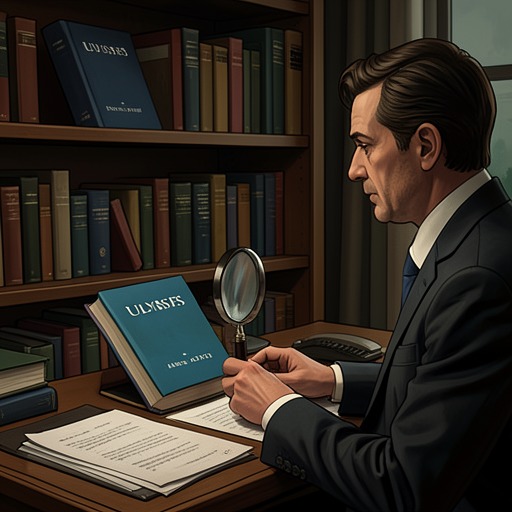
the Swabian cultural promoter
2666The Swabian cultural promoter is a former arts journalist turned organizer in a forgotten Frisian town, and the witness whose account first gives the critics a vivid, physical glimpse of Benno von Archimboldi. His story has the texture of a local literary evening—an inexpensive room, a reading at city hall, sausages and potatoes, rain against the windows—but it ends with Archimboldi’s unexplained disappearance. When the Swabian later retells the encounter in print, and the critics dispute what his retelling means, he becomes more than a source of information: his partial, shifting testimony mirrors the novel’s larger problem of how to recognize a vanished writer.
Identity and Background
Before appearing as a witness to Archimboldi’s past, the Swabian is introduced as an obscure German writer among the participants at a literary gathering in Amsterdam. The organizers had spent most of their funds on luxurious accommodation for English literary stars; with what remained, they brought in several French and Italian writers and three German ones. The first two German guests were vaguely renowned novelists from the recently reunified East and West Berlin. The third, the Swabian, was so little known that even Piero Morini, despite his expertise in contemporary German literature, knew nothing about him.
In conversation, the Swabian recalls earlier work as a journalist, an editor of arts pages, and an interviewer of writers and artists who were wary of interviews. He then describes serving as a cultural promoter in distant or forgotten towns that nevertheless had an interest in culture. That past gives him a practical, provincial vantage point: he knows the modest arrangements behind literary appearances, rather than approaching them from the perspective of a celebrated author or metropolitan institution. The Amsterdam group, interested in Archimboldi, listens to him as an unexpected conduit to the writer’s early career.
The Frisian Reading
The Swabian met Archimboldi while promoting culture in a small Frisian town north of Wilhelmshaven. The place faced the North Sea and the East Frisian islands, and its winter was defined by penetrating cold and salt-heavy damp. The Swabian describes two ways of enduring that season: drinking, or listening to music—often amateur string quartets—in the town hall auditorium. Writers from elsewhere were another occasional attraction. They received a room at the town’s only boardinghouse and a few marks for the train journey home; after expenses, they might earn a little more by selling books following a reading.
Archimboldi arrived when the war had only recently ended, amid continuing social and economic damage. At twenty-nine or thirty, he was a young writer of whom the Swabian had not previously heard. The Swabian went to meet him at the railway station and escorted him to the boardinghouse, talking with him about the bad weather. He then brought him to city hall, where Archimboldi read two chapters from a novel still in progress. He did not set up a table to sell books.
The Swabian recalled that Archimboldi’s first novel had appeared in Hamburg that year, although Archimboldi did not read from it. To establish that the book existed, he carried a copy in his jacket pocket. The Swabian could not settle on its length—perhaps one hundred pages, perhaps 120 or 125—and remembered the book’s cover less clearly than the garment holding it. Once a deep ivory, pale wheat, or gold, the cover had become dull and nearly colorless, with only the title, author’s name, and publisher’s colophon remaining distinct.
The jacket, by contrast, stayed vivid in his memory: black leather, loose enough to fit over heavy sweaters, with a high collar, horizontal pockets, and four buttons sewn on with something like fishing line. Its shape reminded him of jackets worn by Gestapo officers, although black leather jackets were fashionable at the time and people wore them without necessarily considering what they evoked. The detail links the young writer to the material atmosphere of postwar Germany, where a garment could carry a troubling historical resemblance without resolving anything about the person wearing it.
After the reading, the Swabian had dinner with Archimboldi, a teacher, and a widow who preferred music or painting but was willing to take part in a literary evening. The meal was limited by the town’s times and budget: sausages, potatoes, and beer. The widow steered the conversation. A few minutes afterward, the Swabian walked Archimboldi back to the boardinghouse. The next morning, he returned to take him to the station, but Archimboldi had already gone.
The Account and Its Uncertainties
When the Swabian tells this story in Amsterdam, the four critics respond with unusual intensity. Manuel Espinoza wants him to himself; Jean-Claude Pelletier warns against overwhelming him; Morini counsels care; and Liz Norton says they should be very nice to him. They treat the account as precious testimony, recording his words as if they had found a guide to Archimboldi. The Swabian notices their attention, and it deepens his shyness and reserve. Their eagerness produces no further revelation: he has already said what he has to say.
Pelletier later finds an article by the Swabian in the Reutlingen Morning News. It repeats the account of Archimboldi’s visit and the dinner, but changes the evidentiary character of the episode by including an exchange between Archimboldi and the widow. She asks where he comes from; he says he is Prussian. Asked whether his is a noble name, he allows that it probably is. She tests the sound of “Benno von Archimboldi,” then offers other names, none of which he recognizes. He says that all he knew of Prussia were its forests. The widow points out that his name is Italian in origin.
The printed exchange does not settle the past. Instead, it gives the dinner a sharper, sardonic shape while raising questions about the relation between memory and performance: the newspaper account differs from what the Swabian had said in Amsterdam, and the critics do not know whether the difference reflects invention, selective recollection, or a change in the teller’s manner. The widow’s presence also becomes a focus for speculation. Espinoza and Pelletier think the Swabian may have been her lover, despite the disparity in their ages. Norton suspects that he tells different versions according to his mood and audience, perhaps no longer remembering exactly what was said or what happened.
Morini offers another interpretation, imagining the Swabian as Archimboldi’s grotesque double: a negative image that grows more imposing while remaining bound to the original. In his account of the resemblance, both men were young in the years of terror and barbarism under Hitler, both were World War II veterans and writers, and both were poor and adrift in a bankrupt nation when they met. The contrast is also social and professional: Archimboldi was a struggling writer, while the Swabian was a cultural promoter in a town where culture could hardly be treated as a serious concern. Norton rejects the possibility that the Swabian is literally Archimboldi, noting that the Swabian is short and delicate, unlike Archimboldi’s described physical appearance. No theory can make the witness’s story fully transparent.
The Window and Narrative Significance
The critics’ speculation turns the remembered Frisian setting into a scene of suspended recognition. The Swabian is imagined visiting the widow’s house, eating charcuterie and biscuits, drinking tea, and massaging the former cavalry captain’s widow’s back as rain lashes the windows. The account describes him as pale in the weather, approaching a window to look beyond curtains of driving rain, then turning his back when the widow calls him. He does not know why he went to the window or what he hoped to see.
At that instant, the narrative says, something appears: the Swabian has turned away from the window, and only a small colored-glass lamp flickers at the back of the room. The apparition is not explained. It interrupts the critics’ attempt to reduce the Swabian to a convenient biographical role—lover, impostor, or double—and leaves the episode poised between remembered anecdote and unresolved vision. The man who can supply a concrete location, a jacket, a book, a meal, and a departure cannot supply a stable meaning for what happened.
That limit is central to the Swabian’s function in the search for Archimboldi. His account brings the absent writer close through ordinary details, but its later variations and the critics’ incompatible readings prevent those details from becoming a definitive portrait. Archimboldi is present as a young man who reads two unfinished chapters and leaves before morning; the Swabian remains the reserved witness whose testimony illuminates the disappearance without solving it.