Lola
2666Lola’s departure from Oscar Amalfitano and their daughter Rosa begins with a declared plan to visit a poet confined in the Mondragón asylum, but it becomes a long, unsettled passage through Spain and France. Her letters make that journey a story of shifting loyalties and competing versions of reality: she pursues the poet as a beloved prisoner in need of escape, while her practical companion Inmaculada helps her travel and Amalfitano remains at home trying to understand what she has left behind.
Identity and Departure
Lola is Amalfitano’s wife and Rosa’s mother. In Amalfitano’s memories, she is also the member of the family who carries a weapon: before Rosa’s birth, Lola explained a switchblade to an airport officer as a fruit-peeling knife. She left two years after Rosa was born, still carrying it. The recollection places a concrete emblem of self-reliance beside the much less practical story she gave as her reason for going: a journey to visit the poet she admired, who was then living in the asylum near San Sebastián.
On the night before she left, Lola packed while Amalfitano listened to her explanations. She promised to come back soon and asked him to care for Rosa. She also told him she had once met and made love to the poet at a Barcelona party, before Amalfitano entered her life. Amalfitano knew this account was untrue: he believed Lola had first learned of the poet from a book he had given her, and the poet was gay. Lola’s account nevertheless became part of the imaginative world driving her departure. She had bought the poet’s other books and gathered friends who regarded him as a genius or divine messenger, including people recently released from psychiatric care or rehabilitation. Amalfitano expected she would eventually go to San Sebastián; rather than argue, he offered her part of his savings and promised to look after Rosa.
At dawn, Lola’s friend Inmaculada arrived with a small knapsack. Inmaculada—whom Lola called Imma—insisted that they leave before Barcelona became difficult to get out of. Lola and Imma exchanged an intense, largely silent look across the kitchen table. Amalfitano, who had expected to feel more disturbed, watched them go after Lola kissed him on both cheeks. Her departure thus begins not as a clean break but as a scene of unresolved intimacy: a promise to return, a child left in her father’s care, and a companion already setting the pace of the journey.
Letters and the Journey with Imma
A week later, a letter postmarked Pamplona gave Amalfitano an account of the journey so far. Lola and Imma had worked for two days at a roadside restaurant in Lérida, whose owner also had an apple orchard. When the owner asked them to stay for the approaching harvest, Imma spoke with him while Lola read one of the poet’s books beside their Canadian tent, pitched under the orchard’s only poplar. Imma did not explain the offer; the next day, the two women left for the highway and hitchhiked on without saying goodbye.
In Zaragoza, they stayed with one of Imma’s old university friends. Lola, exhausted, went to bed early and heard the others talking late into the night about their past, resistance to Franco, a women’s prison in Zaragoza, and striking images of underground struggle. The letter then turns from travel report to a personal declaration. Lola insists that she is not a lesbian, while acknowledging that Imma is; she describes her own understanding of sexuality in terms that Amalfitano cannot make sense of. The letter’s abrupt shifts disclose how little control he has over either her itinerary or her account of it: he reads with the letter in his hands while rocking Rosa’s seat with his foot, caught between the daughter present at home and the wife writing from elsewhere.
Lola’s pursuit of the poet takes her and Imma repeatedly to the asylum. On an early visit they are refused entry, so they study the grounds from outside: roads, gray walls, the inmates’ walks, and the surrounding trees and brush. On their third attempt, they secure an appointment by presenting Imma as a newspaper reporter and Lola as a poet. A doctor or priest leads them through blue-and-white corridors to a plain room, where Lola finally speaks to the man she has been seeking. She tells him she has missed him, recounts her attempts to keep watch over the philosopher’s Barcelona apartment, and describes the highways and towns she and Imma have crossed. The poet asks Imma for a cigarette; she gives it to him and begins reading while Lola talks.
Lola eventually states the real purpose of her visit: she believes the poet is a prisoner who wants to escape, and proposes that the three of them go to France. Her plan is specific. They will cross the mountains, travel to Saint-Jean-de-Luz, take a train to Paris, and find work cleaning or caring for children. The poet will write; Lola expects to become pregnant, and imagines returning to Spain months later. Imma, she says, devised the plan. The rescue plot therefore belongs to Lola’s conviction and Imma’s practical planning, though the poet’s response remains uncertain. He asks about Imma, who continues reading, and does not simply confirm the future Lola has designed for them.
The next day and on the days that followed, the asylum staff told the women that the poet was on bedrest. When their money ran out, Imma decided to go south to Madrid to ask her brother for a loan. Lola stayed behind in San Sebastián, visiting the asylum alone and writing long letters to Amalfitano. She clung to the fence as if trying to establish telepathic contact with the poet, and sometimes read or gathered flowers and grasses near the grounds. The hoped-for escape had not occurred; the pursuit instead became a routine of waiting, watching, and writing.
Waiting, Disappearance, and Paris
Lola’s letters also record the relations she forms while waiting. She accepts a ride with Larrazabal, a driver who takes her to the Mondragón cemetery, where they have sex and talk afterward. She refuses the money he offers at first, tells him about her fixation on the poet, and listens as he admits that he does not understand it. Later, in a letter bearing French stamps, she describes Larrazabal as kind: he offers her a place to stay, drives her to the asylum, helps with expenses, and takes her to the cinema. He proposes marriage, although Lola reminds him that she is already married. His care changes the conditions of her waiting, but not its direction. She visits the asylum less often and seeks signs without expecting to understand them, while at other times she disappears without warning and Larrazabal searches for her around San Sebastián.
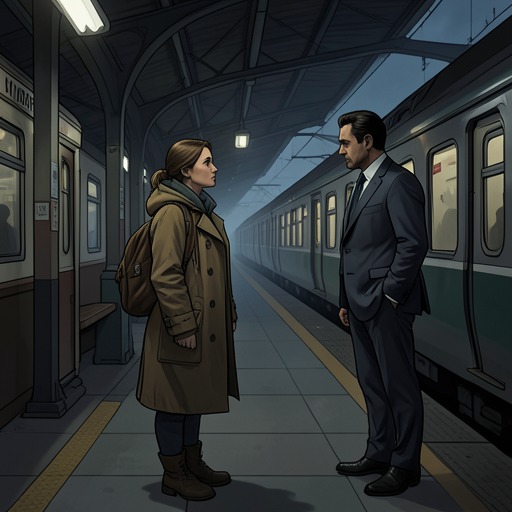
The correspondence then stops. Amalfitano has no news of Lola for five years. In a Paris letter, she says she is cleaning large office buildings on a night shift that starts at ten and ends sometime between four and six in the morning. She takes the metro home and describes the city at that hour as profoundly sad. She has had another child, a son named Benoit, and says that she has been in the hospital without explaining why or whether she is still ill. She does not mention a man, ask about Rosa, or say what has become of her plan for the poet.
The letter is typed, and Amalfitano imagines Lola writing it in one of the offices she cleans, among desks and cleaning equipment, with the lights of Paris beyond a window. His imagined scene makes the distance between her reported life and the life he pictures visible without resolving it. He wonders whether she is telling the truth about her work, then settles on a vivid conception of her as a cleaner writing during the night. Her silence about Rosa does not prove that she has forgotten her daughter, but it makes the distance between them unmistakable.
Return, Reunion, and Departure Again
Seven years after leaving, two years after the Paris letter, Lola returns to look for Amalfitano and Rosa. She searches at old addresses, encounters people who no longer recognize or trust her, and sleeps in a boardinghouse near Las Ramblas among foreign workers. She is preoccupied with reaching her family, though her wandering through changed Barcelona is also filtered through mythic identifications: at moments she imagines herself as Electra, and at others as a mother watching children from a window. These self-images do not make the search less concrete; they show the stories through which Lola tries to inhabit it.
An ex-student of Amalfitano recognizes her and offers her a room. Their encounter is intimate but not straightforward: when he embraces her, she lets him do so briefly, says something in his ear, and he withdraws to sit on the floor while she remains in her chair. For several hours they occupy opposite corners of the living room. They later resume their efforts to find her family. When Lola finally sees Amalfitano, she approaches him at once, although she does not recognize him at first. He is heavier and has lost some of his hair; he recognizes her immediately. Their exchange is brief—she observes that he has changed, he replies that she has not—and then they leave together.
By this time Amalfitano is living in Sant Cugat and teaching philosophy at the Autonomous University of Barcelona; Rosa attends a local public elementary school. Lola tells Rosa that she is her mother. Rosa screams, embraces her, and almost immediately runs to hide in her room. The reunion is therefore both recognition and retreat, not an instant restoration of their former relationship. That night Lola tells Amalfitano that she is very sick and probably dying, and that she came to see Rosa once more. She refuses his offer to take her to the hospital, saying she trusts French doctors more, and shows him papers in French stating that she has AIDS.
The next day, Lola and Rosa walk together near the station holding hands. Amalfitano follows at a distance rather than interrupting them. During Lola’s five days with the family, he asks about Benoit. Lola remembers her son as intelligent and sensitive, and says he had realized she was going to die simply by looking at her. She argues that children should not be lied to about such things. Her attention is divided between the daughter she has returned to see and the young son she left in Paris; when her French medicine is nearly gone, she says she must go back to Benoit. She acknowledges that she does not know who needs whom, but insists that she must see how he is.
Amalfitano leaves her an envelope containing much of his savings. Although he expects her to have gone when he returns from work, Lola remains in the living room, reading a book about Greece while the television plays without sound. After the family has eaten and Rosa is asleep, Amalfitano asks Lola to stay the night because it is late. Her return has not ended in a permanent reunion: the five days bring mother and daughter back into one another’s lives, but Lola’s illness and responsibility to Benoit pull her away again.
Narrative Role and Significance
Lola’s story is carried in large part through what Amalfitano remembers and what Lola writes to him from the road. The letters supply vivid, sometimes contradictory accounts of her motives and experiences, while Amalfitano’s responses expose the limits of what he can know. He recognizes that her story of a past romance with the poet is false, yet cannot dismiss the force of her pursuit; later, he imagines the setting in which she typed her Paris letter, but cannot confirm every detail of the life behind it. This structure preserves Lola’s distance rather than turning her into a fully explained object of her husband’s understanding.
Her journey repeatedly contrasts a romantic design with practical circumstances. She imagines liberating the poet and building a life with him in Paris, complete with work, poetry, and a child, but the visits yield restrictions, waiting, and the poet’s uncertain response. Imma’s planning, Larrazabal’s assistance, and Amalfitano’s savings help meet immediate needs without dissolving Lola’s attachment to her imagined destination. The difference between the escape she proposes and the intermittent, precarious life she lives is central to her trajectory.
Lola’s return makes the consequences of her departure personal rather than abstract. Rosa is old enough to recognize her mother and to run from the intensity of their reunion; Benoit’s existence reveals that Lola has built another family during the years of silence. Her illness brings her back to Rosa, but does not erase her bond to the son she leaves in Paris. She enters and exits the family again, leaving Amalfitano and the children connected to one another through a series of absences, letters, and brief encounters rather than a settled homecoming.