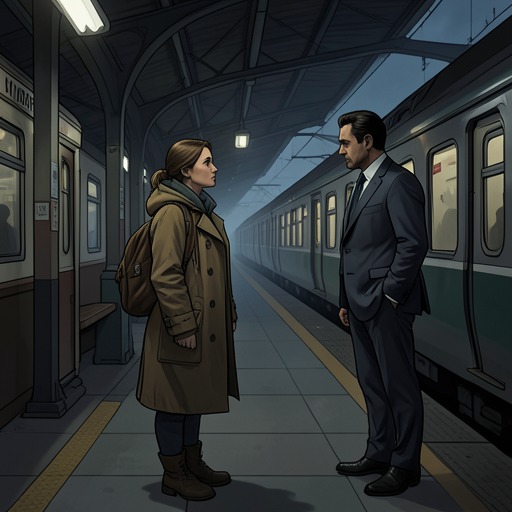
Oscar Amalfitano
2666Oscar Amalfitano is a Chilean professor whose life in Santa Teresa brings literary expertise into contact with exile, paternal anxiety, and a reality that grows difficult to interpret. His connection to Benno von Archimboldi draws European critics to him, but the book’s account of Amalfitano also turns on the strains of his ordinary life: an uncertain home in a border city, a daughter exposed to danger, a strange book on a clothesline, and a voice that unsettles his sense of what can be trusted.
Identity and Background
Amalfitano lives in a small, single-story house in Santa Teresa with his daughter, Rosa. The house has three bedrooms, a combined kitchen, living room, and dining room, and a porch with a weather-worn wooden bench. Its yard is large enough for grass and flowers, though he does not know what would grow there. He has old books he has kept for decades, more recent books he is willing to lend, and others sent in parcels with unfamiliar return addresses that he no longer opens. His monthly salary and the unfinished work of the house give his life a modest, material frame, but his private question about why he is in Santa Teresa has no comparably practical answer.
His expertise in Archimboldi’s work is real, though less devotional than that of the critics who seek him out. Amalfitano learned German at a German school in Chile, which he attended as a child before transferring to a public high school at fifteen. Around the age of twenty, he read three Archimboldi novels in German—The Endless Rose, The Leather Mask, and Rivers of Europe—from a public library in Santiago. Its German-language collection had been donated by a deceased German resident to the municipality of Nunoa; it also held Bifurcaria Bifurcata, which Amalfitano began but did not finish.
In 1974, an Argentinian publisher arranged for Amalfitano to translate The Endless Rose. He had been translating whatever work he could find and supporting himself as a proofreader. He later suspected that the edition might have been unauthorized, although he could not establish that this was so. He admires Archimboldi without sharing the critics’ almost worshipful intensity, and considers Günter Grass and Arno Schmidt comparably accomplished. His knowledge thus makes him a useful intermediary, but it does not make him a disciple.
The Critics and the Search
When Jean-Claude Pelletier, Manuel Espinoza, and Liz Norton meet Amalfitano in Santa Teresa, the dean’s note introducing him as an Archimboldi expert changes their opinion of him. They ask how he learned German, when he encountered the writer, which books he read, and what he thinks of them. His answers establish both the basis and the limits of his expertise: it comes from school, a narrow library collection, and a translation job rather than from an academic cult around Archimboldi.
The encounter takes place against the critics’ own sense of estrangement. A note from Augusto Guerra, dean of the Faculty of Arts and Letters, calls the three visitors his “colleagues” and promises that Amalfitano will help them. The word makes them laugh and then leaves them sad: it seems to build a firm bridge between Europe and their temporary lodging in Santa Teresa, though they remain uncertain how to inhabit the city around them. The note’s image of the desert as a petrified garden offers a polished description of a place they experience as difficult to enter. Amalfitano’s arrival gives their search a local guide, but not a solution.
The following morning, he meets the critics in their hotel lobby and joins them for breakfast and a discussion of how to proceed. Archimboldi has not visited the university’s Faculty of Arts and Letters; there is no German consulate in Santa Teresa to consult. Asked how many hotels the city contains, Amalfitano admits he does not know, but suggests asking the reception desk for a list of hotels and motels. His usefulness is practical rather than omniscient: he helps turn an elusive literary search into a series of ordinary inquiries, even as the writer they seek remains absent.
Exile, Family, and Uncertainty
After a week in the city, Amalfitano asks himself why he is in Santa Teresa and answers that he genuinely does not know. The passage gives the uncertainty a physical setting: a west-facing house, a wind-worn bench, books in different states of attachment, a yard whose planting he has postponed, and a gate in need of paint. These details do not resolve his question; they show a life assembled from possessions and routines without a settled account of what brought it there or what should come next.
Lola’s letter to him, sent from Pamplona, brings the absent family past into that unsettled present. She describes traveling with Imma, working briefly at a roadside restaurant in Lerida, sleeping in a Canadian tent beside an old garage, and leaving the job without saying goodbye. The letter then turns to Lola’s past with the poet, who had lived in Barcelona before his institutionalization, and to her account of her own sexuality and relationship with Imma. Its abrupt, emphatic shifts resist a tidy explanation. Amalfitano reads it while holding the letter like a fragile raft and rocking Rosa’s seat with his foot. He is a father listening to a daughter who is far away, unable to make her account less turbulent simply by receiving it.
Lola’s journey also supplies a stark image of precarity. When Imma has still not returned after a week, Lola imagines her friend moving through a valley, exposed yet seemingly protected by her hesitation. Lola herself is soon turned out of her boardinghouse and sleeps at a railway station, in an abandoned warehouse, or outdoors near the boundary between the asylum and the world beyond it. Amalfitano’s thought that madness is contagious follows this account, linking the daughter’s flight and the poet’s confinement to his own growing unease without claiming that they are the same experience.
The Geometry Book and the Voice
One afternoon, while opening boxes of books with a kitchen knife, Amalfitano finds a copy of Rafael Dieste’s Testamento geometrico that he cannot remember buying or receiving. Published in 1975 by Ediciones del Castro, the book is divided into three parts: an introduction to Euclid, Lobachevsky, and Riemann; a section on the geometry of motion; and three proofs of the V Postulate. The subject means little to Amalfitano, and he has no immediate intention of investigating the unfamiliar postulate. The book’s front flap presents its three parts as independent yet connected by an overarching inquiry into space, while the dedication page’s capitalized names of Dieste’s supporters strike him as oddly more prominent than the honored poet’s own name.
When Rosa leaves to go to the movies with a friend, Amalfitano walks out into the yard still holding the book. He looks for his daughter and for the car but sees neither. The moon appears oversized in the daytime sky; though sunlight remains, he cannot find his shadow. His attention settles on the clothesline, its cords stretched between a small goal-like frame and hooks on the side of the house, with Rosa’s embroidered shirt, underwear, and wet towels already hanging there. He takes three clothespins from a supermarket bag, calls them by the Chilean word perritos, clamps the geometry book, and hangs it from a cord. The act calms him. It recalls Marcel Duchamp’s Unhappy Readymade, in which a geometry book was hung outdoors so that wind could act upon it; for Amalfitano, the gesture imports an artistic precedent into an anxious domestic scene without making the book’s meaning any more secure.
The book remains visible in the backyard when Amalfitano first hears a voice that he is certain is addressing him. He checks Rosa’s room and window, then goes outside to inspect the yard, porch, and street. No one is there. The geometry book hangs beside laundry, and the only figure he sees is a stray dog moving toward a bus stop. After returning inside, he locks the doors and windows, takes a sturdy kitchen knife from a drawer, and sets it beside a history of German and French philosophy. His actions register fear and caution; they do not establish the source of the voice.
In a later exchange, the voice proposes a grandfatherly identity and asks Amalfitano whether he is homosexual. Amalfitano refuses to flee or wake Rosa and tries to establish what kind of encounter this is. The voice insists that calm is essential and argues that nearly everything else—ethics, duty, honesty, curiosity, love, bravery, and art—can fail him. Amalfitano objects that bravery and love for one’s children do not fail. The disagreement makes his attachment to Rosa a measure by which he tests the voice’s bleak generalizations. He asks whether calm is the opposite of madness, but the voice denies that he has lost his mind and describes their exchange as a casual conversation. Its confident reassurance cannot verify its own claims; the episode leaves Amalfitano between a possible mental crisis and an apparently ordinary conversation with an impossible speaker.
The next day, Amalfitano is surprised to find himself excited by the experience. Eating boiled chicken and salad at a distant table in the university cafeteria, he tries to reflect amid students’ laughter, shouts, and the clatter of plates. The thought that he might be losing his mind does not immediately extinguish his happiness. He considers a worse future in which he is confined in an asylum in Santa Teresa or Hermosillo and Rosa must return to Barcelona, then imagines that she might nevertheless make a life there. His speculative planning reveals the practical fear beneath the exhilaration: even in the midst of uncertainty, he is calculating how to provide for his daughter if he can no longer care for her.
Protecting Rosa
Amalfitano’s anxiety becomes more pointed when Rosa begins seeing Chucho Flores. After one evening with her boyfriend, she comes home and sees her father talking to the geometry book hanging in the backyard. She withdraws to her room to read and consider the relationship. Her observation joins the book’s strange presence to the household’s growing division: Amalfitano’s preoccupation is not just an inward disturbance but something his daughter can witness, even when he does not notice her.
Amalfitano has already met Chucho Flores. During that meeting, he asks him what he thinks of hexagons, whether he knows how to construct one, and what he thinks of the killings of women in Santa Teresa. Chucho says he has no opinion about hexagons, admits he cannot construct one, and calls the killings regrettable while claiming that the police are catching the killers one by one. Amalfitano asks nothing further. After Chucho leaves, he tells Rosa to be careful because he has a bad feeling about the man, but offers no explanation. Rosa jokes that this means she should break up with him; her father tells her to do so. The encounter makes his protectiveness legible through the questions he chooses, though it provides no explicit account of what has produced his suspicion.
When the subject returns, Amalfitano separates his and Rosa’s possible responses: she should leave Chucho, while he might seek electroshock treatment at the Clinico when they return to Europe. The line sets a potential intervention for himself beside a direct warning for his daughter, without showing either outcome. His worry about his mental state and his concern about Rosa are intertwined, but he does not treat them as interchangeable problems.
On a later afternoon, Amalfitano happens to be home after pleading illness rather than teaching. Chucho brings Rosa back with Charly Cruz and Rosa Mendez. Amalfitano becomes unexpectedly sociable with Charly, whose conversation with him later acquires sharper outlines in Rosa’s memory. He asks about apparent movement, and Charly correctly describes the illusion produced by images persisting on the retina. Amalfitano supplies the name of the Frenchman who discovered the phenomenon, Professor Plateau, then describes a spinning disk with a laughing drunk on one side and prison bars on the other. The image seems to show the drunk behind bars, though each picture occupies a separate face of the disk. Amalfitano draws out the ambiguity: the drunk may laugh because he imagines himself free, or because observers mistake the image for confinement. The demonstration becomes a way of thinking about perception and credulity, rather than a simple classroom lesson.
That concern with how appearances can deceive sits beside the family’s immediate danger. Rosa later encounters Chucho after accepting a classmate’s offer to go to an air-conditioned coffee shop. When the classmate leaves, she sits alone with a book on twentieth-century Mexican painting. Chucho arrives, calls her a whore, and demands that she leave with him; she refuses and asks where he intends to take her. The account establishes the confrontation without resolving it in this scene. In the context of Amalfitano’s earlier warning and his questions about the killings, the episode sharpens the stakes of his efforts to protect Rosa while leaving the limits of his knowledge and power exposed.
Narrative Role and Significance
Amalfitano connects the critics’ pursuit of an absent European writer to the book’s increasingly immediate concern with Santa Teresa and its residents. He can explain how he came to read Archimboldi and help the visitors plan their search, but neither literary knowledge nor university affiliation gives him mastery over the city. The hotel note’s image of a petrified garden, his own uncertain purpose, and the search’s mundane leads all mark the gap between naming a place and being able to understand it.
His domestic scenes develop a related tension between interpretation and what resists it. The geometry book appears to invite an intellectual solution, yet Amalfitano cannot remember how it entered his house and does not understand its central mathematical problem. Hanging it from the clothesline gives the object a recognizable artistic association, but not a definitive explanation. Likewise, the voice speaks with assurance while offering no verifiable identity; the spinning disk makes confinement and freedom appear to trade places; and Rosa’s encounters with men she knows leave Amalfitano acting on incomplete evidence. Repeatedly, perception supplies images and provisional theories rather than certainty.
The most durable point of orientation in this uncertainty is Amalfitano’s responsibility for Rosa. His imagined arrangements for her future, his reply to the voice that love for children does not fail, and his warning about Chucho all make paternal care an active counterweight to his fear that his own mind may be failing. The account does not resolve that fear or provide a complete answer to the dangers surrounding his daughter. It instead places the professor between the urge to interpret and the obligation to act, in a city where neither expertise nor vigilance guarantees control.