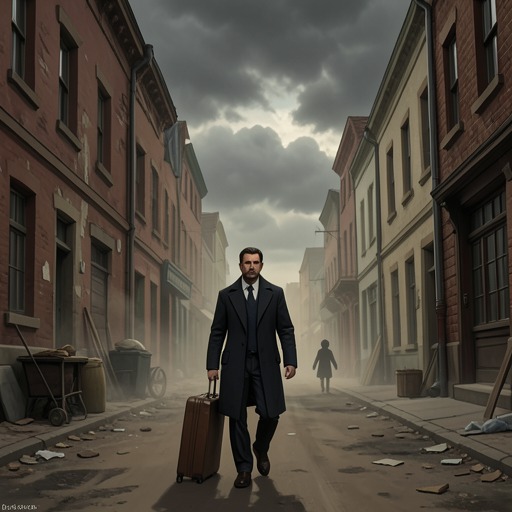
Chucho Flores
2666Chucho Flores is a thirty-five-year-old journalist in Santa Teresa who works for a local newspaper and radio station. He becomes a guide and companion to Oscar Fate, introducing him to the local press scene and to the city’s nocturnal rhythms. Through Flores, the novel connects personal relationships and journalistic camaraderie with the routine return—and routine forgetting—of the murders of women in Santa Teresa.
Identity and Introduction
Fate first encounters Flores after returning from a ranch with another reporter, Angel Martinez Mesa, who writes for a Mexico City sports paper. Flores is a little shorter than Fate, thirty-five, and, in Fate’s impression, always smiling. Their companion is older, short, and visibly exhausted, his stained suit and scuffed shoes contrasting with Flores’s designer suit, tie, and gold cuff links. Fate reads their bond as that of a grateful disciple and a largely indifferent master, though he attributes Martinez Mesa’s distance more to weariness than to arrogance.
The three stop at a bar after driving back into the paved streets of Santa Teresa. Although Fate is not hungry, he joins the reporters for a beer. Later, after Martinez Mesa has been dropped off at the Sonora Resort, Flores insists on another drink and takes Fate to a bar on a narrow central street. Its walls are painted fluorescent colors, and its bar zigzags through the room. The bartender, whom Fate judges to be no more than twenty-five, moves with an authority that makes him seem more like the owner; Flores, meanwhile, talks to Fate about New York and journalism.
Work, Ambition, and the City
Flores tells Fate that he would like to live in New York and work for a Hispanic radio station. The wish gives his reporting a personal horizon beyond Santa Teresa, even as his work remains rooted in the local paper and radio station. Their conversations make journalism both an occupation and a possible route elsewhere: Flores asks about New York, while Fate, newly arrived from outside the city, listens and watches the professional and social world Flores already inhabits.
Flores also names the pattern by which the killings of women enter public conversation. At breakfast near the Arena del Norte, Fate asks what the reporters had been discussing. Flores explains that whenever the number of victims rises, the killings become news again; people talk, and the story swells until attention ebbs, the public forgets, and everyone returns to work. His account is not an abstract comment detached from the plot: it comes in the midst of Fate’s reporting assignment and describes a cycle that the novel repeatedly sets against the continuing presence of the dead and the missing.
Flores and Fate
Flores’s companionship with Fate is active but not wholly transparent. One evening he comes to find Fate without inviting the other man present, Campbell. Fate feels both pleased and unsettled by the exclusion. Flores drives around Santa Teresa for a while, apparently trying to find the right moment to say something. When Fate asks not to go too far, Flores asks whether he is hungry; after Fate says yes, Flores laughs and puts on music.
Fate hears accordion and distant voices and asks what the music is. Flores identifies it as Sonoran jazz. The scene is small but characteristic of their encounters: Flores supplies a local name for something Fate cannot place, while the music and the city’s night remain only partly legible to the newcomer. Fate returns to his motel at four in the morning, having been drunk, sober, and drunk again over the course of the night. Flores thus draws him into a social world that leaves him with more impressions than explanations.
On another occasion, Fate goes upstairs at Charly Cruz’s house after asking where the women’s room is. He climbs a slightly unsteady metal staircase into a green-carpeted hallway, passes a serious-looking young man, and finds Flores on a cell phone in a room with a man in a checkered shirt and bolo tie. Flores notices that the man has gestured toward the doorway and invites Fate in. The encounter places Flores within the house’s private and potentially dangerous spaces, while Fate’s entrance is managed by Flores rather than explained to him.
Rosa Amalfitano and Charly Cruz
Rosa Amalfitano later tells Fate that she had been Flores’s girlfriend, or something like that. Her account begins with her friendship with Rosa Mendez, whom she met at Charly Cruz’s video store. Rosa Mendez works at a supermarket by day and as a restaurant waitress at night, likes films, and is especially fond of thrillers. Rosa Amalfitano is drawn to her cheerfulness and bleached-blond hair. Through Rosa Mendez, she meets Charly Cruz, the store’s owner, who sometimes lends her films or lets her rent them without charge. She spends whole afternoons there, talking with the pair or helping Cruz unpack new shipments.
Rosa meets Flores when the store is about to close. He takes both women to dinner and later drives Rosa home, declining her invitation to come inside because he does not want to bother her father. After she gives him her number, he calls the following day and asks her to the movies. At the theater he is already with Rosa Mendez and her date, an older real-estate man who treats Flores like a nephew. The arrangement suggests that Rosa and Flores’s connection develops within an existing social circle rather than as a private courtship isolated from the city’s other relationships.
Judgment, Violence, and Narrative Role
Flores meets Rosa’s father, Oscar Amalfitano. He comes away saying he has a positive feeling about the meeting, but Rosa doubts him: she cannot see how anyone could like a man after being looked at as her father looked at Flores. Amalfitano asks Flores three questions: what he thinks of hexagons, whether he knows how to construct one, and what he thinks about the killings of women in Santa Teresa. Flores answers that he thinks nothing about hexagons, does not know how to construct one, and considers the killings regrettable, adding that the police are catching the killers one by one. Amalfitano asks nothing further. After Rosa walks Flores to the door, her father tells her to be careful because he has a bad feeling about the man, without explaining why. Rosa laughs and interprets the warning as advice to end the relationship.
The exchange leaves Flores’s optimism about the police untested by the scene itself. Elsewhere, his breakfast account has already shown how attention to the murders flares and disappears, while the novel’s case narratives make the cost of that public forgetting concrete. Its record of Esperanza Gomez Saldana’s death establishes January 1993 as the point from which the killings began to be counted, while acknowledging that earlier victims may never have entered the list. Later, a woman found in a school field is never identified, and the medical examiner cannot settle the precise cause of death. Flores’s brief answer to Amalfitano belongs to this larger contrast between official assurances and unresolved deaths, without establishing that Flores himself knows more than he says.
As a supporting character, Flores is defined less by a single decisive action than by the connections he makes possible: between Fate and Santa Teresa’s reporters, between Rosa and the city’s video-store circle, and between everyday conversation and the killings that repeatedly break into it. His wish to leave for New York stands alongside his work in Santa Teresa; his sociability coexists with the unease Fate senses in their drives and meetings. Through him, the novel gives its cycle of publicity and forgetting a local voice, while leaving the deeper reasons for Amalfitano’s suspicion unexplained.