Dmitriev's Military Coup in Crimea
AfterburnDmitriev's Military Coup in Crimea transforms a suspected power grab into open conflict inside the Crimean Military District. Dmitriev claims command of the district, denounces General Boychenko as a traitor, and faces armed resistance from forces loyal to Boychenko. The fighting unfolds amid an attempted assassination, a fragile international command arrangement, and U.S. forces already operating under restrictions that make the crisis more than a local contest for authority.
Suspicion and the political setting
The possibility of a coup first takes shape as a reading of events rather than a confirmed announcement. Matt “Tombstone” Magruder is still assembling what he calls the larger parts of a puzzle, with many pieces missing, when he judges that the situation bears the marks of an attempted coup. He reasons that if Dmitriev intends to take control of the Crimean Military District, an assassination attempt combined with an attack could serve that purpose. The inference is cautious, but it gives the violence a political shape before Dmitriev publicly declares his claim.
The crisis arrives in a region where the limits on outside intervention have already been explicit. The National Command Authority had directed U.S. forces not to involve themselves in fighting between the Red and Blue Russian factions; the Marines were to go ashore at Poti only. That restriction belongs to the Georgia mission, but it establishes the political risk of being drawn into Russian factional warfare. Earlier debate over whether American forces should serve under United Nations commanders now becomes an immediate operational problem rather than a distant policy argument.
The seizure of authority and the fighting
At Yalta, gunfire crackles in the distance as the attack by Dmitriev's naval forces begins. Matt “Tombstone” Magruder is trapped at the palace with a group of people and feels particularly helpless. His position puts him near the crisis without giving him control over the forces producing it: the sound of fighting confirms that the threat he had been trying to interpret has become immediate.
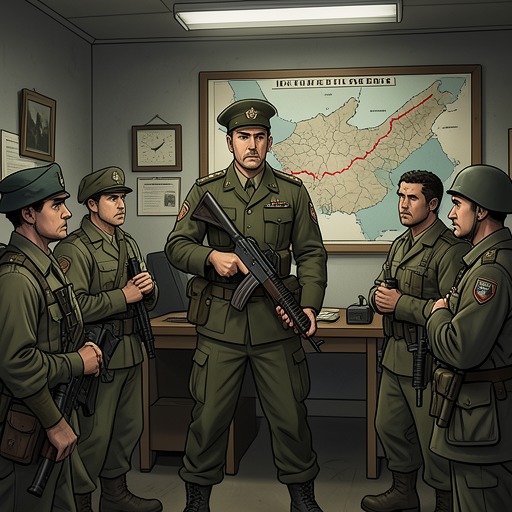
Dmitriev then announces that he is assuming command of the Crimean Military District. He declares General Boychenko an enemy of the state and says he will be arrested as a traitor when found. The announcement is both a claim of authority and an attempt to define the opposition as criminal. In a later report from Yalta, the mutiny is described as Russian naval forces refusing to follow Boychenko, amid the wider disintegration of the Russian Federation. The dispute over who commands the district is therefore no longer confined to competing statements: it has broken into combat.
The same report identifies the opposing forces and the severity of the confrontation. Army units loyal to Boychenko fight naval infantry and air force units under Dmitriev's command, with casualties reported as heavy. Dmitriev characterizes Boychenko as a rebel employed by antigovernment forces and assumes full command of all military units in Crimea. His public declaration and the fighting serve the same purpose: to make his authority appear complete while Boychenko's loyalists contest it on the ground. The account places these developments in the wake of the attempted assassination, but does not establish who arranged it.
A contested command chain
The coup intersects with an unusual arrangement for U.S. forces. The United Nations requests operational authority over American forces in the Crimean Peacekeeping Operational Zone, and Washington grants it. The American commander tells his officers that they will operate under United Nations command until the President says otherwise, while emphasizing that the order comes through the commander in chief and must be obeyed. This shift does not erase the earlier policy against joining the factional fighting; instead, it places U.S. personnel inside a peacekeeping command structure at the moment when the district's own chain of command is being violently contested.
The competing lines of authority carry practical consequences. An exchange about the chain of command notes that Captain Brandt, previously Admiral Tarrant's flag captain, has received a brevet promotion to admiral, confirmed through Naples. The change underscores how quickly the wider command structure is being adjusted during the crisis, though the available account does not specify that the coup itself caused Brandt's promotion. For Matt “Tombstone” Magruder and the personnel at Yalta, meanwhile, the immediate fact is simpler: armed forces are attacking while their own ability to act is bounded by orders and by a changing hierarchy.
The wider military trap
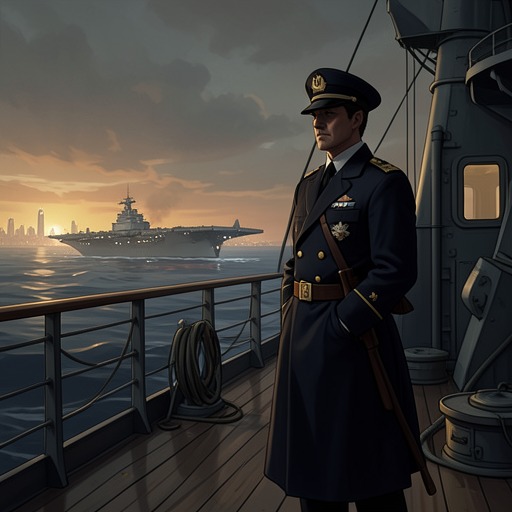
The coup develops against a logistical emergency in the Black Sea. A modern carrier such as the Jefferson needs at-sea replenishment of expendables every two to three weeks. Although nuclear-powered, the ship depends on fuel for its aircraft, and its battle group's replenishment depends on UNREP tankers following it. The distinction matters: the carrier can remain powered while its air operations run short of the supplies that make it useful in combat.
By the time the crisis is being assessed, the Jefferson's margin is described as only two to four days under a heavy schedule. After that, the ship and its escorts risk becoming effectively useless inside the Black Sea, trapped by the closing of the Bosporus Strait. U.S. officials ask whether the force can get through and resupply the group; Magruder distributes estimates to those at the table. Later, the plan requires pumping nearly three million gallons—about nine thousand tons—of aviation fuel aboard, with flight-deck operations suspended during the work. These facts do not make the coup the cause of the carrier's fuel shortage, but they show why political instability in Crimea compounds an already narrow operational margin.
Consequences and significance
The coup's immediate consequence is a split military command backed by armed factions, not a settled transfer of power. Dmitriev claims the entire district and labels Boychenko a traitor; Boychenko's army loyalists continue fighting naval infantry and air force units. The reported heavy casualties and the violence at Yalta make the claim of an orderly succession untenable. The evidence here does not resolve who ultimately controls Crimea or establish the final fate of either leader.
As a turning point, the coup forces several kinds of uncertainty into the same frame: who holds legitimate authority, whether foreign peacekeepers can remain outside the conflict, and how long the forces surrounding the crisis can sustain operations. The attempted assassination gives the struggle an ominous prelude; the radio and news declarations give it competing public accounts; and gunfire at Yalta supplies its immediate physical reality. What began for Magruder as an incomplete pattern becomes a contest whose stakes extend from the streets of the Crimean Military District to the command rooms and supply routes of the international force.