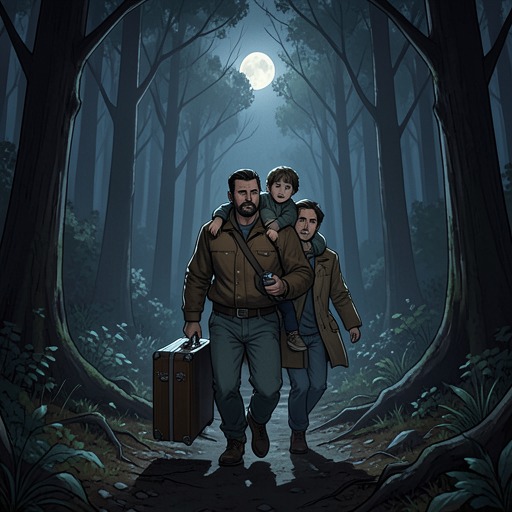
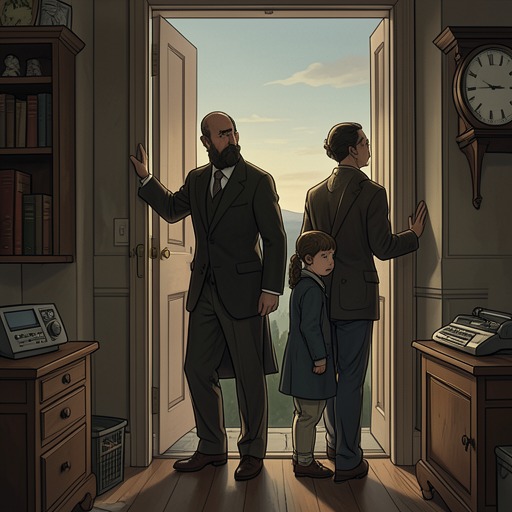
Karabekian's parents flee Armenia and immigrate to America
BluebeardRabo Karabekian’s parents flee the Armenian massacre separately, meet only after crossing into Persia, and travel onward through Cairo under the protection—and then the deception—of fellow survivor Vartan Mamigonian. Their escape toward a promised home in California is a story of practical ingenuity, fragile trust, and the inheritance of trauma: the mother carries jewels gathered after the killing, while the father carries a painful sense of having survived when his family and community did not.
Massacre and Separate Escapes
The journey begins in the destruction of the parents’ Armenian communities. The narrator describes the Turkish Empire’s massacre of about one million Armenian citizens, presenting the victims as people suspected of disloyalty because they were educated and had relatives across the border in the Russian Empire. The account places this violence in an age of empires and calls attention to the organized character of mass killing, while distinguishing the narrator’s later historical commentary from the parents’ particular experiences.
The mother survives by pretending to be dead among the victims. She is still young, and the narrator later argues that she had at least as much cause as his father to suffer what Circe Berman calls Survivor’s Syndrome: she had been in the midst of the killing, with the dead around her. When she tells the story, she stresses a precise limit to what she took from that scene. She gathered the jewels that had fallen from an old woman’s mouth, but left untouched those still inside it, which she regarded as the dead woman’s personal property. The distinction gives her survival a moral boundary as well as a material consequence: the jewels she did take would later help pay for the family’s passage onward.
The father survives by hiding in the privy behind the schoolhouse where he taught. He had stayed after the school day to write poetry when he heard the soldiers coming. He did not witness the killing itself; instead, what remained with him was the village’s stillness at nightfall and the realization that he was its only inhabitant. His route and the mother’s route do not immediately converge. She is not from his village, and they do not meet until both have crossed the lightly guarded border into Persia, about seventy miles from the massacre.
From Persia to Cairo
Persian Armenians take in the two refugees. They decide to go together to Egypt, with the father doing most of the talking because the mother is carrying the jewels. At the Persian Gulf, she sells one of the compact treasures to buy passage on a small freighter bound for Cairo by way of the Red Sea. The journey is therefore not a single flight but a sequence of decisions shaped by what they can carry, whom they can trust, and how they can pay for the next leg.
In Cairo, they meet Vartan Mamigonian, a survivor of an earlier massacre. Their shared Armenian experience gives him an opening: the parents tell him about the jewels and their plan to marry and go to Paris, where a large, cultivated Armenian community lives. The father’s later warning about survivors—advice specifically associated with Mamigonian—makes the encounter a family lesson in the difference between having endured violence and being trustworthy. The narrator’s account does not treat shared victimhood as proof of solidarity; the disclosure of the jewels instead places the couple at risk of being exploited.
The California Promise
Mamigonian has become wealthy by manufacturing military boots for both the British and German armies, which are soon to fight one another in World War I. He offers the parents poorly paid, dirty work, then casts himself as their adviser and protector, supposedly concerned with finding a safe place for their jewels in a city known for thieves. They have already put the jewels in a bank, but he continues to cultivate their confidence and proposes a different bargain: a future in California.
The supposed opportunity rests on a fabricated brother in San Ignacio. Mamigonian claims that this brother has become rich there, that many Armenians are prospering in the town, and that the community needs a teacher fluent in Armenian and familiar with its literature. He produces forged letters to support the story. The imagined community would offer the father a teaching position and sell him a house with twenty acres of fruit trees for a fraction of their true value.
The offer is made to look tangible. The alleged brother’s letter includes a photograph of the house and a deed, and authorizes Mamigonian to sell the deed to a suitable teacher in Cairo. These particulars turn an invented future into something the parents can handle and assess: a job, a home, land, and a place among other Armenians. The narrator identifies the brother and the opportunity as a fantasy, exposing the promised route to security as Mamigonian’s scheme rather than a genuine settlement arranged by a distant family.
Inheritance and Retrospective Meaning
The parents’ flight shapes the narrator’s understanding of both citizenship and family memory. He later tells Circe Berman that without the jewels he would not be a citizen of the United States and would not stand in a position to claim his house as private property. The remark traces his own place in America to an object carried out of the aftermath of the massacre, while the mother’s insistence that she did not take the jewels still inside the dead woman’s mouth preserves the ethical limits she attached to that escape.
The father’s survival remains an unresolved emotional inheritance. When Circe suggests that he was ashamed not to have died with his friends and relatives, the narrator replies that his father was ashamed that his son had survived too. He says he has forgiven his father many times, yet remembers the conversation as an occasion to revisit the old pain. He also argues that his mother, who survived by lying among the dead, had still stronger grounds for Survivor’s Syndrome. In this retrospective account, the parents’ escape does not end with reaching safety: its consequences persist as grief, shame, family conflict, and a story the next generation must repeatedly tell.
Much later, the narrator notes that Celeste and her friends are back in school and that she asks what he knows about the Universe for an essay. The brief return to ordinary American school life contrasts with the history behind his own family’s arrival: a child’s assignment and a family’s existence in the United States sit at the far end of a route that began with massacre, crossed Persia and Egypt, and was redirected by a fraudulent promise of California. The episode makes migration at once an escape from immediate danger and an inheritance whose origins continue to shape how the family remembers survival.