Circe Berman renovates the Karabekian mansion foyer
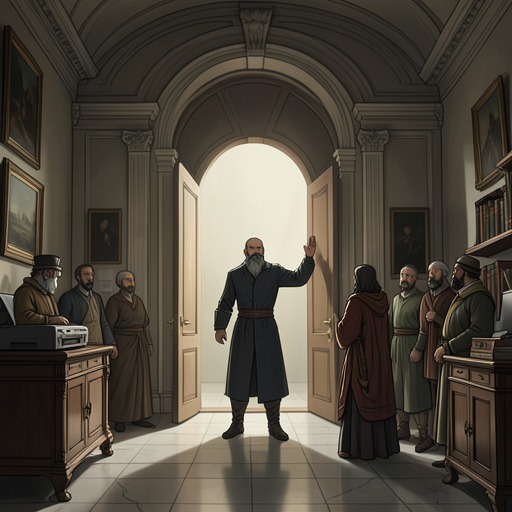
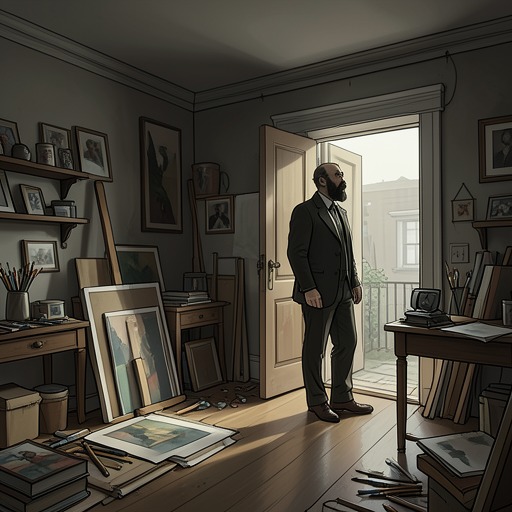
BluebeardCirce Berman renovates the Karabekian mansion foyer while Rabo Karabekian is away, replacing the room Edith Taft had designed to bring modern art into the family home. Rabo’s return turns the renovation into a domestic rupture: what Circe has made for herself becomes, to him, a repudiation of his late wife and of the home he believed he knew.
The foyer Edith created
Rabo’s account establishes the force of the change by first reconstructing the foyer he expected to find. Its walls had been oyster white, like the other principal rooms. Terry Kitchen’s painting Secret Window faced the entrance; a Matisse depicting a woman with a black cat stood to one side, and a Hans Hofmann to the other. Edith had bought the Matisse for their fifth wedding anniversary, while Terry had given Rabo the Hofmann after Rabo paid for a transmission for Terry’s Buick. The room’s art was thus not merely a display: it gathered the couple’s history and the friendships through which individual works had come to Rabo.
The foyer’s public reputation reinforced its private meaning. A 1981 issue of Architect & Decorator had featured it on the cover, looking through the open front door from a flagstone walk lined with hollyhocks. The article described the entrance hall as a small museum’s potential permanent collection, only an introduction to the art in the white rooms beyond. But Rabo says the transformation had been Edith’s idea, not his. The house was a Taft family heirloom, associated with Edith’s childhood summers and her first marriage. When she asked if he was comfortable with its old-fashioned surroundings, he told her he loved them as they were and that she should change nothing for his sake.
Edith nevertheless undertook a complete redesign. She had the contractors remove the wallpaper down to the plaster, take down the chandeliers, install track lighting, and paint the trim, doors, window sashes, baseboards, and walls oyster white. When the work was finished, she recognized a previously unacknowledged talent for remodeling and decorating. She then arranged for Home Sweet Home Moving and Storage to bring Rabo’s paintings out of storage and back into the house. The foyer Circe later altered was therefore the result of Edith’s personal authorship, Rabo’s collection, and a deliberate return of the art to domestic view.
The transformation and Rabo’s return
After a trip to New York City, Rabo is driven home by Floyd Pomerantz’s chauffeur. He gets out at the flagstone walk and enters, expecting the familiar, light-colored foyer. Instead, Circe’s version confronts him: black wallpaper covered with red roses as large as cabbages, brown baseboards, trim, and doors, and six framed chromos of little girls on swings, each with a purple-velvet mat and a heavy gilded frame. The wall color, the art, and the decorative style have all changed at once; the contrast with Edith’s white gallery-like entrance is total.
Rabo initially cannot identify what he is seeing and repeatedly cries that he is in the wrong house. The household staff, who had been anticipating his homecoming as a surprise, have difficulty suppressing their laughter at his distress. The discrepancy between their shared knowledge of the renovation and Rabo’s shock makes his first response both painful and comic: he experiences a change to a familiar room as the loss of his home’s identity.
He learns that Circe did the work herself, not that she had hired painters and paperhangers while he was away. Celeste explains that Circe used to be a professional paperhanger and had met her husband, a doctor, while papering his office; she had gone on to paper his home as well. The detail gives the renovation a practical history and makes Circe’s intervention more than a spontaneous act of decoration: she possesses the trade skill to execute the transformation personally.
Confrontation and consequence
Rabo eventually confronts Circe about the foyer. She is getting dressed and says that her date may arrive at any moment; he insists that the room, rather than her clothes, is what he wants to discuss. He calls the renovation an unforgivable insult to art history and an affront to Edith’s memory, emphasizing that Edith, not Rabo, had created the former foyer. His objection is therefore also a defense of Edith’s authorship: the room he had originally told his wife not to change had become, through her work, a lasting expression of her own taste and of their shared life.
Rabo demands that Circe leave and never return. Circe dismisses his accusation with the word “Bushwa.” The exchange ends in direct conflict rather than agreement or a negotiated compromise. The foyer’s renovation has changed the appearance of the house, but its decisive consequence is relational: it exposes how strongly Rabo associates the old arrangement with Edith, and how little room he initially allows for Circe’s own claim to the space.
Domestic space and competing authorship
The sequence is organized around expectation and recognition. Rabo first recalls the foyer in exact relation to its artworks and Edith’s decisions; only then does the changed room appear. His delayed recognition gives the familiar entrance a disorienting effect without changing the underlying facts: he has returned to his own house, but its most visible room no longer confirms the past he expects to inhabit.
The renovation also brings two kinds of authorship into collision. Edith had remodeled the historic house to accommodate Rabo’s collection, turning an inherited domestic interior into a setting for modern art. Circe, herself an experienced paperhanger, replaces that arrangement with a radically different decorative scheme. Rabo reads the change chiefly through its relation to Edith and the collection; Circe’s own explanation or intention is not supplied in this episode. What the scene does establish is that the foyer cannot remain a neutral backdrop: its successive designs carry competing claims about whose taste, labor, memory, and presence may shape the home.