Rabo reveals the warehouse mural to Circe and opens it for display
BluebeardRabo Karabekian’s revelation of the enormous painting in his potato barn begins as an intimate test of trust and ends by changing how the work is seen: the sealed, private object becomes the centerpiece of a public museum tour. Circe Berman’s challenge prompts him to unlock the barn, while the painting’s scale, wartime subject matter, and carefully staged viewing turn disclosure into an experience that neither visitor nor artist can take in at a glance.
The Decision to Open the Barn
After taking up residence in his house again, Rabo had become the solitary old man Circe asked about his parents’ deaths. On her last night in the Hamptons, she pressed him about a painting he had kept from view. He had called it the last thing he had to give the world, but said he did not want to be present when people judged its quality. Circe answered that refusing to show it made him a coward and said that was how she would remember him. Her judgment changes the terms of his refusal: he agrees to fetch the keys and asks her to come with him.
The decision is consequential because Rabo is not simply offering Circe a private preview of another picture. He has returned to his house after years of isolation, and the barn has remained shut; in his will, he stipulated that it should not be unlocked until after his burial. Opening it now means overriding that intended posthumous boundary while he is alive, with Circe as the first witness to what he has withheld. The revelation thus makes a concealed work available to another person before its maker can control how it will be received.
A Staged First View
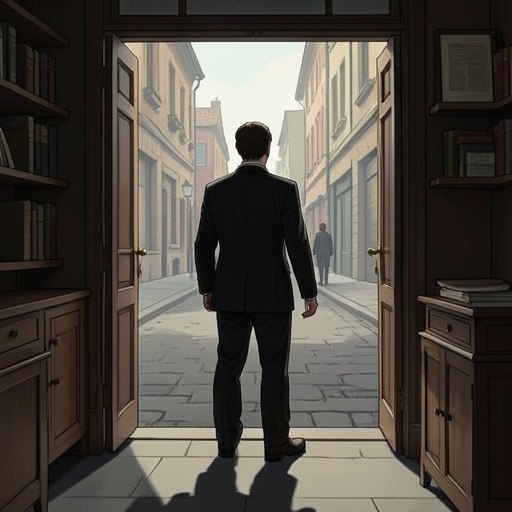
The two set out in the dark with a flashlight. Their route begins on flagstones, then veers toward the carriage house and continues along a stubble path cut through the wilderness. At the barn doors, Rabo reaches inside for the light switch and asks whether Circe is scared. She says she is; he admits that he is too. The mutual acknowledgment makes the scene less like a confident unveiling than a shared approach to something neither can yet understand.
Their position determines what the painting initially seems to be. They stand at the extreme right end of a work eight feet high and sixty-four feet long. From there, the full length is compressed by foreshortening into what looks like a triangle eight feet high but only five feet wide. Rabo switches on the floodlights, and Circe gasps. Asked what she sees, she describes an immense fence covered with jewelry. The image is not a reliable guide to the composition as a whole: the deliberately limited vantage point leaves the painting’s subject unknown, delaying recognition until the pair moves.
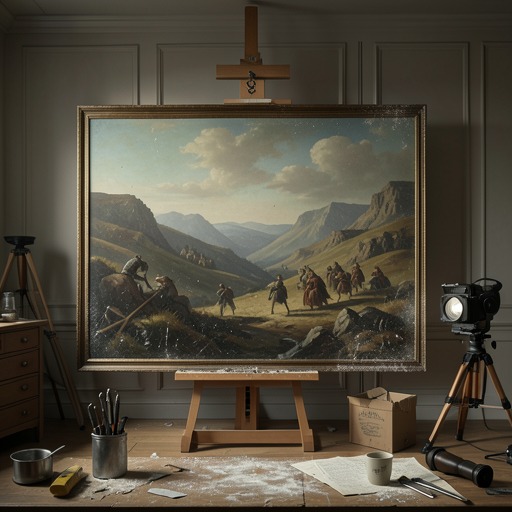
Rabo takes Circe’s hand, asks her to close her eyes, and leads her to the middle. When she opens them, thirty-two feet of canvas extend on either side. They are at the rim of a green valley in spring, populated by 5,219 people on the rim and below. The figures are minute—the largest the size of a cigarette, the smallest a flyspeck—and the scene includes farmhouses and the ruins of a medieval watchtower. Though the painting is so realistic it might be mistaken for a photograph, its immense scale and density make it more than a simple landscape. When Circe asks where they are, Rabo identifies the place as where he was when the sun rose on the day the Second World War ended in Europe.
The Painting’s War Stories
The setting connects the work to Rabo’s own military past. He had served as an artist in an Army Engineers camouflage unit near the end of the war, but in Luxembourg his men were fighting as ordinary infantry. He lost his left eye, was captured, and was taken unconscious to a German military hospital. He later described his return to the United States as a blank state and said that neither he nor his fellow artist Fred Jones had anything to come home to. Against that personal history, the valley of survivors is not an abstract meditation on war: Rabo locates himself in the landscape at the moment the war in Europe ended.
The painting’s inhabitants include far more than identifiable soldiers. Rabo says that an average square foot contains ten clearly drawn survivors of the Second World War. Magnifying glasses in the barn reveal even the tiny figures as concentration-camp victims, slave laborers, prisoners of war from different countries, German soldiers from different military units, local farmers and their families, or people released from asylums. The magnifiers turn distance into a practical problem of attention: figures nearly lost at the scale of the whole work carry their own specific histories when examined closely.
Rabo says he made up a war story for every figure and then painted the person to whom it had happened. At first, he made himself available in the barn to tell visitors the stories behind particular figures, but gave up because explaining them exhausted him. He now invites visitors to make up their own war stories as they look and stays in the house, pointing the way to the barn. The change shifts some interpretive work from the artist to the audience without erasing the histories that structure the image. On the night he first showed the work to Circe, however, he was glad to tell her any stories she wished to hear.
From Private Work to Public Attraction
The disclosure leads to a change in the barn’s function. Rabo eventually incorporates the enormous work into the regular tour of his museum: visitors first see the little girls on swings in the foyer, then early works by the first Abstract Expressionists, and finally the huge picture in the potato barn. He unspikes the barn’s sliding doors so the increased stream of visitors can enter at one end and leave at the other without bottlenecks. Some visitors go through more than once, sometimes revisiting only the barn rather than the whole museum. A space once shut by locks becomes an organized public route through the work.
Rabo resists describing the picture in conventional art-critical terms. Asked by lay visitors what kind of painting it is, he calls it a tourist attraction, a World’s Fair, and a Disneyland, then qualifies the comparison by calling it gruesome: nobody there is cute. He says that no solemn critic has yet appeared and doubts one will, because the picture excites ordinary visitors. His answer sets popular response against the authority of formal critical judgment, while also making clear that attraction does not mean lightness. The spectacle is built from survivors and from stories of wartime suffering, not from charming figures.
The revelation therefore changes both access and interpretation. In the barn, Circe’s first view is determined by position, and understanding comes only after Rabo leads her to the center. In the museum, the doors and visitor flow make the work available to repeated public viewing, while the magnifiers and countless small figures reward closer looking. Rabo no longer undertakes to narrate every figure’s story, but the painting’s scale and his invitation to invent stories keep interpretation active. What began as the last gift he feared exposing becomes a public attraction whose meaning cannot be reduced to a single explanation.