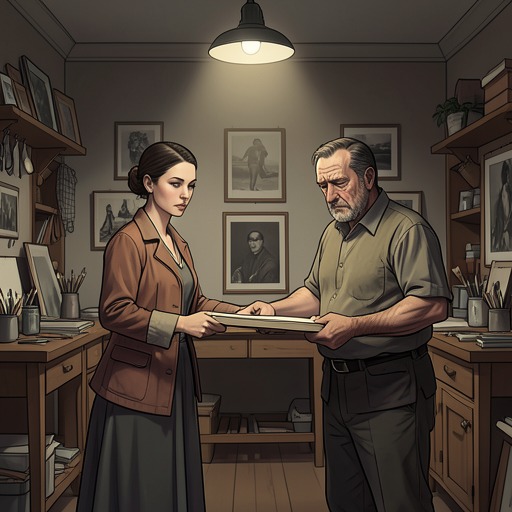
Terry Kitchen shoots his father and then kills himself
BluebeardTerry Kitchen’s shooting of his father and subsequent suicide are recalled as an accidental family tragedy: after seeing that his shot had wounded his father, Kitchen killed himself. The episode reverses his earlier insistence that he could never hurt his father and belongs to a wider account of the estrangements and losses that shape Rabo Karabekian’s postwar life.
Background and Relationship
Kitchen had once spoken of the relationship between fathers and gifted sons through a story about the poet Conrad Aiken. As Kitchen recounted it, Aiken became a poet because his own father’s poetry was poor; Kitchen said he could never do that to his own father. The remark presents filial loyalty as a principle, making the later violence a stark contradiction rather than a foretold outcome.
The Shooting
Six years after that conversation, Kitchen was drunk, as he often was, in the front yard of his shack about six miles from Rabo’s home. His father had come yet again to urge him to seek treatment for his alcoholism. Kitchen fired a pistol, striking his father in the shoulder. Rabo says the shot’s intention can never be proved, though he believes it must have been meant as a gesture; the account preserves that uncertainty rather than assigning Kitchen a definite motive.
Suicide and Aftermath
When Kitchen realized that he had actually shot his father, he put the pistol in his mouth and killed himself. Rabo calls the shooting an accident, distinguishing the unintended result from the possible intent behind the gesture. The sequence is brutally compressed: a recurring plea for treatment, a shot whose purpose remains uncertain, recognition of its consequence, and Kitchen’s death.
Meaning in Rabo’s Recollection
Rabo recounts the tragedy while looking back on the wartime and postwar lives he shared, at a distance, with other wounded men. He remembers losing his left eye near the end of the war, spending years as a hermit after his first wife and sons left him, and later naming his failure as a husband and the resulting alienation from his sons as sources of shame. These parallels do not make Kitchen’s fate equivalent to Rabo’s; they place the episode within a narrative attentive to damaged family bonds and the consequences of isolation. Its final insistence that the shooting was accidental leaves both the gesture and its meaning unresolved.