Rabo seals off the potato barn studio
BluebeardRabo Karabekian’s sealing of his potato-barn studio transforms a working artist’s space into a locked, deliberately unknowable part of his legacy. After Edith dies, he secures the barn from both sides and vows that its contents will remain hidden until he is dead; the resulting mystery draws visitors, tests his friendship with Paul Slazinger, and gives the plain exterior a place in art history before anyone knows what lies within.
The Studio and Its Uses
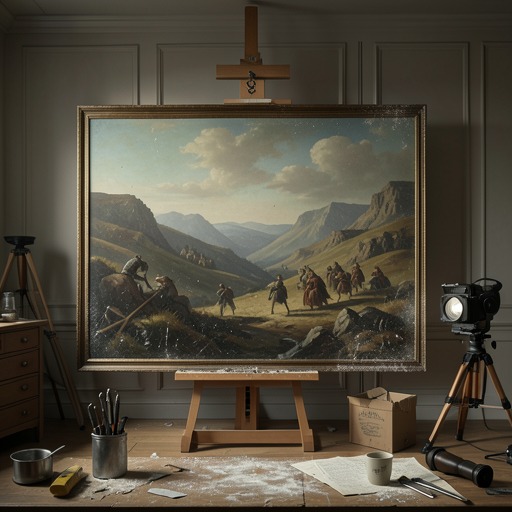
The potato barn is a long, narrow, windowless building designed for a single agricultural purpose: storing potatoes. Sliding doors and a potbellied stove at each end could help maintain an even temperature, keeping the crop from freezing or sprouting before it was ready for market. The structure’s dimensions, once-cheap local property, and suitability for exceptionally large canvases had also drawn painters to the area. Karabekian depended on that space to work on the eight panels of Windsor Blue Number Seventeen as a single piece.
The barn therefore carries two histories at once. It began as a practical building for preserving a harvest and became an unusually large artist’s workspace; after Karabekian sealed it, it acquired a third function as a container for a secret. Its former usefulness remains legible in its construction, but the doors no longer offer access to the work they once enabled.
The Sealing
Karabekian shut the studio two years after Edith’s death. Because there are no windows, a visitor cannot even look inside. He nailed the doors at one end shut from within using six-inch spikes, then immobilized the doors at the other end from outside with six padlocks and massive hasps. This is not a casual decision to leave a room unused: the different measures at each end make the enclosure a sustained barrier, established by the person who knows what it contains.
Karabekian says he has not gone back inside since sealing it. He nevertheless insists that the barn contains something, rejecting the prospect that the eventual discovery will be merely empty space or a token left behind to signify loss. The distinction matters: the secret is not just the absence of its maker, nor a broken paintbrush or his Purple Heart on a swept-clean floor. The locked building holds an actual object, although the narration withholds its identity.
He narrows the possibilities by ruling out several expected or joking answers. It is not a painting of potatoes, a Virgin Mary wearing a derby and holding a watermelon, a self-portrait, or anything with a religious message. His only scale clue is that the contents are bigger than a bread box and smaller than the planet Jupiter. These exclusions sharpen the curiosity without resolving it: the reader receives dimensions and prohibitions, not an explanation.
Secrecy and Its Audience
The locked barn becomes a recurring question for people who visit Karabekian’s house. After showing them the art collection indoors, he is often asked to show them what is in the barn. He permits them to see its exterior, which he calls a significant landmark in art history, but not to enter it. The building’s fame thus grows not from public access to the hidden object but from the visible fact of its exclusion.
The secret also strains the friendship between Karabekian and Slazinger. Slazinger has failed to guess what is inside and has said more than once that he does not see how their friendship can continue if Karabekian does not consider the secret safe with him. The dispute exposes the social cost of the concealment: the mystery is not only a puzzle offered to outsiders but a confidence withheld from an intimate friend. Karabekian maintains the boundary without supplying Slazinger, visitors, or the reader with the answer.
Even the barn’s exterior has a specific artistic association. When Terry Kitchen first used a paint-spraying rig, he aimed it at an old piece of beaverboard leaning against the barn. The episode links the building to an early act of Kitchen’s painting practice without revealing its interior. The visible walls and nearby working materials accumulate art-historical associations while the sealed space itself remains inaccessible.
The Delayed Opening
Karabekian sets the terms for discovery after his own death. He imagines that, once he has been buried next to Edith, the executors of his estate will finally open the doors. The contents are therefore tied to a precise future condition: neither curiosity, friendship, nor a visitor’s interest is sufficient; the opening belongs to the administration of his estate after his burial.
His public explanation turns that future into a joke at his own expense, describing the contents as the worthless secret of a silly old man who will have gone to the big art auction in the sky. The jest does not cancel the promise that something is there. Instead, it sets the modest claim against the elaborate precautions and the attention the barn has attracted. The article of faith is the object’s existence; its value and meaning remain unsettled.
As a narrative device, the sealed studio makes withholding visible. Karabekian tells readers that there is something inside, supplies a succession of exclusions and a playful size limit, and names the people who have failed to solve the riddle, yet keeps the central fact—the object’s identity—beyond the account. The barn consequently functions as both a real space shaped by the artist’s work and a suspenseful boundary around his legacy. Its eventual opening is promised, but the contents are not disclosed here.