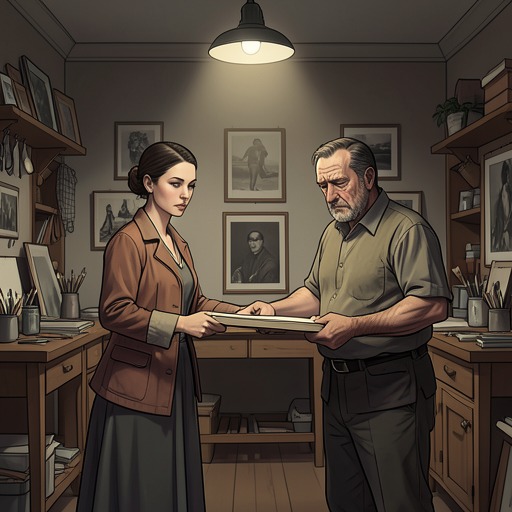
Terry Kitchen dies by suicide
BluebeardTerry Kitchen dies by suicide in Rabo Karabekian’s retrospective account of the deaths of his painter friends. The event is more than a grim biographical fact: it joins Kitchen’s artistic success to Rabo’s unnerving memory of a friend whose eyes seemed suddenly empty, and places Rabo as the sole survivor of their drinking circle.
Context and Artistic Recognition
Rabo recalls that Kitchen had once been his closest friend. Years later, Kitchen began producing paintings that led many people to call him the greatest of the Abstract Expressionists, superior even to Jackson Pollock and Mark Rothko. Rabo does not dispute the acclaim, but remembers its personal cost as a disturbing change: when he looked into Kitchen’s eyes, he felt that nobody was home. The account links the friend’s artistic ascent to a perceived loss of presence without claiming that the paintings caused his death.
The Suicide and Its Place in the Deaths
In a list of painter friends who died by suicide after achieving, or approaching, artistic success, Rabo gives Kitchen’s death a precise place in time. Jackson Pollock drove his car into a tree while drunk in 1956; three weeks later, Kitchen shot himself through the roof of his mouth with a pistol. Rabo sets the deaths beside one another, making Kitchen’s suicide part of a sequence of losses rather than an isolated episode.
The Three Musketeers
The remembered friendship also belongs to a shared New York life. Pollock, Kitchen, and Rabo were all heavy drinkers and were known at the Cedar Tavern as the “Three Musketeers.” Rabo turns that group identity into a stark count of survivors: asked how many remain alive, the answer is himself alone. The joke is brief, but its arithmetic exposes the loneliness underneath the former camaraderie.
Narrative Significance
Rabo admits that he cannot see in suicide the dramatic necessity that Marilee sees in Ibsen’s play, and suggests that this inability may mark his shallowness as a participant in serious art. His account therefore offers no explanation of Kitchen’s motive. Instead, it holds together artistic recognition, a friend’s felt absence, and the final fact of suicide, while leaving the cause unclaimed. In the larger recollection of artists who could not be satisfied, Kitchen’s death becomes part of Rabo’s unresolved meditation on achievement, discontent, and survival.