Rabo paints his sons’ portraits, and Dorothy takes them along with the wall
BluebeardRabo paints his sons’ portraits, and Dorothy takes them along with the wall in an episode that makes artistic ability suddenly personal: after Dorothy challenges his explanation of Abstract Expressionism, Rabo answers not with an argument but with life-size drawings of their sleeping boys. Six years later, Dorothy leaves with the children and cuts those portraits out of the wall, leaving two square holes. Rabo connects the empty house to his father’s remembered solitude after a massacre, making the portraits’ removal both a domestic separation and an image of inherited loss.
The Dispute About Abstract Expressionism
Years later, Rabo recounts the episode to Circe Berman while recalling a conversation with Dorothy beside a kitchen fireplace. The conversation had begun with a remark by an Italian sculptor about the first Abstract Expressionist paintings exhibited in a major European show, at the Venice Biennale in 1950. The works in question were by Gorky, Pollock, and de Kooning; Rabo had not exhibited there. The sculptor’s criticism, as Rabo reports it, was that the American painters entered the water before they knew how to swim. Rabo understood the jab to mean that they could not draw.
Dorothy turned that criticism into a challenge to Rabo’s own account of the movement. She suggested that the painters worked as they did because they could not make a convincing picture of something real. The exchange was not simply a discussion of artistic method: Rabo says Dorothy wanted to hurt him as much as he had hurt her. Her taunt made the question of whether he could draw concrete and personal, pressing his abstract artistic identity against the possibility of representational skill.
The Portraits on the Kitchen Wall
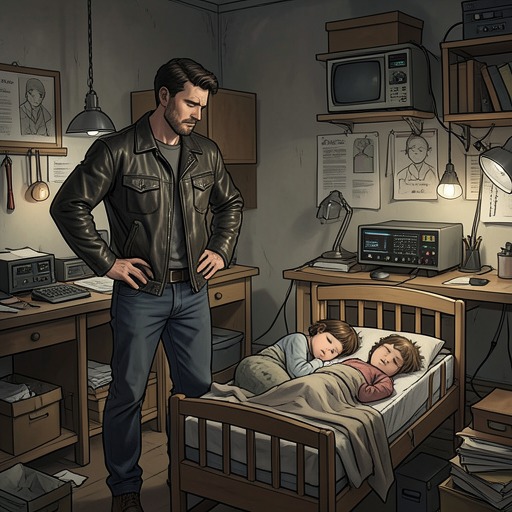
Rabo did not answer Dorothy in words. He took a green crayon she had been using to list repairs needed inside and outside the house and drew the heads of their two sons on the kitchen wall. The boys were asleep in front of the fireplace in the living room. Rabo made the portraits life-size without going into the room to look at them first, turning an argument about his ability into an immediate demonstration.
The drawings went directly onto new Sheetrock that Rabo had nailed over cracked plaster. He had not finished the wall: the joints between the sheets remained untaped and unfilled, and the nailheads uncovered. Asked later whether he ever completed those repairs, he said he did not. The unfinished surface therefore stayed part of the portraits’ setting rather than becoming a temporary stage for them. Dorothy was astonished and asked why he did not draw that way all the time. Rabo answered that it was too easy; he also recalled that it was the first time he had used profanity in speaking to her, even when they had been angry with one another.
The contrast between the crayon portraits and Rabo’s abstract work gives the scene its force. He does not refute Dorothy’s claim by defending Abstract Expressionism or explaining his intentions. Instead, he produces a recognizable image of their children, while insisting that such drawing feels effortless. The gesture establishes that he can draw, but it does not resolve the dispute over what his other paintings mean or why he makes them.
The Wall Leaves with Dorothy
The portraits remained on the Sheetrock for six years. Then Rabo came home one afternoon half drunk and found that Dorothy, the children, and the pictures were gone. Dorothy had left a note saying they were gone forever, and she had cut the portraits out of the wall and taken them with her. Two large square holes marked where the sections of Sheetrock had been.
The manner of their removal makes the drawings more than keepsakes. Dorothy did not merely paint over or discard them; she took the wall around them, carrying away the images in the material on which Rabo had made them. The portraits had first answered her challenge by demonstrating a capacity she doubted. At the end of their marriage, those same portraits became part of what she removed from the house. Their survival as images is inseparable from the visible absence they leave behind.
Loss and the Memory of Rabo’s Father
When Circe observes that Rabo must have felt awful, he links Dorothy’s departure to two other recent losses. Pollock and Terry Kitchen had killed themselves only a few weeks earlier, and Rabo’s own paintings were falling apart. Against that accumulation, the two empty squares in the house become a point at which he cannot finish his thought. Circe asks him to continue, and Rabo says that this was as close as he would ever come to feeling what his father must have felt as a young teacher, left alone in his village after the massacre.
The episode thus joins a specific domestic event to Rabo’s family history without equating their circumstances. His father’s remembered solitude supplies the comparison through which Rabo can describe the abandoned house; the missing pictures give that solitude a visible form. The story also places the separation beside the collapse of Rabo’s paintings and the recent deaths of Pollock and Kitchen, but it does not claim that any one loss caused another. Its ending is the image of the cut-out wall: the portraits have been taken, the children are gone, and Rabo stops short before completing the sentence that would explain what the emptiness means.