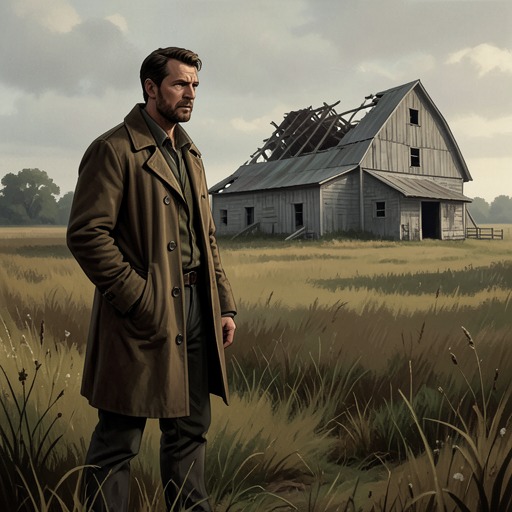
Rabo Karabekian is invited to apprentice with Dan Gregory
BluebeardDan Gregory’s invitation to apprentice with him turns Rabo Karabekian’s isolation and uncertain prospects into a concrete passage toward a new life. The telegram’s compact promise of travel, lodging, support, and art lessons takes Rabo from San Ignacio to New York City, where the young Armenian arrives with a portfolio and no one to welcome him. The opportunity is not simply a job: Rabo remembers the journey as a birth into a city where he must begin again.
The Telegram and Its Offer
Around Christmas in 1932, Rabo had grown bored with being the audience for Marilee Kemp’s letters, most of which lay about unread. Against this subdued background, a telegram arrived addressed to him. Rabo’s father remarked that it was the first telegram the family had ever received, making the unfamiliar message an occasion before its contents were even known.
The telegram announced, “BE MY APPRENTICE. WILL PAY,” and promised transportation, free room and board, a modest allowance, and art lessons. It was signed by Dan Gregory. The clipped, emphatic wording made a distant possibility immediate: Gregory was not merely offering instruction, but proposing to bring Rabo to him and provide the means to live while learning. The offer joined artistic mentorship to material support, an unusually complete invitation for a young cartoonist whose prospects had been limited to drawing for a local newspaper.
From San Ignacio to New York City
Rabo first told Arnold Coates, the old newspaper editor for whom he had been drawing cartoons, about the opportunity. The decision that followed took him to New York City. In retrospect, Rabo frames the departure as a chance to be born again, and connects it to an American capacity to leave one place and start anew. He contrasts his freedom to go with the rootedness of his parents, who had land, friends, and relatives to leave behind; for him, beginning elsewhere could feel like beginning from zero.
The journey becomes an extended birth image. Rabo recalls crossing the continent in Pullman cars with a mind as blank as an embryo’s. The Twentieth Century Limited carried him from Chicago into the tunnel beneath New York, which he likens to a birth canal. Ten minutes later, in Grand Central Station, he was “born” into the city: wearing the first suit he had ever owned, carrying a cardboard valise and a portfolio of his best drawings. The progression from telegram to train to station gives the invitation a physical consequence. A few lines of type have moved him across the country and placed his work, and his future, in his hands.
An Arrival Without a Welcome
The imagined rebirth has no ceremonial welcome. Rabo asks who was there to greet the “beguiling Armenian infant,” then answers that not a soul was there. The contrast between the grandeur of the birth metaphor and the plain fact of his solitude makes the beginning both hopeful and exposed. Gregory’s offer has brought Rabo to New York, but the telegram has not itself supplied companionship or certainty; Rabo has to meet the new life alone.
His clothes and luggage sharpen the scene’s economic detail. The suit had come through the mail from Sears, Roebuck; his shoes were old and cracked, though he had shined them, fitted them with new rubber heels, and replaced their laces. One lace had broken around Kansas City and been clumsily spliced. Rabo imagines that a truly observant person would have noticed this small repair. The portfolio of his best drawings signals the professional hope he carries, while the valise, mail-order suit, and mended shoes show how modestly equipped he is to pursue it.
The Opportunity’s Significance
Rabo’s account makes the invitation a threshold between local work and an artistic apprenticeship. Before it arrived, he had been drawing cartoons for Arnold Coates and listening to Marilee Kemp’s letters with diminishing interest. After it, he crosses the continent to enter the orbit of Dan Gregory, whose name on the telegram turns artistic ambition into an actual destination. The offer’s practical provisions matter: transportation makes the move possible, room and board promise a place to live, the allowance offers limited support, and art lessons define the work awaiting him.
The remembered scene also holds open a tension between promised guidance and actual solitude. The telegram is direct and confident; Rabo’s arrival is quiet, unaccompanied, and marked by signs of limited means. Yet the portfolio gives the young arrival a purpose beyond simply reaching the city. He has come carrying the drawings that make the invitation meaningful. In Rabo’s later telling, the apprenticeship begins not with a mentor waiting at the station, but with a first suit, a cardboard case, and the startling fact that nobody is there.