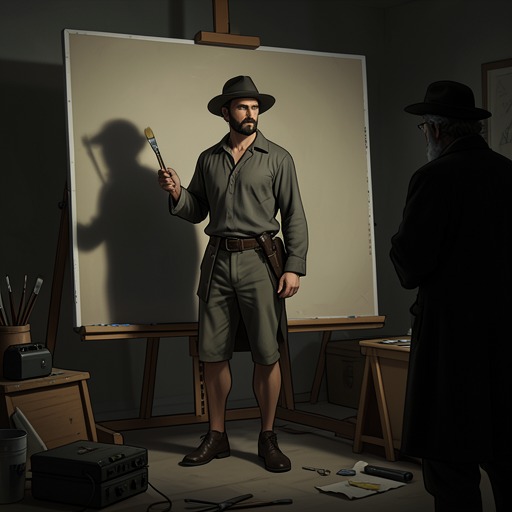
Dan Gregory burns Rabo’s painting
BluebeardDan Gregory burns Rabo Karabekian’s painting after first seeming to praise it, transforming a moment of recognition into an irreversible rejection. The picture, the product of six months’ painstaking work, goes into the fireplace; Gregory’s verdict that it has “No soul” makes the destruction a judgment not only on Rabo’s craft but on the painting’s failure to convey a distinctive human presence.
The Apparent Praise
Rabo recounts the episode retrospectively, describing how Gregory looked at his painting and said, “Not bad, not bad.” For a moment, the praise seems to mark Rabo’s emergence as a rival. He imagines Gregory as Robinson Crusoe discovering that he no longer has his island to himself: Rabo is now someone to reckon with. The comparison gives the compliment an edge of competition, but it is Rabo’s interpretation of Gregory’s reaction, not a declaration of mentorship or equality.
Gregory immediately revises the apparent approval. He asks whether “not bad” might instead mean disappointing or worse. The qualification turns praise into a trap: Rabo is allowed to hear recognition, then made to understand that Gregory considers the work inadequate. Before Rabo can formulate a reply, Gregory has already acted on his judgment.
The Painting in the Fire
Gregory places the picture atop the glowing coals in the fireplace, whose mantelpiece is decorated with skulls. The image is destroyed in an instant, while the six months of labor behind it cannot be recovered. The speed of the burning is the scene’s decisive reversal: a painstaking work disappears almost as soon as its maker can ask what is wrong with it.
Rabo manages to ask, chokingly and in astonishment, what the matter was with the painting. Gregory answers, “No soul.” The judgment is brief, but it defines the conflict. The criticism is not that the picture is technically incompetent; it is that, in Gregory’s view, it does not carry the life of its maker. The fire makes that verdict material: Gregory does not merely explain his standard but enforces it by destroying the object under review.
Gregory’s Standard of Art
Rabo says he knows what Gregory is complaining about, and that the complaint is not laughable coming from him. Gregory’s own pictures, as Rabo understands them, are alive with the full spectrum of his loves, hates, and neutralities, even if that spectrum belongs to its own time. In a private museum in Lubbock, Texas, Gregory’s works would form something like a three-dimensional hologram of the painter: his presence would remain legible through the paintings, even though it could not be physically touched.
That comparison makes “soul” more than a vague insult. Gregory’s art bears the imprint of an individual personality, while the picture he burns has failed, by his measure, to do so. The episode therefore distinguishes representational labor from expressive identity: six months of painstaking work do not guarantee that a painting will communicate its maker. It also leaves the standard unequal and personal. Gregory is both the judge and the man who can make his judgment final by putting the painting into the fire.
Consequence and Retrospective Meaning
The immediate consequence is the destruction of Rabo’s picture and the loss of six months’ work. The narrative does not describe a later recovery of the painting or a reconciliation over its destruction. Instead, the episode remains a sharp early measure of Rabo’s dependence on Gregory’s approval: the young painter asks for an explanation only after the work has already been condemned and destroyed.
Read alongside Rabo’s later account of his art, the scene also exposes a lasting tension between artistic meaning and public valuation. He will eventually describe his own collection as pictures “about absolutely nothing but themselves,” and note that he owned them long before marrying Edith. Much later, a Rothko from the collection sells off the wall to a representative of the Getty Museum for a million and a half dollars, while Circe Berman calls the pictures bad rubbish and urges him to get rid of them. The contrast does not establish that Gregory’s burning caused Rabo’s later collecting, but it places the episode within a novel preoccupied with who may judge art, what a work communicates, and how artistic worth can diverge from both price and personal attachment.
The novel’s author’s note cautions that the book is a hoax autobiography, not a responsible history of the Abstract Expressionist school, and that its characters, including Gregory and Rabo, never lived. Within that fictional account, however, the burning crystallizes a conflict the narrative returns to: whether art’s value lies in what it depicts, what it communicates about its maker, or what viewers and collectors are prepared to call valuable. Gregory’s fire settles the matter for this painting by ending its material existence; the scene leaves the larger argument open.