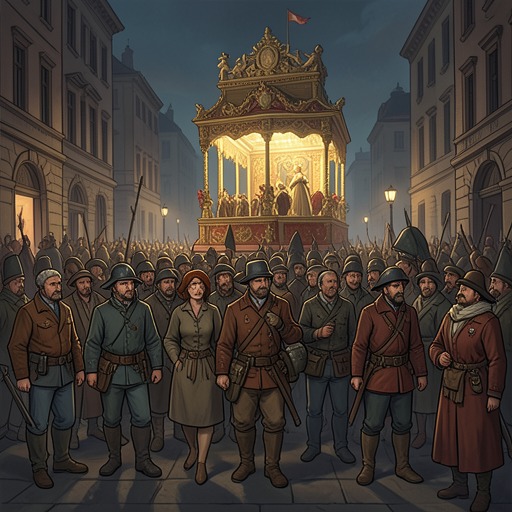
Gregory finds Rabo and Marilee at the Museum of Modern Art and drives Rabo away
BluebeardDan Gregory finds Rabo Karabekian and Marilee Kemp at the Museum of Modern Art and drives Rabo away in a confrontation that converts a forbidden museum visit into a decisive break with Rabo’s mentor, home, and first love. On Saint Patrick’s Day, 1936, Gregory treats their apparent disloyalty not simply as youthful transgression but as rejection of his authority over art and allegiance; Marilee remains behind, while Rabo leaves alone and does not see her for fourteen years.
The Museum Encounter
A Saint Patrick’s Day parade stalled traffic on Fifth Avenue, leaving Gregory’s convertible Cord directly in front of the Museum of Modern Art. Fred Jones was at the wheel. Rabo and Marilee emerged from the museum as the parade boomed nearby, both wearing green with the other people in the scene. Gregory clambered over the car door, pushed through the crowd, and planted himself in front of them, trembling and pointing at the pair.
The setting made their offence visible to Gregory and ambiguous to onlookers. He called out that he had caught them, then accused them of being parasites and ingrates. Rabo later observed that passersby might have assumed Gregory had discovered lovers leaving a hotel or apartment house rather than a museum. Gregory’s grievance, however, was specifically about the institution and what he believed it represented: he had asked them not to go there as proof that they were on his side.
Loyalty as a Prohibition
Gregory framed his rule against visiting the museum as a symbolic pledge, not a fear that Rabo and Marilee might encounter paintings he disliked. He said his request had been simple and easy to obey, and remembered it as a demand that they stay away from the museum. In his account, their happiness as they came out was more wounding than the visit itself: it looked to him like a mockery of his efforts to control the paintbrush and of his authority as their protective, parental figure.
His attack on the museum’s art was emphatic. He described its pictures as smears, spatters, splotches, daubs, and dribbles made by lunatics, degenerates, and charlatans. The confrontation sets Gregory’s command of loyalty against Rabo and Marilee’s independent pleasure in what they have seen. Rabo also notes the irony in calling these works genuinely modern: many had been painted before the First World War, before he and Marilee were born. The scene therefore makes the prohibition a conflict over allegiance and artistic judgment, not merely a dispute over where the young couple had gone.
Expulsion and Separation
Gregory said he would have Fred take him to City Island, where his yacht, the Ararat, lay in dry dock. He intended to live aboard it until Fred could assure him that Rabo and Marilee had left his house on Forty-eighth Street and that every trace of their presence had been removed. The threatened retreat was both literal and theatrical: Gregory would be living on an eighty-foot sailing yacht in dry dock, reaching it by ladder and relying on a boatyard’s toilet and telephone. He then ordered them out and declared them bad rubbish.
Marilee told Rabo that he had to go while she had to stay. She had saved enough money to look after him for a week or two, but insisted that it was time for him to leave and that he had become too comfortable. After they had been intimate, she told him that the clocks had stopped during their encounter and had started again, and that it did not count. She described him as still a boy and said she needed a man to take care of her; Gregory, in her view, was a man. Her response separated their attraction from any promise of a shared future.
Rabo packed his belongings, confused and humiliated. Marilee did not see him out, and he did not know which room she had gone to or what she was doing there. As the sun went down on Saint Patrick’s Day, 1936, he left Gregory’s house forever, without looking back. His first night on his own was at the Vanderbilt YMCA, only a block away.
The Long Aftermath
Rabo would neither see nor hear from Marilee for fourteen years. For a month or two after the expulsion, he imagined that he might become a great financial success and return to take her away from Gregory, a possibility shaped by the kinds of stories Gregory used to tell. The Arthurian imagery of those stories furnished Rabo with a fantasy of return: Marilee had posed as Guinevere, and he imagined bringing her the Holy Grail. The fantasy did not alter the immediate facts of his departure or the long separation that followed.
The Great Depression soon made such ambitions seem impossible. Rabo could not provide himself with decent food or a bed and was often among the homeless in soup kitchens and shelters. He used libraries for warmth and self-improvement, reading histories, novels, poems, encyclopedias, dictionaries, and popular books about succeeding in America. The expulsion thus leads directly into years in which the young apprentice has to survive without Gregory’s household, instruction, or support.
Retrospective Irony: The Museum Guard
The episode acquires an additional resonance from Rabo’s later life. Decades after the confrontation, he lives in a house that contains what he calls the most important private collection of Abstract Expressionist paintings still in private hands. Visitors treat him as a museum guard and repeatedly ask what the pictures are supposed to mean. The former apprentice once cast out for visiting the Museum of Modern Art has become the resident explainer of a collection in his own home.
That home’s conversion into a display space was Edith Taft’s idea. She brought Rabo’s stored collection into the Taft family house, and a 1981 issue of Architect & Decorator presented the foyer as the entrance to a modern-art collection within a redecorated Victorian home. The later museum-like household does not erase Gregory’s expulsion; it reverses the positions established by it. Rabo, once condemned for crossing a threshold, now stands among the works and answers visitors’ questions.
By the end of the book, the display extends beyond the foyer and house. Rabo opens the potato barn to visitors, unspikes its sliding doors to improve the flow through the enormous work inside, and finds that many visitors pass through more than once. Lay visitors ask what kind of painting it is; Rabo answers that it is not a painting but a tourist attraction, a World’s Fair, and Disneyland. The contrast with Gregory’s insistence on artistic loyalty gives the remembered museum confrontation a long afterlife: Rabo’s eventual public role is not to enforce Gregory’s prohibition, but to guide people through an experience that unsettles the boundary between art, museum, and attraction.