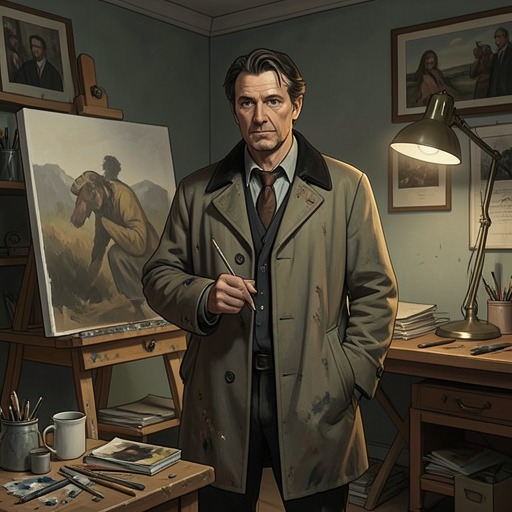
Rabo persuades General Whitehall to establish a camouflage unit
BluebeardRabo persuades General Whitehall to establish a camouflage unit by using an Army portrait commission as both a professional opening and a moment of strategic persuasion. While painting the general, Karabekian quietly advances the case that camouflage from the air belongs with the Engineers and that artists are naturally suited to the work. Whitehall’s retirement address turns that conversation into an order: enlisted men with artistic experience are to form a new camouflage unit under Karabekian’s command. The episode links artistic practice to military organization, and leads to a unit whose deceptions help protect its own lines during World War II.
Background and Opportunity
When war in Europe cost Karabekian his advertising-agency job, he joined the still-peacetime United States Army. A recruiting sergeant had suggested that a more American-sounding name might improve his prospects, even proposing Robert King; the Army instead retained him as Rabo Karabekian. His opportunity to influence military policy arose through Major General Daniel Whitehall, commander of the combat troops of the Corps of Engineers, who wanted an oil portrait of himself in uniform.
Whitehall was due to retire within six months because of failing kidneys and had narrowly missed service in both world wars. He wanted a portrait that might preserve his image, while Karabekian, then a scrawny recruit, was required as a regular soldier to paint without a fee. Whitehall did, however, willingly buy the expensive materials Karabekian used. The commission placed the young artist in the presence of a powerful officer and gave him time to shape the conversation around the Army’s future needs.
Persuasion Through the Portrait
Karabekian’s method was to flatter Whitehall while presenting useful ideas as extensions of the general’s own thinking. He praised Whitehall’s chin, encouraged him to imagine surveying a valley where a battle would take place, and suggested that aerial photography would become important if war came. As the portrait session continued, he steered the discussion toward the rivalry among service branches over aerial camouflage, arguing that the Engineers were the branch properly equipped to take responsibility for it.
He also represented himself as the first of what could become many artists recruited by the Corps of Engineers, rather than as an isolated painter asking for a personal favor. Whitehall had to hold his pose, so Karabekian could continue talking while he worked. The portrait therefore served two purposes: it was an image of the retiring general and the setting for a practical argument about aerial observation, camouflage, and the talents of artists. Karabekian later recognized the exchange as a form of advice from a powerless Armenian to a figure of authority, though his proposal also served his own interests.
The Order and Its Immediate Result
The painting was unveiled at Whitehall’s retirement ceremonies. By then Karabekian had completed basic training and become a private first class. He stood among the enlisted soldiers in front of the bunting-draped scaffold supporting the portrait, while Whitehall spoke from the ceremony. The general publicly lectured on aerial photography and the Engineers’ mission to teach other branches about camouflage, adopting the ideas Karabekian had urged during the sittings.
Whitehall then announced that one of his final orders would assign enlisted men with what he called artistic experiences to a new camouflage unit. He named Master Sergeant Rabo Karabekian as its commander, adding that he hoped he had pronounced the name correctly; Karabekian recalls that he had. The appointment followed a sharp change in Karabekian’s status, from recruit who had painted the portrait to the noncommissioned officer responsible for the new unit. Its creation was thus not simply a private exchange of ideas: the retirement speech made the proposal an Army assignment and put Karabekian in charge of carrying it out.
The Unit in Combat
The unit’s later work confirms the practical basis of Karabekian’s argument. It consisted of artists serving as Army engineers, selected on the theory that their civilian experience made them especially capable of camouflage. Near the end of World War II, however, the camouflage specialists were also fighting as ordinary infantry. Their task was not limited to disguising equipment or positions: they created misleading impressions for German forces about what was dangerous behind Allied lines and what was not.
The unusual formation answered directly to the Supreme Headquarters of the Allied Expeditionary Force rather than belonging permanently to a division or corps. It was assigned temporarily to generals who had heard of its deceptions; each became its patron for a short time, permissive of the artists’ unconventional habits and ultimately grateful for their work. The unit moved on when its temporary assignment ended. Karabekian refused promotion beyond captain so he could remain with what he called his happy family of thirty-six men, making the military unit not only the consequence of his initiative but also his first experience of a large family.
Significance
The episode turns portraiture into an instrument of advocacy. Karabekian’s persuasive work does not happen in a formal planning room but during the slow, constrained business of making an image: praise, pose, and technical instruction give him openings to direct Whitehall’s attention toward a new military capability. The finished portrait is unveiled alongside the policy it helped bring about, so the image and the order emerge from the same encounter.
The resulting camouflage unit joins the visual imagination of artists to the practical demands of war. Its work depends on inducing the enemy to misread a landscape and its hidden dangers; what begins as Karabekian’s claim that artists can contribute to camouflage becomes an operational method tested under fire. His later recollection also stresses the institution’s consequences for him personally: he chose the unit’s companionship over further promotion and remembered its thirty-six members as a family. The story therefore presents the formation both as a military achievement and as the beginning of a durable alternative to isolation.