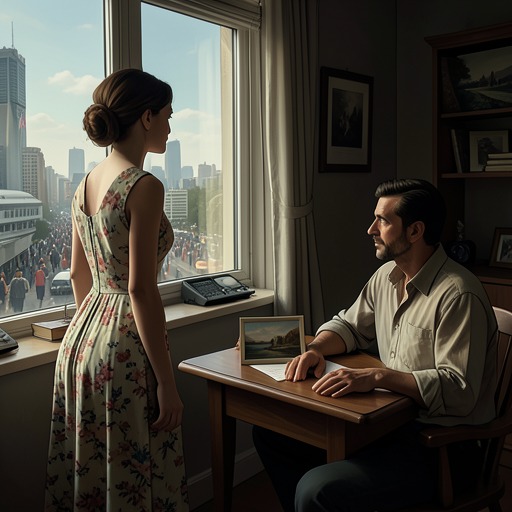
Rabo Karabekian's father dies at the movie theater
BluebeardRabo Karabekian’s father dies alone in the Bijou Theater in San Ignacio in 1938, remaining in his seat after the movie ends and the other patrons leave. Recounted by Rabo to Circe Berman, the death is more than a family loss: the theater becomes a final setting for a man who had survived the destruction of his former world, and whose chosen life in America embodied both his grief and his self-punishment.
The Death in the Theater
When Circe asks how Rabo’s father died, Rabo answers with a precise place and year: the Bijou Theater in San Ignacio, in 1938. His father had gone to the movie alone. He did not remarry after his wife’s death, and the account gives no suggestion that anyone accompanied him on this last outing. The simple fact of his solitary attendance echoes the solitude of his death.
Rabo supplies the film’s title when Circe asks what his father had been watching: Captains Courageous, starring Spencer Tracy and Freddie Bartholomew. The movie, about cod fishermen in the North Atlantic, belonged to a world entirely unlike the one his father had known. Rabo cannot say whether his father watched it before he died; he allows both possibilities, that he saw none of it or that he saw some. The uncertainty keeps the scene from becoming a neat final revelation about what the old man thought. What Rabo can say is that the film’s distance from his father’s experience might itself have mattered.
A Life After Loss
At the time of his death, Rabo’s father still lived above the little store in California where he had first established himself in the American economy. Rabo, by contrast, had been living in Manhattan for five years and working as an artist for an advertising agency. Their separate lives clarify the distance between father and son: the father remained in the place of his first foothold, while his son had moved to the city and entered a different working world.
The father had lost friends and relatives in the massacre. Rabo describes his father’s embrace of an unfamiliar America as a way of honoring them: he welcomed evidence that the planet of his boyhood had disappeared entirely. A film about North Atlantic fishermen, with no connection to anyone or anything he had known, could therefore offer a rueful confirmation of that disappearance. The account does not establish whether he watched the movie, but it links its radically foreign subject to the vanished world his father carried with him.
Work, Humiliation, and Remembrance
Rabo interprets his father’s life in America through a bitter reversal. With his education, his father could have learned English, become a respected teacher in San Ignacio, and resumed writing poetry, perhaps translating the Armenian poets he loved into English. Instead, he became a cobbler, as his father and grandfather had been. Rabo calls this choice a form of humiliation, and suggests that no lesser abasement would have answered his father’s need to punish himself.
That self-punishment is presented as a response to the massacre, not as a simple rejection of the father’s former life. By making himself over into the very kind of worker his ancestors had been, he both repeated the family past and degraded the educated person he might have become. Rabo’s account of the theater death gathers this history into a single image: the old man goes alone to see a story from a world outside his own, and remains behind when everyone else has gone home.
Rabo’s Recollection
The episode is told retrospectively by Rabo in answer to Circe’s direct questions. Her inquiries move from the manner of death to the movie itself, and Rabo answers first with the concrete circumstances, then with speculation about what his father might have made of the film. The narration marks the boundary between what Rabo knows and what he cannot know: the place, year, and title are stated plainly, while his father’s final experience of the movie remains uncertain.
That distinction gives the memory its force. Rabo does not claim access to his father’s last thoughts; instead, he interprets a solitary death through the longer story of exile, grief, and chosen abasement. The movie theater’s emptying audience supplies the scene’s final contrast: everybody else goes home, but his father stays. The image does not resolve his father’s history so much as make its solitude visible.