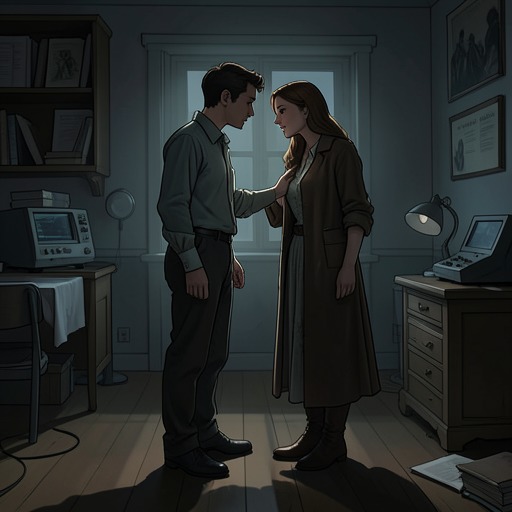
Rabo and Marilee's Saint Patrick's Day tryst
BluebeardRabo and Marilee's Saint Patrick's Day tryst is a clandestine encounter between the nearly twenty-year-old apprentice and the twenty-nine-year-old mistress of his mentor, Dan Gregory. Told retrospectively by Rabo, it rises from a forbidden visit to the Museum of Modern Art into a physical, almost ecstatic episode, then collapses into denial and separation. Its decisive consequence is immediate: Rabo leaves Gregory's house at sunset on March 17, 1936, and does not see or hear from Marilee for fourteen years.
The walk home and the imagined bond
After leaving the Museum of Modern Art, Rabo and Marilee slouch home like whipped children, laughing and falling into each other's arms. Their attraction is reciprocal and physical: on the way, they feel each other up, and Rabo imagines them as husband and wife, departing Eden together to face the wilderness. The fantasy gives their walk the shape of a shared future, even as their actual circumstances make the liaison dangerous.
The age difference and the threat of discovery sharpen the episode's illicit character. Rabo is almost twenty; Marilee is twenty-nine; Gregory, the man they are about to cuckold, is fifty-three. On the way home they stop to watch two men fighting outside a bar on Third Avenue, an interruption that places their private excitement against the city's ordinary disorder. Rabo remembers Marilee's slight limp and leftward list as lasting effects of Gregory's having pushed her down the stairs. In the present encounter, the man who injured her is absent, while Rabo's desire seems to him to bind them together.
Lovemaking as a self-contained work
Rabo later describes their lovemaking as having no purpose beyond itself: it is about absolutely nothing but itself, and in that sense anticipates Abstract Expressionism. The comparison gives the episode a formal idea as well as a bodily one. Rabo recalls the painter Jim Brooks's account of beginning with a first stroke of color and letting the canvas do at least half the work; for the lovers, the first stroke is a kiss just inside the front door. From there, the movement seems to direct itself.
The pair kiss, grope, and move in a swooning tango up the spiral staircase and through the grand dining room. They knock over a chair and set it upright again before continuing through the butler's pantry into an unused storage room, about eight feet square. A broken-down sofa and a tiny north-facing window looking onto the leafless treetops of the back garden define the makeshift setting. Rabo says they need no further instructions to complete their masterpiece, and remembers the encounter as repeated bull's-eyes. The artistic analogy does not make the scene less physical; it recasts its improvised progression as an experience that, for a short time, appears to need no explanation or external goal.
Interruption and mutual denial
The lovers' suspension of ordinary time ends when they hear the big front door open and close downstairs. Rabo recalls that they had been touching each other's upper arms and exploring their bodies when the sound forced the practical world back into the room. Marilee dresses and rejects the idea that she has done something either right or wrong; she tells Rabo that neither of them has, then declares that the encounter never happened. Her composure and direct look make the denial a deliberate boundary, not a continuation of their earlier fantasy.
The change is stark: what Rabo has experienced as reciprocal intimacy becomes, in Marilee's account, an event that does not count. She asks whether he feels better, and he says that he does, but the exchange offers no promise of a continuing relationship. The clocks, she says, stopped while they were together and have now started again. The image grants the tryst a temporary exemption from time only to withdraw it, restoring the lives and attachments that existed before the kiss.
Expulsion and departure
Marilee frames their possible future as a familiar tragic story: the mistress of a great painter seduces his young apprentice, the pair are discovered and cast out, and they freeze to death. She then makes the practical decision that follows from their unequal positions in Gregory's household: Rabo must go, while she must stay. She has enough money to support him for a week or two, but insists that he was becoming too comfortable and that it is time for him to leave.
When Rabo asks how they could part after what has happened, Marilee answers that she has already forgotten it. She says that he is still a little boy and that she needs a man to take care of her; Gregory, she says, is a man. The contrast with Rabo's imagined marriage and shared wilderness is exact: the future he projected from their walk home is replaced by Marilee's stated need and her decision to remain with Gregory.
Rabo goes to his room confused and humiliated, packs his belongings, and leaves without seeing Marilee again before departing. Nobody sees him out. At sunset on Saint Patrick's Day, 1936, he walks away from Gregory's house without looking back at the Gorgon on its front door. He spends his first night on his own at the Vanderbilt YMCA, only a block away, but will not see or hear from Marilee for fourteen years. For a month or two he imagines that success might let him return and take her away from Gregory, a possibility shaped by the stories Gregory used to tell. The encounter thus ends not in a shared life but in separation, with Rabo carrying a romantic possibility that Marilee has explicitly dismissed.