Sateen Dura-Luxe paint destroys Rabo's paintings
BluebeardSateen Dura-Luxe paint destroys Rabo Karabekian’s paintings through an unforeseen chemical reaction that strips the color and tape from his canvases, reducing valuable works to blank surfaces and scattered residue. The collapse of Windsor Blue Number Seventeen made the paint’s promised permanence an irony with lasting consequences: years later, when the mural’s panels were recovered from a locked basement chamber, Rabo chose to keep them rather than throw them away.
The Postwar Promise and the Failure
After the Second World War, Rabo reflects, new products were presented as miracles of modern life, from instant coffee and antibiotics to synthetic fibers. Sateen Dura-Luxe belonged to that faith in technological progress. Its advertisements promised that its colors would outlast the smile on the Mona Lisa, a claim Rabo recalls against the evidence of his ruined paintings. By the early 1960s, he says, he was among the first people to be completely wrecked by one of these postwar miracles.
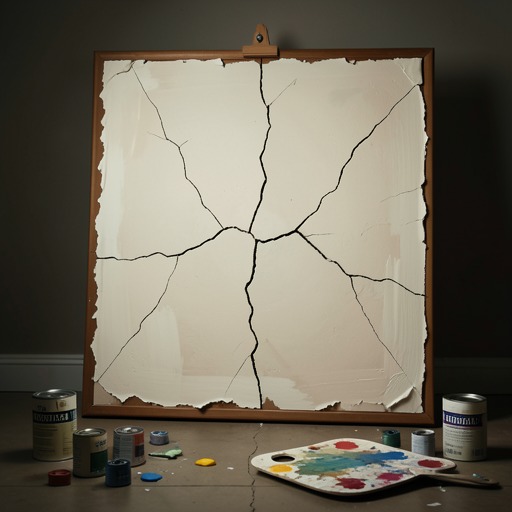
The damage came from unforeseen chemical reactions between the sizing of Rabo’s canvases, the acrylic wall paint, and the colored tapes he had applied. The finished paintings destroyed themselves: the paint and tape shed away, leaving canvases blank and ringlets of tape and moldy-looking fragments on the floor. People who had paid fifteen, twenty, or even thirty thousand dollars for his pictures were left looking at a surface ready for a new painting. The material failure was also a reversal of value: works once sold as finished art became empty supports and debris.
Rabo contrasts the defective house paint with the supplies he used for his earlier work. His oils were Mussini and his watercolors Horadam, both from Germany; his brushes came from Winsor and Newton in England, while his pastels, colored pencils, and inks came from Le-fébvre-Foinet in Paris, and his canvas from Claessen’s in Belgium. These costly materials had been supplied to him by Marilee Kemp, who had taken them from the basement stockroom at Dan Gregory’s mansion without permission because she feared Gregory, who regularly hit and kicked her. The contrast underscores that the paintings’ eventual destruction did not arise from a general scarcity of good materials: the catastrophe centered on the incompatible combination of canvas sizing, acrylic wall paint, and colored tape.
Windsor Blue Number Seventeen
The most prominent casualty was Windsor Blue Number Seventeen, which had first graced and then disgraced the lobby of GEFFCo’s headquarters on Park Avenue. Its eight panels, each eight feet square, formed a continuous mural sixty-four feet long, with a total area of 512 square feet. The dimensions had been part of the company’s publicity around the work, although Rabo notes that other murals in New York City and elsewhere were larger. Its fame and scale made its deterioration especially visible: the painting that had been presented as a landmark of modern art became an emblem of failure.
The paint’s advertising boast acquires a bitterly comic afterlife in Rabo’s account. The Mona Lisa, he observes, is still smiling, but Sateen Dura-Luxe has disappeared from the paint trade; a dealer who had worked in the business long enough would laugh at someone asking for it. The contrast turns the product’s claim of endurance back on itself. What endured was not the promised finish but the memory of the ruined paintings and the name of the failed paint.
Recovery and Rabo’s Decision
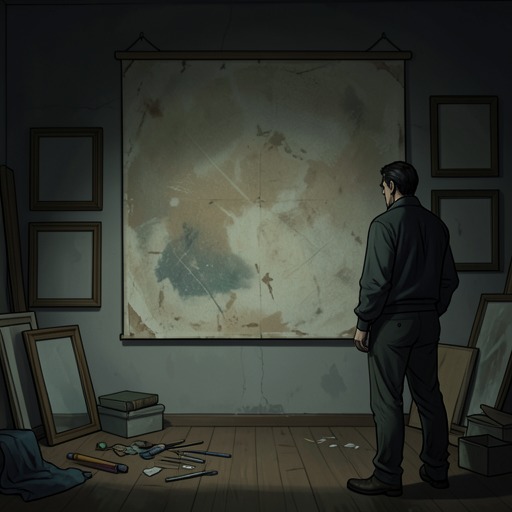
Years after the mural’s collapse, its panels were found behind a locked steel door in a chamber on the lowest of three basement floors beneath the Matsumoto Building, formerly the GEFFCo Building. A Matsumoto insurance inspector, searching underground for fire hazards, recognized the canvases from remnants of Sateen Dura-Luxe still clinging to them. Nobody knew what was behind the door; the inspector obtained permission to break in and later offered to return the panels to Rabo, with Matsumoto’s absent-minded approval.
The inspector explained that she was both the first woman and the first Black safety inspector at her company, joking that she was two birds with one stone. Her offer came from reluctance to see the canvases wasted, not from any claim that they remained useful or valuable. Rabo initially thought he had no use for them and did not expect to paint again. The potato barn had room to store them, but their presence would mean living beside one of the greatest embarrassments of his past.
He eventually asked the inspector not to throw the panels away and arranged for Home Sweet Home Moving and Storage to collect them. Her name was Mona Lisa Trippingham, an accidental echo of the paint’s old promise about the Mona Lisa’s smile. Rabo’s decision did not undo the chemical damage or restore the mural; it preserved the ruined canvases, carrying the failed work from a hidden corporate basement into the potato barn where they remained part of his later life.
Meaning in the Narrative
The destruction is not merely a metaphor for artistic rejection: the narrative identifies a physical failure in the materials themselves. Paint, tape, and canvas interact in a way their maker did not foresee, and the work’s disappearance is visible in what remains—blank panels, tape rings, and fragments on the floor. The canvases later preserve that history in turn, with scraps of the paint still attached when the inspector finds them.
The episode also connects a public career wound to Rabo’s recurring reflections on his father. He imagines that his father would have laughed at the destroyed paintings, as he would have mocked Rabo’s postwar abstract work. The paint’s failure thus revives an old resentment as well as the humiliation of the ruined pictures. Yet the recovered panels complicate the idea that the work has simply vanished: Rabo first regards them as a burden, then chooses to save them, allowing the remains of the catastrophe to persist rather than be discarded.