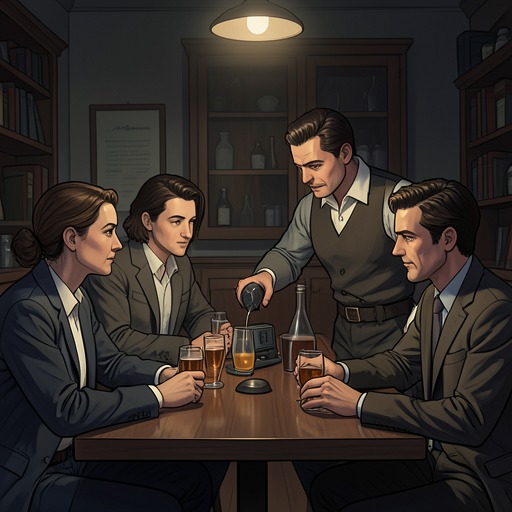
Phokla Chatterjee’s alcohol dependence
ChowringheePhokla Chatterjee’s alcohol dependence is presented as a daily compulsion that he cannot master and as a source of shame that reaches beyond himself to his nephew, Anindo Pakrashi. In a conversation with Sata Bose and Anindo, Phokla’s comic ease collapses into a tearful admission of his drinking and its consequences.
The Daily Compulsion
Phokla says he cannot do without alcohol. As darkness falls over Calcutta, he feels unable to resist drinking; he describes obtaining it by begging, borrowing, or stealing, but says that whatever the means, he has to reach for the bottle every day. His account makes the dependence more than an appetite: it governs the evening and narrows his choices to securing another drink.
The admission comes after Phokla has laughed and praised Sata Bose’s importance to the Hotel Shahjahan. The shift is visible even as the laughter continues: the confident performance gives way to a tearful confession. When Sata Bose is about to ask a waiter for a drink for him, Phokla stops him, pauses to think, and then gets up, leaving cash on the table for the drinks already consumed. The scene records that interruption, not a cure or lasting change.
Shame and Anindo
Phokla describes himself as less than a man, likening himself to an animal and a Muscovite mule. His self-condemnation is tied to his role in Anindo’s life: he admits that he was the one who started his nephew drinking and asks whether anyone else would have encouraged a nephew to do so. Anindo’s protest signals his discomfort, but Phokla’s confession makes the harm explicit.
He recalls that when his sister asked him to choose a name for her son, only Anindo, meaning the irreproachable, came to mind. Holding his nephew’s hand, he regards him as still innocent. The contrast sharpens the confession: Phokla sees in Anindo the virtue that he feels he has lost, while recognizing that his own drinking has already helped compromise it.
What the Scene Reveals
The episode places dependence within a family relationship rather than treating it as a private failing alone. Phokla’s account links his daily need for alcohol to the example he set for Anindo, and his tears expose the regret beneath his earlier laughter. His decision to stop Sata Bose from ordering another drink is a concrete interruption in the moment; the scene does not establish that he has overcome the compulsion.