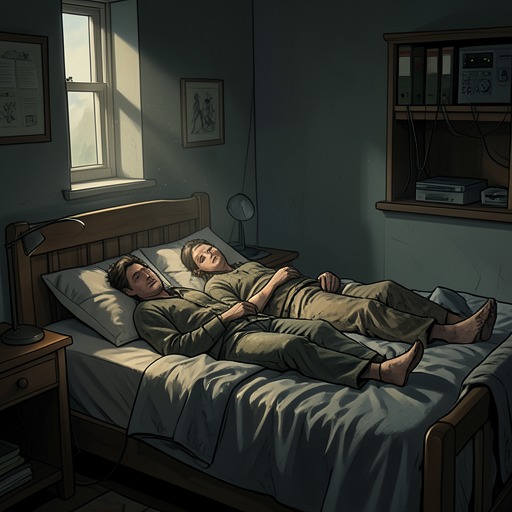
Smallpox infection
ChowringheeSmallpox in the narrative is not a single episode but a condition seen at two very different distances: in the pockmarks left on a waiter long after his illness, and in the active infection that devastates Robert Adam’s household in Williams Lane. The contrast makes the disease both a lasting mark on an individual body and a crisis whose consequences spread through a poor community, where care is constrained by money, fear, and misinformation.
A Visible Trace of Past Illness
At a hotel, Dr. Sutherland orders two pineapple juices and notices the waiter’s pockmarked face just as the man is about to leave. The waiter is embarrassed when the doctor asks when he had smallpox; he answers only that it was a long time ago. The exchange briefly interrupts an ordinary act of service: a face that might otherwise pass unnoticed becomes the focus of the doctor’s attention.
Dr. Sutherland responds not with revulsion but with wonder and concern. He remarks that the man was saved at the last moment and might otherwise have lost his eyes. The narrator is struck by the depth of feeling an unfamiliar foreigner can show toward an ordinary waiter. The scene establishes that the marks of smallpox remain visible after the illness has passed, and that this visible difference draws a humane response from the doctor rather than reducing the waiter to a curiosity.
Robert Adam’s Illness
The later crisis begins when a priest tells the narrator that Robert Adam has smallpox. Robert is at home in Williams Lane, and the people around him face an immediate practical dilemma: they cannot keep him there indefinitely, but sending him to an infectious-disease hospital raises the question of who will care for him and how the household could afford it. Jane Grey refuses to leave her husband and stays beside him throughout the day. Her commitment does not remove the financial danger or the burden of nursing.
Friends warn the narrator to keep well away from the infection and suggest sending money through the priest. He goes toward the house anyway, but does not enter. From a distance he can smell phenol and medicines. The priest, he understands, is inside tending Robert and applying olive oil to the lesions. The account makes care concrete through these materials and actions, while its image of Robert’s body as if burning conveys the severity of the illness without making the disease itself a distant abstraction.
Jane, pregnant and carrying a shopping bag on her way to the market, meets the narrator outside. The encounter sharply contrasts her present circumstances with her former public life: she had once drawn crowds and applause at the Hotel Shahjahan, where her performances helped bring customers and increase drink sales. Now she is living amid illness and poverty, still trying to manage ordinary necessities. Smallpox thus alters the setting around her as much as it threatens Robert: the celebrated performer appears in the neighborhood not as a spectacle but as a woman carrying the burdens of care and household survival.
A Ward, a Rumour, and a Loss
Robert is eventually in a hospital ward, where a watchman tells the neighborhood boys that patient number thirty-two has lost his sight. The boys take this to mean he will never see again. They are moved to tears and immediately consider raising the money for a specialist whose consultation costs eight rupees. Their response shows both the force of the news and the narrow practical terms in which help is imagined: even a small sum for medical attention must be gathered collectively.
The report proves inaccurate. The priest later protests that Robert has not become completely blind: he has lost sight in one eye, while the other has been miraculously spared. The correction matters, but it comes too late to undo the distress it has caused. The boys had tried to conceal the news from Jane and, unaccustomed to lying, could not sustain the attempt. She faints and is taken to the priest’s house.
That night Jane gives birth prematurely. She is gravely ill, and the priests kneel in prayer for her. She dies before the night is over, leaving the boys of Williams Lane in tears. The timing is set against the Hotel Shahjahan bar, which is still open as customers call for whisky and soda. The contrast places neighborhood bereavement beside the hotel’s continuing business, without suggesting that Jane’s death was itself caused by smallpox. Robert’s infection and the mistaken report of total blindness form part of the crisis surrounding her, while the narrative identifies premature childbirth and her subsequent death as events in their own right.
Care, Knowledge, and Unequal Exposure
Across these scenes, smallpox exposes differences in what people can see and what they can do. Dr. Sutherland recognizes the lasting bodily evidence of an old infection and answers it with tenderness. In Williams Lane, the priest provides hands-on care, the boys try to raise money, and Jane remains beside her husband; none of these acts can make illness safe or erase the household’s poverty. The warning that Robert has lost all sight magnifies fear before the truth is known, while the correction narrows the damage to one eye but cannot reverse the suffering already set in motion.
The narrative also places the disease inside a wider social contrast. At the hotel, the waiter’s pockmarks become visible to a doctor who has the time and means to notice them; in Williams Lane, infection is entangled with crowded responsibility, scarce money, and uncertainty about hospital care. The waiter’s surviving face and Robert’s endangered sight make vision a recurring measure of what smallpox leaves behind, but the scenes resist a simple account of illness as either recovery or death. One man bears old marks, another survives with sight lost in one eye, and Jane dies amid the same extended emergency—while care continues wherever people are able to offer it.