The commodification of women’s bodies in dance performances
ChowringheeThe commodification of women’s bodies in dance performances at the Hotel Shahjahan is presented as both a commercial system and a public spectacle: performers are packaged, priced, and circulated for audiences, while their actual bodies remain subject to scrutiny and demand. Connie’s arrival and performance make visible how the cabaret industry converts youth, appearance, and bodily display into sources of revenue.
The touring market and its measures
Connie is promoted as an established attraction, arriving at the Hotel Shahjahan after performing in the Middle East and appearing in Persia. Her advertised journey is part of a broader international circuit: Paris-based companies arrange engagements, usually six or eight months in advance, and performers move from city to city for two or three weeks at a time. As one engagement nears its end, photographs are sent ahead to the next stop and advertisements begin circulating, making the performer’s image a selling instrument before she arrives in person.
That market assigns particular value to youth. Dancers are expected to have photographs taken every three months and provide certificates confirming that the images are recent; agents and other industry evaluators inspect them before setting fees. Because performers sometimes try to submit photographs several years old, the hotel has arrangements with recognized photographic studios around the world. Images made in Calcutta could be sent onward to Kuala Lumpur, Tokyo, Manila, or North America. The performer’s body is thus commercially assessed through representations that travel independently of her, while the demand for novelty and youth helps determine what that body can earn.
The staged body and its audience
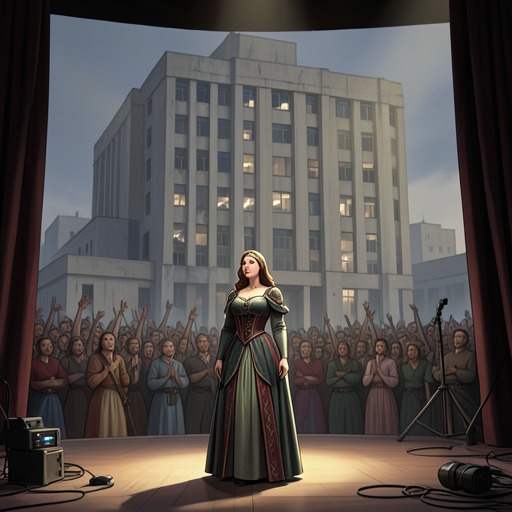
At the Hotel Shahjahan’s banquet, Connie’s body is made into the evening’s central attraction before she appears. The event is presented as a gathering for humanity, attended by philanthropists who claim to have set aside their private concerns for society, the nation, and the world. Yet the spectacle is carefully arranged to concentrate attention on a woman’s appearance. The narrator introduces Connie in extravagant terms, and when the lights go out, a wandering spotlight searches the darkened stage while the audience waits. The delay turns her entrance into part of the sale: anticipation is cultivated before the performer herself can be seen.
The first figure revealed is Lambreta, dressed in evening clothes and made conspicuous by a tall top hat and cane. Connie’s entrance is announced through this theatrical misdirection, which briefly makes the show a play of concealment and reveal. Her long, wide costume initially restricts the rhythm of her dancing, and she addresses the audience with an invitation to measure her figure. No one responds. The silence exposes the difference between the audience’s appetite for the spectacle and its willingness to acknowledge its own gaze openly.
As Connie dances, the gradual removal of her clothes converts that gaze into the show’s explicit currency. Each garment that falls raises the audience’s hopes, only for the discovery of further layers to prolong the unveiling. The narrator describes Calcutta as hungry for female flesh; when Connie is finally uncovered, the hall goes dark, and she gathers a garment to cover herself before disappearing. The lights return to applause, while Lambreta picks up her skirt, underwear, brassiere, and blouse from the stage. The applause and the scattered clothes frame the performance as both a carefully managed commercial act and a bodily exposure whose aftermath must be physically gathered up.
Respectability, race, and the labor behind display
The cabaret’s display of women’s bodies belongs to a wider social order in which women’s work and appearance are judged by those who profit from or consume them. At a banquet advertised as service to humanity, the narrator sees guests behaving with sexual impropriety beneath the tables, while hotel workers are treated as if their occupation made them morally suspect. The contrast exposes the respectability claimed by the public gathering: the audience can indulge its appetites, but the people who serve it remain vulnerable to contempt.
Rosie’s experience shows how that contempt converges with racialized judgment and economic need. She says people call her dark behind her back and insists that local prejudice persists even when Calcuttans condemn racial segregation abroad. Her family depends on her earnings: her father is paralysed, her parents are ill, and her unmarried sisters have no work. She had considered marrying Banerjee and arranging for her sister to take her hotel job, partly so that the girl might enjoy the food and comforts Rosie can access through her employment. Her account makes clear that a woman’s position in the hotel is not simply glamour or privilege; it is also a means of supporting relatives whose poverty sharply limits their choices.
The stigma attached to women’s service work reaches beyond Rosie. Robbie Adam loses his job after marrying a woman who had served drinks to strangers in a bar, because his employer claims the marriage has diminished the company’s prestige and could harm its business. The episode shows how the woman’s former occupation becomes a mark that affects her husband’s livelihood as well as her own standing. William Ghosh later learns that Rosie’s family lives in a single-room-and-a-half slum and that her ancestors were brought from Africa in chains and sold in Calcutta. The remembered history of enslavement deepens the account of how racial identity, inherited poverty, and precarious work shape the lives of women whose bodies and labor are publicly evaluated.
Rates, Race, and the Price of Attraction
The market’s prices make its judgments unusually plain. Bose-da cites a German dancer earning 180 rupees a week, plus allowances and passage, while an Egyptian performer and her sister together receive 1,000 rupees a month. Lola, from Cuba, earns 500 dollars weekly through an act in which ten tomatoes are attached to her body and sold for 100 rupees apiece; a customer may select one, which Lola bites and passes to him, after which he may taste it and return it. The transaction turns the dancer’s body into both display surface and point of sale, making audience participation part of the commodity rather than an incidental response to it.
The comparison with Marjorie exposes another measure of value. Though Bose-da calls her a remarkable singer, she earns only 100 dollars a week and draws little of the audience; he attributes the lack of interest to her being Black. Talent, then, does not determine a performer’s price or popularity on its own. The cabaret economy sells novelty and bodily appeal, but its valuations are also shaped by racial preference, assigning different rewards to women whose work may be equally skilled. The figures and examples leave the glamour of the touring spectacle intact while revealing the unequal calculations beneath it.