Varicose veins among hotel employees
ChowringheeVaricose veins among Hotel Shahjahan employees expose the bodily cost of work that requires waiters to remain on their feet. Through Mayadhar’s pain and his fear of seeking treatment, the condition is shown not simply as a medical problem but as a trap: the work aggravates the symptoms, while the worker cannot afford the rest that doctors recommend without risking his income and his family’s survival.
The condition and its visible signs
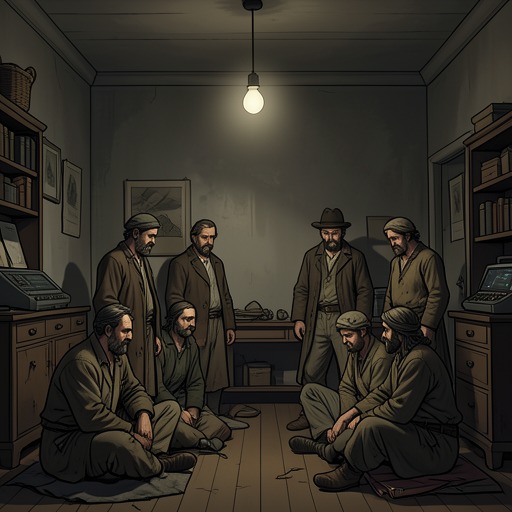
One evening, Mayadhar is lying on the grass and clutching his legs in agony. A fellow waiter explains that the pain in Mayadhar’s legs has become worse that day. Examining them under the light of the Calcutta Electric Supply Corporation, the narrator sees veins swollen like knotted ropes, or bluish snakes intertwined around the legs. Satyasundar Bose had identified the condition as varicose veins.
The description makes the illness visible in a way the workers’ uniforms and service roles might otherwise conceal. The comparison to ropes and snakes conveys the raised, tangled appearance of the veins, while Mayadhar’s posture and pain establish that this is not merely a cosmetic difference. His suffering is immediate: he has not even eaten that evening, and his body has brought the ordinary business of the workday to a halt.
Work, pain, and concealment
The waiters describe a shared bodily consequence of years spent standing. By the end of the day, they feel as though their legs have been cut off; over time, the veins begin to swell. Their account links the condition directly to the physical demands of their occupation, rather than presenting it as an isolated misfortune unrelated to work.
Yet acknowledging the illness at work could bring another danger. The men say they must hide their swollen veins from the boss because, if the head waiter learns of the condition, he would dismiss them immediately. The hotel therefore appears in two opposing roles: it is the source of steady work, but its employment demands leave little room for an injured worker. Concealment becomes a means of holding on to a job, even as the condition grows harder to ignore.
That pressure sits within a workplace organized around uninterrupted service. At the reception desk, the workload rises after breakfast, leaving no time for idle conversation as guests pass and exchange practiced greetings. In another scene, a complaint about the color of the bed linen sends the manager rushing to a room, where he answers an angry guest with elaborate apologies. These episodes show the hotel’s service demands from different angles: staff are expected to keep the guest experience running smoothly, while the waiters’ account reveals the strain that service work places on their bodies.
Treatment and the cost of stopping
The waiters know that medical help exists, but its price puts it out of reach. Asked whether they ever see a doctor, they explain that treatment costs too much. Doctors tell them to rest their feet, advice that collides with the basic condition of their employment: working in a hotel means standing, so the prescribed rest is not readily available to them while they continue earning.
Satyasundar Bose has given Mayadhar a letter of recommendation to a doctor he knows, but Mayadhar has not yet gone. He is saving money because the visit is expensive. The referral offers a possible route to care, but it cannot remove the financial obstacle or make rest compatible with the job. His delay is therefore not indifference to his health; it is a decision made under economic constraint, with treatment competing against the needs his wages must meet.
Mayadhar fears what may happen if he waits too long. He expects his legs to become like Bharat’s, with sores that will burst and bleed until he can no longer stand. Losing the ability to stand would mean losing his work, and he fears that his children would then go hungry. The progression he imagines joins bodily deterioration to a precise social consequence: illness threatens not only his own capacity to work but also his family’s means of subsistence.
Narrative significance
The episode turns the phrase “hotel work” into a physical reality. The swollen veins, the unfinished meal, the unaffordable doctor, and the requirement to stand give concrete form to a labor system in which workers may have to conceal the very condition that threatens their ability to keep working. Medical advice alone cannot resolve that contradiction when rest is economically inaccessible and disclosure may cost a job.
The narrator’s close inspection of Mayadhar’s legs and his questions about doctors make the workers’ account available to the reader without transforming their condition into an abstract statistic. Mayadhar speaks for himself about the costs, the delayed appointment, and the feared outcome. His account shows how a seemingly localized ailment reaches outward—to employment, household income, and the children who depend on it—while leaving the underlying workplace demands unchanged.