The marginal circumstances of Shahjahan Hotel employees
ChowringheeThe marginal circumstances of Hotel Shahjahan employees are made visible in the building’s divisions: guests occupy the cooled floors and polished public rooms, while workers climb toward improvised quarters, sleep where they can, and manage their own needs around a service routine built for others. Their marginality is not simply poverty; it is a spatial and occupational condition, sustained by the hotel’s demand that workers remain attentive, composed, and useful while their own comfort and privacy come second.
A hierarchy built into the building
The elevator journey with Sata Bose turns the hotel’s social order into a physical ascent. The first and second floors are reserved for guests. As the elevator rises beyond them, the air-conditioning ends and the atmosphere grows warmer. The elevator operator, previously standing straight, leans against the wall and scratches his leg. The small change in his posture makes the transition palpable: this is no longer the space where the hotel displays effortless comfort to its clientele. Sata Bose identifies the area beyond the cooled floors as the employees’ zone.
The route into that zone is itself a threshold. Once the elevator descends, the landing is left in darkness; a door opens onto a sudden spill of light, with instructions to pull on one side and push on the other. Sata Bose treats the signs as an image of fortune: people who choose the wrong direction may find that their doors never open. The wry observation sits beside a more concrete divide. The staff’s quarters are not an extension of the guest floors but a hidden interior that the hotel’s public face conceals.
On the roof, numerous small cubicles have roofs of tile or corrugated tin. Sata Bose calls this free accommodation the hotel’s hidden entrails. His own room offers a measure of privacy, but only within a wooden cabin whose walls are not brick. It has two small windows facing west and north and a door to the south, looking onto the street. The room is a refuge, yet its modest construction and exposed position mark the distance between the employee who keeps the hotel running and the guest protected by its climate-controlled interiors.
Service as continuous performance
The employees’ working day follows the hotel’s timetable rather than ordinary time. Sata Bose explains that it begins with tea in bed, proceeds through breakfast, lunch, afternoon tea, and dinner, and continues even when the calendar date changes. The phrasing makes the institution seem to have its own clock: the day can turn over, but the hotel’s labor does not stop with it.
At reception, the pace intensifies after breakfast. Guests emerge from their rooms and pass the counter singly or in pairs; the exchange of greetings becomes mechanical, yet Sata Bose delivers each one with precise, practiced attention, addressing guests by name or asking whether they slept well. A guest’s casual greeting is returned with the polish of a professional player sending a ball back across a net. The interaction may be brief, but its smoothness depends on the receptionist’s work: remembering, responding, and maintaining a welcoming manner amid a growing workload.
That emotional discipline is tested by complaints. When a guest summons the manager because the bed linen clashes with the curtains, Marco Polo hurries to the room, while the narrator follows, angry at the disproportionate alarm. The guest, a middle-aged Englishwoman, presents the room’s colors as a danger and says they have made her faint. Marco Polo shows no anger. He apologizes, offers three sets of replacement linen, and explains that the colors had been chosen for American tourists and that he had not known she would occupy the room. His response resolves the immediate complaint by accommodating the guest, while the contrast with the narrator’s fury shows how managerial composure is also part of the hotel’s labor.
Rooms without secure privacy
The rooftop room assigned to the narrator exposes another kind of vulnerability. Room 362 has not been opened for some time; dust on the door signals its disuse. Inside, Rosie’s cosmetics remain neatly arranged and her belongings are scattered about, as though she might return after a short absence. The narrator is not entering an empty, neutral lodging but taking up space in a room that still bears the absent occupant’s life.
The room is tiny, with dark green walls and doors, a white ceiling covered in burlap, a bed, a dressing table, and a wardrobe that occupies most of the available space. There is only one chair. Its deliberately sparse arrangement keeps curious visitors at bay, but it also makes clear how little room there is for anything beyond basic use. When a storm drives wind and rain through the rooftop quarters, the door slams against the wall and water reaches part of the bed. The narrator feels cut off from the rest of the world. The scene gives the employees’ lodging a material fragility absent from the guest rooms: privacy exists, but it is thinly protected from weather and intrusion.
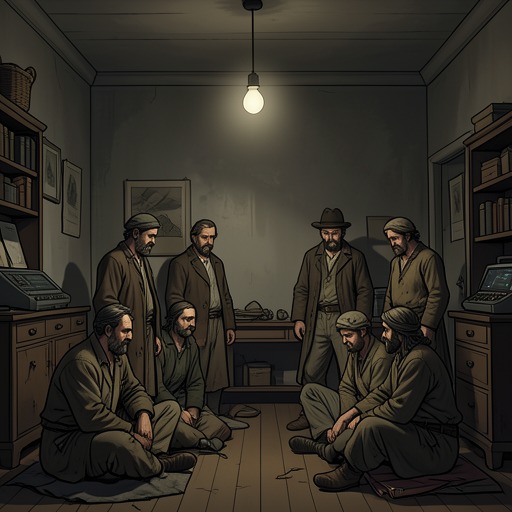
The hotel’s public spaces are not available as alternatives. The narrator finds workers sleeping outside and learns that they have nowhere to sleep in the kitchen, where the cooks’ assistants will not admit them. Although the lobby carpet could accommodate sleepers and the portico might offer shelter, both are ruled out because sleeping there would damage the hotel’s dignity or prestige. Workers are therefore driven to seek refuge at the feet of statues of Sir Ashutosh and Victoria House. The hotel can spare space for the appearance of comfort, but not for workers to sleep without compromising that appearance.
Food, too, follows the constraints of limited means. One worker has a standing arrangement with Little Shahjahan for meals at three and a half rupees each; Mayadhar is the only one who has not eaten that evening. These details keep deprivation specific: the employees are not simply described as poor, but shown negotiating meals and shelter within the narrow options their work and the hotel’s rules leave them.
Recognition and solidarity within the hierarchy
The narrative also shows that the employees’ marginal position does not erase their skill or value to one another. Sata Bose is exhausted after standing through the day, yet his authority among the staff is plain: a uniformed worker responds to his call, removes his shoes and socks, and sets out his sandals without being asked to explain the routine. Bose introduces this worker, Gurberiya, as his watchman, and presents the newly arrived narrator as someone who may become an important figure in the hotel. Their exchange suggests a close working world with its own trust and forms of recognition, distinct from the status displayed to guests.
Sata Bose’s encouragement of the narrator is generous, but it also reveals how the hotel absorbs workers’ abilities into its needs. After the narrator has presented a cabaret performer, Bose tells him that Connie is pleased and predicts that the narrator will become indispensable at the counter, bar, and cabaret. He has sandwiches sent for and offers a gift. The praise gives the narrator a place in the institution, yet the list of hotel functions leaves little distance between personal promise and perpetual usefulness: the ideal employee is one on whom every department can depend.
The narrator’s tears follow this encouragement, and Sata Bose embraces him. The episode briefly makes visible a solidarity grounded in shared endurance: Bose is described as having burned with the same fire for years. That intimacy does not remove the inequalities of the hotel, or alter the cramped rooms and restricted sleeping places. It does, however, show that the hidden employee world is not only a space of exclusion. Within it, people notice fatigue, offer food and practical help, and recognize in a newcomer the strain they have themselves borne. The contrast between this private care and the hotel’s polished guest-facing surface is central to the employees’ marginal circumstances: they make the institution appear seamless, while their own lives are held together through makeshift shelter, disciplined service, and mutual aid.