The narrator’s unemployment and poverty
ChowringheeThe narrator’s unemployment and poverty begin with the death of the British lawyer who had employed him, abruptly undoing the refuge he had found after an earlier life of hardship. Once treated with kindness among the courts and offices of Calcutta, he must start over without savings, influence, or a dependable way to earn a living. His search moves from appeals to acquaintances to a commission-only job selling wicker wastepaper baskets, where even access to an office lift is denied. The episode turns private misfortune into a view of a city whose social boundaries are enforced in small, everyday encounters.
From security to sudden loss
As a young secretary in the Calcutta High Court, the narrator had experienced his British employer’s benevolence as an oasis after poverty and deprivation. That security seemed capable of lasting; the lawyer’s death revealed how fragile it was. For someone already living close to hardship, even a slight disturbance could destroy the shelter on which everything depended. The loss is more than the end of a particular position: it removes the support around which the narrator had begun to imagine a stable life.
The departure from his former working world leaves him facing an urgent practical question: how to live. He has a school-leaving certificate, but the credential cannot itself secure employment. His former colleagues feel sympathy, yet their concern does not restore his income. In the contrast between earlier professional belonging and sudden need, the book shows how quickly a person can fall out of a respectable social circle when employment disappears.
A search that yields refusals
The narrator approaches people he knows, and they express regret at the sudden news. When he asks for work, however, sympathy gives way to excuses: businesses are struggling financially, and any possible vacancy will be mentioned later. One office contact, Mr. Dutta, is especially revealing. The narrator’s former law firm had accepted Dutta’s case without charge after the narrator requested help for him; now Dutta will not even receive the narrator. An assistant delivers a note pleading that Dutta is too busy to meet, and asks the narrator to write in return. He swallows his pride and does so, but receives no answer.
He also sends applications by the dozen, setting out his qualifications in detail to people both known and unknown, including post-office boxes. The effort produces no employment; its only dependable effect is to increase the post office’s revenue. The repeated applications turn a hopeful search into a measure of exclusion: the narrator follows the expected procedure, but the people and institutions capable of hiring him remain beyond reach.
Poverty and the basket trade
With no savings set aside for lean times, the narrator spends nearly everything he has and comes face to face with hunger. The next job is a small commission-selling operation presented under the polished-sounding name Magpil & Clerk. Its goods are wicker wastepaper baskets, which the narrator must carry from office to office and sell for four annas each. The business is run by M. G. Pillai, whose scant possessions and dirty clothes stand in sharp contrast to the respectable names the company echoes. A dim room on Chhatawala Lane serves simultaneously as factory, office, showroom, kitchen, and bedroom; the venture’s grand commercial label cannot disguise how precarious it is.
The commission sounds promising to a man with almost nothing, but the narrator cannot sell even his first baskets. He makes the rounds with them in hand, looking beneath clerks’ desks for a possible need. In May, the streets seem to melt under the sun, and the narrator’s shirt is soaked with sweat. He is desperately thirsty, yet the small roadside water channels are provided for horses, not people like him. The contrast gives physical form to his position: he must keep moving in pursuit of work while the city’s modest provisions do not extend to the unemployed.
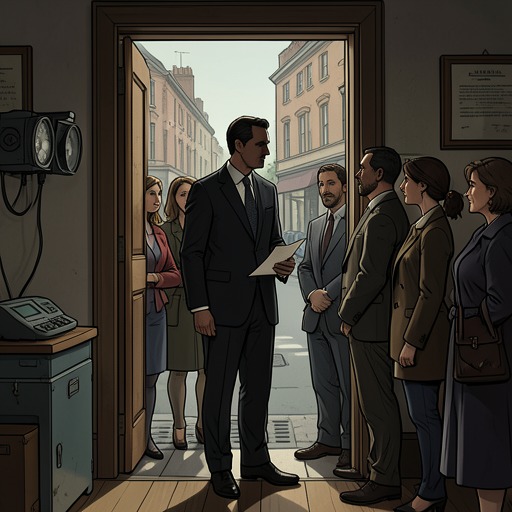
At one large building, he enters an elevator, still carrying the baskets. The operator recognizes what his burden signifies and opens the doors again, directing him to the stairs: the lift is reserved for officials and employees. The rejection is immediate and spatial. Before the narrator can offer his goods, his appearance and cargo mark him as someone who does not belong among the salaried occupants. Selling baskets takes him into office buildings, but does not grant him the status or access of the people who work inside them.
Poverty within a longer history of exclusion
The book places the narrator’s precarious search alongside accounts of older forms of exploitation in Calcutta. Hobbs recalls that human beings were still bought and sold in the city in the middle of the previous century, with British residents and local aristocrats purchasing children from Murgihata. Rosie later tells William that her African-descended community traces its presence in the city to people brought in chains from Africa, sold for twenty-five rupees each, and left there even after emancipation. Their descendants, she explains, remained apart from the native mainstream despite generations of suffering and deprivation.
These histories are not presented as the same experience as the narrator’s unemployment. Rather, they widen the frame around his vulnerability: Calcutta’s visible inequalities have a past, and freedom or formal respectability does not automatically provide security, inclusion, or a livelihood. The narrator’s empty applications, depleted savings, commission basket, and denied access to the lift make that broader social fact tangible in the ordinary business of trying to survive.