The shift in Shahjahan Hotel’s management and operations
ChowringheeThe shift in Shahjahan Hotel’s management and operations marks the unravelling of a familiar workplace and the arrival of a new order shaped by modernity, commercial priorities, and control over who may represent the hotel. After Marco Polo leaves, Jim announces that everything will change. Agarwalla’s acquisition of most of the shares from the principal English shareholders gives that change an ownership as well as a managerial dimension; under the new regime, long-standing colleagues are displaced, the hotel’s public face is remade, and the narrator loses his job.
The Hotel as a Stage
Before the management change becomes explicit, the hotel is already presented as a place where public appearances are carefully staged. At a banquet for the newly established Calcutta branch of the philanthropic Sociedad Filantrópica, Agarwalla, Langford, and Khan Bahadur Huq welcome guests in visibly different styles of dress. The gathering is described as a sacrifice of personal pleasure for humanity, yet Satyasundar Bose quietly alerts the narrator to Agarwalla’s company’s permanently rented second suite, which serves like a guest house and is kept by Karabi Guha, who receives a substantial cheque in addition to her salary. The polished public occasion and the private arrangements behind it occupy the same hotel.
Satyasundar Bose also observes that Calcutta’s banquets repeatedly draw the same guests from shared invitation lists. More pointedly, he warns that the next day’s newspaper will not report what actually happened: the speeches and summaries have already reached the editors before the banquet begins. The spectacle is thus managed in advance, with the public account prepared before the event it purports to record. That gap between presentation and backstage reality anticipates the later management’s own language of modernization and renewal.
The hotel’s entertainment likewise depends on controlling what guests see. During Connie’s cabaret, the lights go out and a roaming spotlight delays revealing who is onstage; instead of Connie, Harry appears in evening dress, a towering top hat, and carrying a cane. At the end of the first act, the lights are extinguished at the narrator’s signal to preserve Connie’s modesty. She waits backstage, wrapped in a robe and gasping for breath, while Harry has disappeared in anger. The polished performance depends on backstage labor, timing, and vulnerability—elements that the audience-facing spectacle conceals.
Departure and a New Management
Marco Polo’s departure gives the change an intimate, almost familial starting point. His luggage is loaded into a hotel car while waiters and other employees form a long line outside the office. In shorts and a white shirt, he resembles a ship’s captain; he shakes hands with each employee and asks them to keep the flag flying and improve the hotel’s reputation. He also tells the butler to look after his boys. For the narrator, the departure leaves the building like an empty, accursed castle: the familiar faces that had gradually filled it have gone, and he feels like a patriarch left at an empty table after his family has departed.
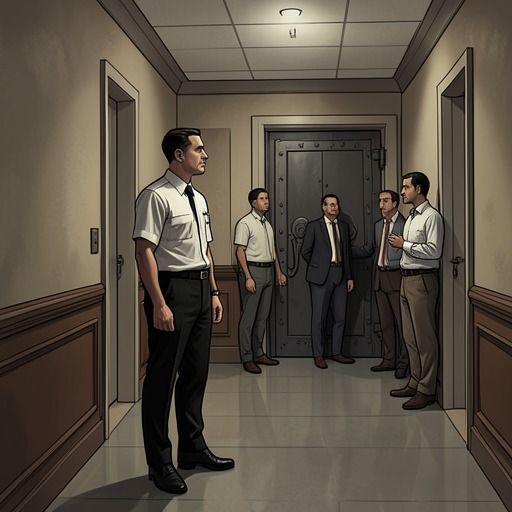
Jim soon makes clear that the hotel will no longer be run as before. As a first sign of the new policy, he brings in a young woman with painted lips to replace Satyasundar Bose. Rosie had hoped for the position, but Jim tells her directly that, given her appearance, she cannot be the hotel’s principal receptionist. Meanwhile, he increasingly assigns William the accounts and records, concentrating his own attention on payments and issued cheques. The shift is not merely a change of personnel: it redraws the division of work and the standards by which employees are judged.
William later tells the narrator that Agarwalla has bought most of the hotel’s shares from its principal English shareholders. The narrator recognizes that he could have anticipated the change by watching how obsequiously Jim behaved whenever Agarwalla was mentioned. The acquisition helps explain why the new management’s plans extend beyond ordinary daily administration. When Phokla Chatterjee comes to inspect the hotel, he says that they want to retain a European style of management while making everything modern, adding that women now walk in the streets where, in Simpson’s day, they had not ventured out of their homes.
Modernization and the New Public Face
Phokla assures Jim that the owners will not interfere with the hotel’s daily work, but immediately describes a substantial intervention in its image and clientele. He and Agarwalla, he says, will bring in attractive girls and make the Hotel Shahjahan a meeting place for all races. The promise of non-interference sits beside a plan to reshape the hotel’s public face through the women it employs and the customers it hopes to attract. Soon, the narrator notices, unfamiliar faces are appearing throughout the hotel, while the changes themselves are conducted in secrecy.
The contrast with the older hotel is not simply between European and Indian management. The new leaders invoke the European style as something to preserve, yet also reject the habits of Simpson’s era in the name of modernity. Their project combines inherited prestige with a redesigned, more conspicuously fashionable image. The hotel remains a stage for public display, but the people selected to appear on it—and the work expected of them—are changing.
Displacement and the Cost of Change
Gómez’s departure makes the new priorities audible. Sitting in a darkened room, he tells the narrator that he has finally understood his mistake: music should be offered only to God. He is preparing for his last concert at the Shahjahan. Jim and Phokla have told him that his instruments cannot produce music cheerful enough for a ballroom filled with the radiant colours of youth; he must play cheerful music or resign. Gómez chooses to leave rather than comply. A priest from Bandel Church has offered him responsibility for the music at a small church on India’s southern coast, and he accepts the position as a gift from God. For his final performance, he puts on his best clothes and holds his small ivory-tipped baton more firmly than before, even as he prepares to play what the hotel demands.
The narrator’s dismissal makes the staffing policy personal. On the last day of the month, Jim summons him while Phokla is present and says that his services will no longer be needed from the following day. Later, Rosie explains that she tried to stop Jim, pleading while she typed, but Jim had already presented his plan to Phokla in detail: they want only girls at the counter. The young receptionist is occupied with her makeup while Rosie bites her nails; the scene places the new policy in view even before its consequences are fully stated. Rosie’s attempt to intervene cannot alter a decision made above her.
The narrator goes up to the rooftop feeling that his world is collapsing, where Rosie joins him beneath the stars and apologizes for failing to prevent his dismissal. Her distress offers a last trace of solidarity within a workplace being reorganized around new priorities. Together, Marco Polo’s departure, Bose’s replacement, Gómez’s resignation, the acquisition of shares, and the narrator’s dismissal show the cost of the hotel’s proclaimed modernization: familiar workers lose their place as management remakes both the institution’s image and the people permitted to embody it.