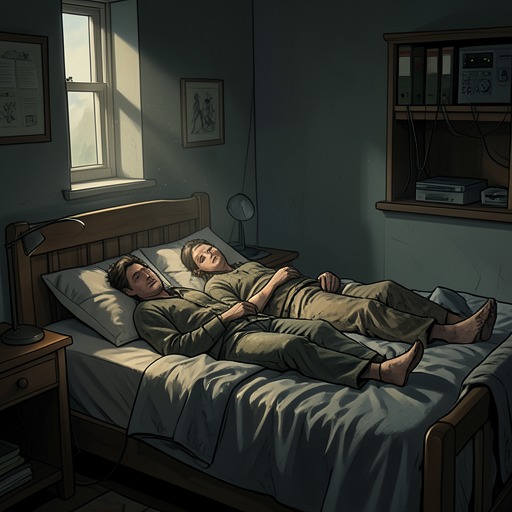
The Adam couple’s poverty
ChowringheeThe Adam couple’s poverty is a gradual collapse of security, not a single sudden fall: Robert Adam loses his position after marrying Jane Grey, employers shut him out because of the marriage, and his eventual commission work cannot keep pace with the couple’s needs. Their descent from the comforts associated with the Shahjahan Hotel to a deteriorating flat in Williams Lane makes respectability, employment, and domestic security appear fragile—and unevenly available to men and women alike.
The loss of employment and social standing
Robert tells the narrator that his employer dismissed him because his marriage to a woman who had served drinks to strangers in a bar was said to diminish the firm’s prestige and threaten its sales. The explanation makes the marriage itself, rather than any dispute at work, the stated cause of his unemployment. The narrator is initially incredulous that an Englishman could lose his job in Calcutta for this reason, but Robert shows him the employer’s handwritten letter, confirming that the dismissal is not merely a rumour.
The couple’s new hardship is therefore tied to Jane’s former work and the stigma attached to it. Robert’s employer presents his wife’s past as a commercial liability: the company fears that retaining him will damage its business. What might be understood as a private marriage is treated as a public mark on his professional standing. The result is material as well as social. Robert loses his income, while Jane’s past becomes the reason that his attempt to support their household is obstructed.
Rejection by prospective employers
After the dismissal, the narrator encourages the couple to look for another position, believing there are many firms in Calcutta. The search soon shows how little that apparent abundance means. Robert visits several businesses, where senior employees recognize him and respond as if his reputation makes him dangerous to employ. They offer him a chair, then identify him as the man who ran away with a Shahjahan Hotel barmaid.
Robert corrects them: he did not run away with Jane; he married her. The employers’ response reduces that distinction to a technicality, treating marriage as scarcely different from abduction or flight. Their dismissive exchange reveals how gossip travels ahead of Robert and frames him before he can present his work or qualifications. The rejection is not confined to a prestigious role: the narrator says that Robert cannot find employment of any kind, however simple. In time, Robert recognizes that no company in Calcutta will hire him. His unemployment is thus sustained by collective refusal, not by a brief interval between jobs.
Savings, insecure work, and approaching childbirth
With no regular income, the couple’s savings gradually run down. They have to give up their carefully decorated little house and move into a smaller place. Jane offers to try to earn money, but women have few available routes into paid work at this time. There are no typists or telephone operators; the options described are sewing or hairdressing for ladies, or opening a shop on Park Street. Each requires a skill the evidence does not establish that Jane has learned, so her willingness to work does not immediately provide an escape from their circumstances.
Eventually, the narrator secures Robert a position with a textile firm through Mr. Street, a businessman from Manchester staying at the Shahjahan Hotel whom the narrator knows slightly. He asks Mr. Street to employ Robert without a salary, on commission. Robert considers the arrangement beneficial, but the terms transfer much of the risk to him: he must make sales to earn, rather than rely on a wage.
The work fills his day. He travels in the morning with fabric samples to Barabazar, returns home for a frugal meal Jane has prepared, and then sets out again elsewhere. The firm’s cloth for parasols is famous, but that does not translate into abundant sales. There are not many parasols to sell in a year, and the commissions are correspondingly low. They cannot afford even a servant or cook; Jane must do everything herself. The couple’s attempt to regain a foothold in work therefore leaves their household precarious, just as Jane’s due date approaches.
Williams Lane and the reversal of domestic life
By the time the narrator visits Jane, the couple is living in a dilapidated flat in Williams Lane. It has two rooms; the plaster is flaking away to reveal the bricks underneath. The physical condition of the home gives visible form to the financial deterioration already traced through dismissal, failed applications, depleted savings, and uncertain commissions. Their hardship is not only that they occupy less space, but that even this reduced shelter is in disrepair.
Jane’s changed routine sharpens the contrast. At the Shahjahan Hotel, she had spent nights in a palace-like setting and walked on soft carpets; waiters had escorted her carefully to the dining room. Now, physically weakened as childbirth approaches, she has to cook and keep the flat in order. The narrator recalls Jane’s former work serving drinks and compares her public smile to a string of pearls accompanying whisky, brandy, gin, rum, and vermouth. That polished hotel persona belongs to a life the couple has lost; it does not protect them from the labour and exhaustion of their present one.
Jane’s response preserves the contradiction rather than resolving it. She cannot forgive the Shahjahan, although it was there that she found her husband. The hotel is at once the place associated with the beginning of their marriage and the remembered world of comfort from which their present poverty marks a departure. Robert’s work has not ended in secure recovery, and the evidence leaves the couple facing childbirth in hardship. Their story shows how a marriage condemned as a threat to an employer’s prestige can narrow a man’s access to work, while the woman whose past occasions that judgment has few independent employment options and bears the immediate burden of maintaining the home.