Aldo Bellini
ConclaveAldo Bellini is a senior cardinal, an experienced Church leader, and the principal liberal candidate in the papal election. He advocates greater episcopal autonomy, tolerance within the Church, and a more open approach to other faiths, while opposing a return to the traditionalist order represented by Goffredo Tedesco. His candidacy brings these political differences into the election, but his friendship with Jacopo Baldassare Lomeli and his eventual decision to acknowledge his limited support reveal a more complex figure than a simple factional standard-bearer.
Identity and position
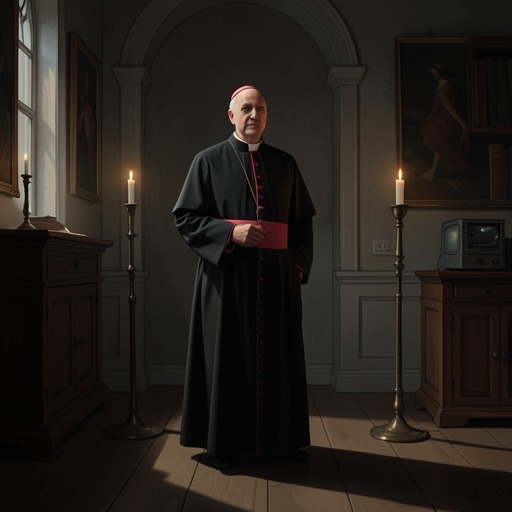
Bellini is the Secretary of State when the late Pope dies, one of four senior cardinals present in the Pope’s apartment alongside Joseph Tremblay, Joshua Adeyemi, and Lomeli. He is a former rector of the Gregorian University and former Archbishop of Milan, and has long been regarded as the liberals’ leading intellectual hope. His office as Secretary of State ends with the breaking of the Fisherman’s Ring, joining the personal loss of the Pope to the abrupt end of his administrative tenure.
The end of office is registered in his appearance. Lomeli sees Bellini standing with his back to the room, his tall, thin frame, usually held erect, seeming broken by the moment. Bellini is absorbed in the late Pope’s travelling chess set, tracing the small red and white pieces crowded into an unresolved position. He asks whether he might keep it as a memento. The unfinished game gives a quiet material form to the uncertainty of succession, while Bellini’s request shows his grief expressed through a private object rather than political calculation.
The succession and political programme
Lomeli identifies Bellini, Tremblay, and Adeyemi as candidates with organized support among the electors, but Bellini’s appeal rests on a distinct liberal programme. In explaining what supporters should say on his behalf, he defines himself in opposition to Tedesco’s traditionalism: he rejects a return to Latin liturgy and to Mass celebrated with the priest’s back to the congregation, and describes the former social order as repressive. He stands for respect toward other faiths, tolerance of differing views within the Church, greater authority for bishops, and a larger role for women in the Curia.
That programme has limits, which Bellini’s supporters are careful to make clear. Giulio Sabbadin warns that a public emphasis on women could give Tedesco an opening to misrepresent Bellini as supporting female ordination. Bellini accepts that the question of ordination is closed for his lifetime and, in his view, likely for several lifetimes. His reformism is therefore neither unqualified nor detached from electoral realities: he articulates changes he supports while recognizing boundaries he does not intend to cross.
The election turns from formal voting toward the arithmetic of assembling a winning coalition. At dinner, the Italian cardinals supporting Bellini assess their disappointing position as other candidates cultivate their own blocs. Goffredo Tedesco, strengthened by leading the first ballot, works among South American cardinals; Tremblay listens to South-East Asian electors; Adeyemi meets conservative archbishops from Eastern Europe; and Bellini is placed among North American cardinals to explain his support for greater episcopal autonomy. The constitutional prohibition on electoral pacts stands beside the practical work of testing views and counting possible votes.
Lomeli recognizes that his own votes may be weakening Bellini’s prospects. He says that if he identifies his supporters, he will ask them to vote for someone else, and that if asked for his preference he will name Bellini. Although questioned about the Dean’s duty of neutrality, Lomeli distinguishes campaigning from expressing a judgment: he considers Bellini the best-qualified person to govern the universal Church. At the first ballot, Lomeli votes for him, making his support concrete rather than merely rhetorical.
Bellini and Lomeli
Bellini’s relationship with Lomeli is marked by political loyalty without a claim of personal entitlement. When Bellini later explains that he does not have sufficient support to be elected, he acknowledges that Lomeli has been among his loyal supporters despite having been replaced by Bellini as Secretary of State—a position that could have given Lomeli grounds for resentment. Bellini’s recognition of that history makes his withdrawal a candid assessment of the election rather than an attempt to preserve his candidacy through personal appeals.
Their exchanges also show that Lomeli trusts Bellini as a source of insight into the late Pope and the Curia. Bellini describes the late pontificate as a sustained institutional struggle: the Pope rejected full ceremonial regalia and the Apostolic Palace, demanded financial transparency, and brought in accountants and management consultants to examine Church accounts. Bellini recalls that this scrutiny provoked hostility within the Curia and that leaks exposed abuses, including the use of funds intended for the poor to pay for apartment renovations and first-class travel. He also connects the Pope’s isolation to attacks from Tedesco and his allies over comments concerning gay people, divorced couples, and women.
Bellini does not present the late Pope’s judgment as infallible in practice. He tells Lomeli that the Pope was frail and ill and that this affected his judgment, then advises him not to use the discovered financial report: publishing it, Bellini argues, would not serve the Pope’s memory, and the document should instead be returned or destroyed. The advice creates a conflict between Bellini’s record of supporting transparency and his concern about the consequences of exposing the report during a fragile succession. His position is not that the financial questions are unimportant, but that disclosure may damage the Church and the dead Pope without resolving the underlying problems.
Financial reform and institutional conflict
The evidence Bellini discusses is concrete. A document hidden among the late Pope’s papers lists official apartments occupied by serving and retired Curia members, including Bellini’s 410 square metres, alongside Adeyemi’s 480 and Tremblay’s 510. The late Pope’s own accommodation at Casa Santa Marta is listed as 50 square metres. An attached memorandum estimates the APSA property portfolio at 347,532 square metres, with a potential value exceeding €2.7 billion but a stated book value of €389.6 million; it also reports a paid occupancy rate of 56 percent and warns that much income may not have been properly declared.
Bellini’s account explains why the late Pope’s attempt to investigate such finances generated resistance. He recalls a demand for properly kept books, disclosure of accounts, outside tenders for building work, and receipts, followed by the placement of auditors and consultants in offices on the first floor of Casa Santa Marta. He describes the resulting hostility not only from traditionalists but also from officials unsettled by scrutiny. The papers therefore expose more than a discrepancy in property values: they place the question of financial supervision inside the same struggle over authority, loyalty, and the Curia’s capacity to reform itself.
Bellini’s counsel to suppress the report has particular weight because he had supported the reforming pontificate and understands the institutional resistance it encountered. He tells Lomeli that the Curia, however imperfect, is the heart and brain of the Church, and that service to God is carried out through the Church. His defense of the institution coexists with a clear account of its failures. That tension complicates any simple division between reformers and defenders of the status quo: Bellini can acknowledge corruption and the late Pope’s campaign against it while still fearing that disclosure at this moment will cause further harm.
Declining candidacy and narrative significance
When Bellini visits Lomeli, he states directly that he has concluded he lacks sufficient support among their colleagues to be elected Pope. Lomeli urges him not to assume the contest is over, but Bellini considers his own decision settled. He recalls his loyal cohort of supporters and singles out Lomeli’s support despite their professional history. His withdrawal is presented as a sober reading of the electoral balance, not a repudiation of his principles or of the friendship that has sustained his candidacy.
Bellini’s role in the election is thus defined by the distance between qualification and viability. He is Lomeli’s preferred candidate and a longstanding intellectual figure for the liberals, yet the election’s shifting coalitions do not guarantee that his programme can command the necessary votes. At the same time, his advice about the financial documents shows that political judgment extends beyond choosing a pope: the electors must decide what the Church should reveal about itself and what institutional loyalty requires. Bellini embodies that unresolved choice, supporting reform while weighing the costs of exposing a wounded institution during the struggle to succeed its leader.