Giulio Sabbadin
ConclaveGiulio Sabbadin, the Archbishop of Milan, serves as an influential organizer among the Italian cardinals during the conclave. A close political supporter of Aldo Bellini, he reads the election through vote totals, alliances, and the prospects of office; when Bellini’s route to victory falters, Sabbadin argues for Joseph Tremblay as the only workable alternative. His calculations make him a clear-eyed broker of electoral power, but his later rebuke of Jacopo Baldassare Lomeli reveals the ethical limit of that approach: he regards compromising information as a weapon to be retained for leverage, while Lomeli insists that it must be disclosed to the electors.
Identity and Position
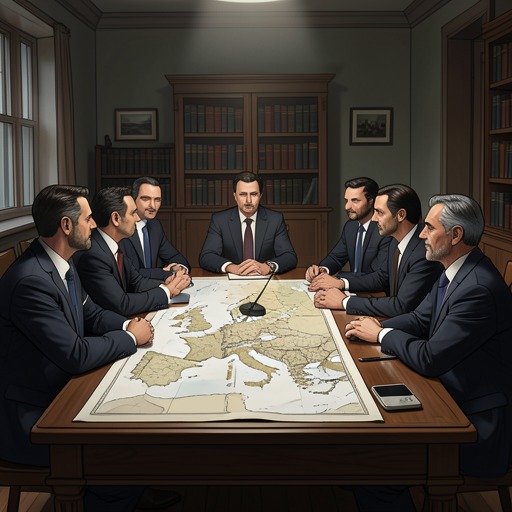
Sabbadin is identified as the Archbishop of Milan and appears among the Italian cardinals who form the core of Bellini’s support. At the first dinner after the initial ballot, he looks around the table at this group as they assess a disappointing result. The scene places him not simply among Bellini’s sympathizers but in a position to interpret their prospects and direct discussion of what they should do next.
The election’s formal ban on pacts and promises does not prevent the cardinals from calculating how support might move. Sabbadin’s role emerges in that gap between rule and practice: he does not control the ballots, but he organizes the Italian bloc’s understanding of the numbers and presses its members toward a strategically viable candidate.
Bellini’s Prospects After the First Ballot
At dinner, Sabbadin asks whether the Bellini supporters can still win. He maintains that they can, but acknowledges that the first ballot has left four men as the plausible contenders: Bellini, Goffredo Tedesco, Joshua Adeyemi, and Tremblay. His answer is not a confident prediction so much as an attempt to keep the Italian group from abandoning its candidate too soon.
Sabbadin then turns Jacopo Baldassare Lomeli’s five first-ballot votes into a potential asset for Bellini. If those votes were added to Bellini’s tally, Sabbadin reasons, the bloc would reach twenty-three; as minor candidates fell away, he expects thirty-eight more votes to become available and argues that Bellini’s supporters need to win most of them. The calculation gives a numerical shape to his optimism, but the exchange also exposes its uncertainty. When the Archbishop of Bologna mocks the idea that anything about the election is simple, the table falls silent, and Sabbadin’s blush marks the limits of persuasion by arithmetic alone.
Recalculating the Coalition
As the ballots continue, Sabbadin revises his strategy. At a later meeting with Lomeli and Bellini, he opens a small black notebook and compares the latest figures: Bellini has fifteen votes, Lomeli twelve, and Tremblay forty. Even if Bellini’s fifteen votes were transferred to Lomeli, Sabbadin calculates, Lomeli would remain in third place behind Tremblay and Tedesco. He adds that the Italians are divided and that the three men present agree that the Patriarch of Venice would be a disastrous choice.
From those premises Sabbadin concludes that Tremblay is the only viable option. The combined twenty-seven votes of the Italian group and Bellini’s supporters, added to Tremblay’s forty, would give Tremblay sixty-seven—twelve short of the two-thirds threshold. Sabbadin expects Tremblay to obtain the remaining votes either on the next ballot or the one after. Lomeli accepts the logic reluctantly, and Bellini likewise recognizes that Tremblay has demonstrated broad appeal. Sabbadin’s intervention therefore helps turn a faltering Bellini campaign into a proposed coalition behind a rival.
Information as Leverage
Sabbadin’s political calculation takes a more troubling form after Lomeli circulates a report concerning Tremblay. Lomeli accepts responsibility for breaking the seals on the late Pope’s rooms and distributing the document, explaining that he believed a potentially excommunicable offence had been committed and concealed. Sabbadin responds not by disputing that account, but by criticizing Lomeli for surrendering a valuable political instrument.
As he passes Lomeli on the way to the buffet, Sabbadin asks why he has thrown away a weapon that could have been used to control Tremblay after his election. In his view, disclosure has not merely weakened the candidate under scrutiny; it has strengthened Tedesco. The rebuke shows how Sabbadin’s coalition politics extends beyond winning votes: he imagines information being held back as a means of constraining a future pope. Lomeli, by contrast, maintains that the electors must judge the evidence themselves. Their disagreement makes explicit the conflict between tactical advantage and the obligation to let the conclave assess what has been revealed.
Character and Narrative Significance
Sabbadin’s actions are consistently shaped by the immediate problem of electoral viability. First he tries to preserve Bellini’s prospects by forecasting the movement of votes; later he abandons that course when the figures no longer support it and advocates a Tremblay coalition. The tiny black notebook, with its ballot counts and projected totals, is the concrete instrument of this political method: it turns a sacred election into a field of arithmetic without erasing the spiritual language the cardinals use to interpret its outcome.
His final rebuke of Lomeli complicates the image of a merely practical strategist. Sabbadin’s willingness to regard damaging information as leverage suggests that, for him, the election’s aftermath matters as much as the result itself. The contrast with Lomeli’s insistence on disclosure gives Sabbadin a distinct narrative function: he embodies the temptation to manage the Church’s crisis through bargaining and control, even when the information at stake bears on the electors’ judgment.