Raymond O’Malley
ConclaveRaymond O’Malley, addressed as Monsignor O’Malley, serves as Secretary of the College of Cardinals and works closely with Jacopo Baldassare Lomeli as the Dean organizes the election of a new pope. He is both an administrator of the conclave and a trusted intermediary: carrying a clipboard through the preparations, interrupting a sensitive conversation with urgent news, and accepting a confidential assignment that Lomeli cannot undertake himself. His part is not to dominate the election but to help its procedures and information move through a moment of uncertainty.
Office and Background
O’Malley holds the College’s secretarial office and is among the small group assigned to supervise the election. As the conclave approaches, he is repeatedly at Lomeli’s side alongside Archbishop Wilhelm Mandorff, the Master of Papal Liturgical Celebrations. On the Sunday before the electors are confined, O’Malley accompanies the Dean to inspect the Sistine Chapel, where the temporary floor, desks, chairs, and other arrangements are still being put in place. The election’s immense scale is thus supported by a notably small working group, of which O’Malley is a central member.
The account describes him as being in his late forties, tall, and already running to fat, with a red face attributed to his Kildare ancestry and taste for whiskey rather than to an imagined outdoorsman’s life. He carries a clipboard during the chapel preparations. His appearance is presented with dry humor, but his office gives him practical importance: he is positioned close to the Dean and involved in the business that turns the election’s rules into an organized process.
Preparing the Election
O’Malley accompanies Lomeli through the final preparations and the arrival of the cardinals. At the Casa Santa Marta, he is one of the officials flanking the Dean as the electors begin to assemble. The arrangements are strict: the cardinals have been told to check in before the doors close, surrender phones and computers, and submit to screening. O’Malley’s presence places him among those responsible for carrying out the practical work of an election whose participants are about to be separated from the outside world.
His work also connects him to the physical preparations in the Sistine Chapel. There, he surveys the installation with Lomeli and Mandorff, amid the activity of workers assembling the voting space beneath Michelangelo’s ceiling. O’Malley’s dry observation that the scene resembles a vision of hell briefly misfires: Mandorff takes it as a joke, and Lomeli has to explain that he is not joking. The exchange establishes O’Malley’s understated wit and the contrast between the laborious, unsettled preparations and the solemn institution they serve.
The narrative also places him among the officials who receive incoming electors. When three Latin American cardinals arrive together, Lomeli greets them, while O’Malley remains part of the team managing the arrivals. The group’s outwardly simple task takes place amid signs of political calculation: Lomeli suspects the cardinals may have discussed a common candidate, but observes that the Brazilian and Chilean prelates will not even look at one another. O’Malley’s role belongs to this broader effort to bring a divided and globally assembled electorate into the same protected process.
Confidential Information and Urgent Intervention
O’Malley becomes a point of contact when Lomeli is weighing a troubling account concerning the late Pope’s final meeting with Joseph Tremblay. Janusz Woźniak tells the Dean that, after the Pope’s death, Tremblay asked what the Pope had discussed over supper; Woźniak says he withheld the details and suspects Tremblay later urged a papal secretary not to speak. Lomeli recognizes that the matter could have grave consequences if Tremblay were elected and a scandal emerged. Before the conversation can continue, O’Malley opens the door and says that the Dean and an archbishop are urgently needed, but declines to disclose the reason in front of Woźniak. The interruption shows him handling sensitive information with attention to who is present, even as it pulls Lomeli away at a critical moment.
Another unexpected arrival tests the conclave’s procedures. O’Malley informs Lomeli that a cardinal whose name was never on the list has appeared and claims to have been created in pectore, or secretly appointed. Lomeli initially thinks the man may be an impostor, but O’Malley reports that Mandorff has spoken with him and believes the claim may be genuine. The episode makes the Secretary a messenger of a development that unsettles the election’s assumptions: the official list is not necessarily complete, and an unanticipated claim must be assessed under the rules.
A Trusted Agent Beyond the Conclave
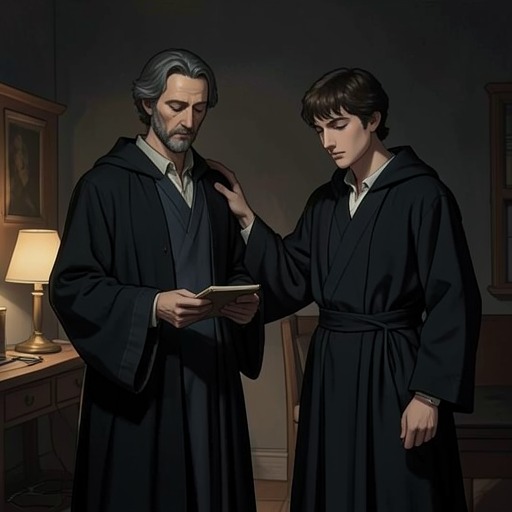
Once the conclave has begun, its restrictions prevent Lomeli from contacting anyone outside. He therefore asks O’Malley to speak privately with someone who may know what occurred at the late Pope’s final meeting with Tremblay. The Dean authorizes him to ask whether anything in that meeting could make Tremblay unfit for the papacy, and stresses that the inquiry must remain secret. O’Malley is visibly taken aback by the sensitivity of the mission, but accepts it without protest. The exchange makes clear both the limits imposed on Lomeli by his office and the trust he places in O’Malley to act discreetly on his authority.
That trust is practical rather than ceremonial. The question is not merely what happened at supper, but whether information withheld during the first hours after the Pope’s death could affect the legitimacy and consequences of the coming election. O’Malley’s assignment puts him between the conclave’s formal isolation and the need to investigate a matter beyond its walls. His willingness to serve as that link gives the Dean a means of pursuing the question without violating his own prohibition on outside contact.
Character and Narrative Role
O’Malley’s characterization emerges through contrasts between the ordinary and the momentous. He is a clipboard-carrying secretary whose appearance receives comic attention, yet he is also one of the few people responsible for helping manage the election of the Church’s next leader. His humor surfaces in the unfinished chapel, while his discretion is clearest when he refuses to explain an urgent interruption in front of Woźniak and when he accepts a confidential inquiry into Tremblay’s conduct.
He functions as an institutional aide whose value lies in proximity, judgment, and dependable service. The novel’s election is governed by rules, deadlines, restricted communications, and the movement of information between people who may not trust one another. O’Malley works inside those constraints: he helps prepare the setting, carries news to the Dean, and acts on the Dean’s behalf when the Dean cannot. The evidence does not give him an independent political campaign or resolve the question of Tremblay’s fitness through his actions; instead, it establishes him as a discreet operational ally in a process where even the careful handling of a document, an arrival, or a question may matter.